
By Shincy George | NursingManthra
Reviewed: 12 October 2026
Are you a pharmacist qualified overseas and considering a career in the UK? You may have a bachelor’s degree, PharmD, master’s qualification or PhD, yet still be unsure whether your qualification gives you direct entry to practice.
The first step is to establish which registration route applies. For many internationally educated pharmacists, the Great Britain route involves GPhC eligibility approval, an Overseas Pharmacists’ Assessment Programme (OSPAP), foundation training and the Common Registration Assessment.
This guide helps you plan the stages, documents, language evidence and budget before committing to a course.
UK pharmacist registration: which regulator should you contact?
| Where you intend to practise | Regulator |
|---|---|
| England, Scotland or Wales—Great Britain | General Pharmaceutical Council (GPhC) |
| Northern Ireland | Pharmaceutical Society of Northern Ireland (PSNI) |
This article focuses on the GPhC route in Great Britain. Do not treat it as a complete Northern Ireland application checklist.
Eligible EU qualifications and qualifications from Iceland, Liechtenstein, Norway and Switzerland have separate arrangements. Some EU qualifications that do not meet the recognition criteria may also require OSPAP. Nationality alone does not determine the route.
Source: GPhC registration criteria—November 2025.
Can internationally educated pharmacists apply?
GPhC evaluates qualifications before confirming eligibility for OSPAP. Approval allows you to seek a university place; it does not guarantee admission or final registration.
Prepare evidence of the professional pharmacy qualification and completion of the requirements to practise in the qualifying country. The university also makes its own admissions decision.
For example, Hertfordshire normally expects a pharmacy degree comparable to a UK bachelor’s qualification and six months of full-time-equivalent patient-facing pharmacist practice. That experience requirement is a provider requirement, not a universal rule to apply to every OSPAP university.
Source: University of Hertfordshire OSPAP requirements.
Can Diploma in Pharmacy candidates apply?
A diploma title alone is insufficient to confirm eligibility.
A short diploma that is below bachelor’s level should not be advertised as automatically eligible for this postgraduate route. However, qualification titles vary between countries, and a document called a “diploma” may record a longer professional programme.
Seek GPhC guidance using the exact award, institution, course duration, transcript, curriculum and evidence of professional eligibility. Obtain academic comparability evidence where required. Do not assume that a home-country licence guarantees OSPAP admission.
If your qualification does not meet the relevant requirements, ask about suitable education routes before paying application or tuition fees.
This advice is based on the degree and qualification-assessment requirements; it is not a blanket regulatory decision about every diploma worldwide.
Does a master’s degree or PhD give an exam exemption?
The standard OSPAP route does not provide an automatic exemption simply because you hold an overseas master’s degree or PhD.
Its published requirements include the accredited programme, 52-week foundation training and Common Registration Assessment. Experience or a higher academic award does not automatically replace them.
Keep these distinctions clear:
- A research MSc or PhD is additional academic learning.
- A professional pharmacy qualification establishes the educational basis for practice.
- An accredited OSPAP prepares an eligible overseas pharmacist for the Great Britain route.
An ordinary UK MSc in pharmaceutical sciences is not automatically an OSPAP. Check the programme’s accreditation and purpose.
What is OSPAP?
OSPAP is a postgraduate programme designed for eligible overseas pharmacists. It prepares candidates for the UK practice environment, covering areas such as pharmacy law, clinical practice and professional responsibilities.
The PgDip academic year may run for approximately nine months; some providers offer an MSc option with additional study. Completing the course alone does not give permission to practise independently.
Choose the course by accreditation, admissions conditions, practical arrangements and cost. A familiar university name or the word “pharmacy” in a course title is not enough.
Source: Aston University OSPAP.
Step-by-step application process
1. Establish your registration route
Review the country and nature of your professional qualification. Request guidance if previous registration or qualifications elsewhere may affect the route.
2. Prepare the GPhC eligibility application
Use the current application pack. Arrange academic comparability, identity evidence, language evidence and direct documents.
3. Apply to an accredited OSPAP provider
After approval, follow the provider’s application process. Consider interviews, entry requirements, deposits, intake dates and available places.
4. Apply for foundation training at the correct time
Do not wait until graduation to investigate recruitment. National recruitment takes place well in advance, usually through Oriel.
GPhC’s overseas guidance warns that recruitment deadlines may occur before eligibility or university decisions are complete. Follow the current recruitment body’s instructions about applying and providing outstanding evidence.
5. Complete OSPAP and foundation training
Follow the approved training arrangements, supervision and required progress evidence.
6. Pass the Common Registration Assessment
Apply when eligible and meet the sitting’s deadlines.
7. Apply for entry to the register
Complete the final application and checks, then wait for confirmation of registration before undertaking duties requiring registered pharmacist status.
Source: GPhC overseas registration guide.
Documents required for the complete process
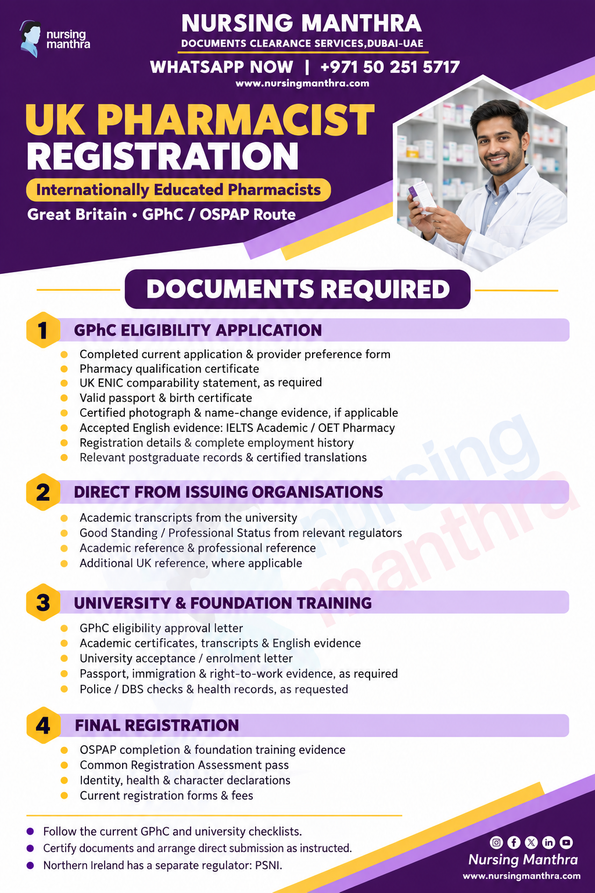
A. GPhC eligibility application: preparation checklist
Prepare the following, subject to the latest application instructions:
- Completed eligibility application and provider preference information.
- Pharmacy qualification certificate and UK ENIC comparability evidence.
- Valid passport, birth certificate and correctly certified photograph.
- Name-change evidence or statutory declarations where applicable.
- Accepted English-language evidence.
- Professional registration details and employment history.
- Relevant postgraduate records.
- Professionally translated documents where needed.
Arrange direct academic transcripts, Good Standing/professional status evidence from the qualifying regulator, academic and professional references, and additional regulator evidence where applicable. The application guidance also addresses an additional UK reference for relevant UK work/study.
Certification and direct submission are different requirements. A certified personal copy does not replace a document that must come from its issuer.
Source: GPhC’s Applying for eligibility to complete an Overseas Pharmacists Assessment Programme, April 2024, archived document copy. This older copy explains preparation; obtain the current pack from GPhC before submitting or paying.
B. University admission documents
A typical provider may request approval, academic certificates/transcripts, passport, language evidence and current immigration information where applicable.
Hertfordshire also requests its DBS self-declaration. Health screening, vaccination evidence and police/background checks may be required for placements. Requirements differ between providers.
C. Foundation training documents
Current OSPAP applicants may need their GPhC approval and university acceptance/enrolment letters. OSPAP graduates may need the PgDip/MSc certificate.
Follow the current recruitment handbook for identity, immigration, employment and training requirements. Keep records of every deadline and any outstanding-document request.
Source: NHS recruitment document guidance.
D. Assessment and final registration documents
Prepare evidence of programme and training completion, assessment eligibility and pass results, identity and the declarations required by the current application.
GPhC registration includes health, competence, character and identity checks. Additional evidence may be requested for individual circumstances.
Use the current stage-specific checklist. Do not assume your initial eligibility application contains everything needed several years later.
English-language requirements: IELTS and OET
Unlike Ireland’s registration-stage approach, OSPAP applicants need accepted language evidence as part of the application to start OSPAP.
| Test | GPhC minimum |
|---|---|
| IELTS Academic | Overall 7, with no component below 7, at one sitting |
| OET Pharmacy | Grade B or better in all four components, at one sitting |
Evidence normally must be less than two years old. GPhC may consider older scores supported by evidence of maintained proficiency. OET@Home is not accepted under the published guidance.
Other evidence routes include a recent pharmacy qualification taught and examined in a mainly English-speaking country outside the UK, or recent practice for at least two years as a pharmacy professional in such a country, with the required evidence.
An English-medium letter from another country does not automatically meet this policy.
Universities may set their own conditions. Aston, for example, does not accept work experience alone for its English admission requirement.
Source: GPhC English-language guidance—June 2025.
UK pharmacist examination format
The 2026 Common Registration Assessment is computer-based and delivered at test centres.
| Part | Format | Time |
|---|---|---|
| Part 1 | 40 calculations, numerical free-entry answers | 2 hours |
| Part 2 | 120 questions: 90 single best answer and 30 extended matching questions | 2.5 hours |
Both parts must be passed in the same sitting. Marks cannot be carried forward. There are at most three attempts within the permitted registration timeframe.
An Irish-style separate TCQR OSCE should not be added to this GPhC assessment description. OSPAP universities conduct their own course assessments, which can include practical work.
Source: 2026 Common Registration Assessment regulations.
Fees and total budget
There is no single UK pharmacist registration package price. Budget for both the regulator and university, plus personal costs.
Verified registration charges from 1 September 2026
| Item | Fee |
|---|---|
| Application for first entry to the pharmacist register | £128 |
| Entry following approval | £311 |
| Combined first-registration charges | £439 |
| Annual renewal thereafter | £311 |
Source: GPhC Registration and Renewal Fees Rules 2025.
Other costs to include
| Cost | How to budget |
|---|---|
| GPhC OSPAP eligibility application | Confirm the current charge in the current pack/payment request |
| OSPAP tuition | Use the chosen provider’s offer for the intended intake |
| Common Registration Assessment | Confirm the sitting-specific application fee |
| Academic comparability | Check UK ENIC’s chosen service |
| English test | Provider’s current fee |
| Certification, translations and regulator documents | Issuer/service charges |
| Background and occupational health checks | Provider/employer requirements |
| Visa, travel, accommodation and living costs | Individual circumstances |
| NursingManthra support | Any separately agreed service fee |
Published tuition example: Aston lists £16,350 for its 2027/28 OSPAP PgDip on the course page reviewed.
Using that tuition example, tuition plus the currently verified first-registration charges equal £16,789. This is a partial subtotal, not the complete cost.
Your calculation is:
Tuition + eligibility fee + assessment fee + first-registration charges + document/testing expenses + immigration/travel/living expenses.
The current eligibility and examination fee pages could not be independently retrieved during this review. Their amounts therefore require confirmation before a complete total can be published. Avoid using old application-pack fees as today’s rates.
Foundation training is a salaried employment stage under the current route, but a future salary should not be treated as money available to pay upfront course costs.
Duration and time limits
Plan for approximately two years of study and training after entry to the standard route, with extra time for applications, recruitment and registration.
The November 2025 criteria require OSPAP to begin within two years of approval, subject to the specified extension arrangements. Registration must generally be sought within four years of starting OSPAP or two years of passing the assessment, whichever is sooner; documented extensions may be considered.
Allow time for delays. A missed annual intake or recruitment window can change the plan considerably.
Proposed future changes: do not confuse them with today’s route
GPhC’s 2026 consultation proposed a shorter integrated programme with practical learning and independent prescribing education. It continued to require the Common Registration Assessment.
The consultation identified 2028/29 as the earliest expected launch, subject to decisions and programme accreditation, while describing continuing OSPAP intakes for 2026 and 2027.
These are proposals and implementation expectations—not a guaranteed available one-year pathway for today’s applicant. Check subsequent GPhC announcements before enrolling.
Source: GPhC international education consultation.
Employment and immigration planning
Professional approval, university admission, training employment and immigration permission are separate decisions.
Check that you have an appropriate immigration plan for both study and training. Do not assume a course visa automatically covers the following employment stage or that every PgDip supports the same post-study immigration options as an MSc.
Seek course-specific advice from the university and use GOV.UK for current immigration rules. Discuss employer sponsorship where relevant.
Frequently asked questions
Can an overseas pharmacist register without OSPAP?
Some qualification routes have separate recognition arrangements. For applicants directed to the standard OSPAP route, all its requirements apply.
Does a master’s or PhD remove the final examination?
No automatic exemption based on those awards is provided under the standard route.
Is OET Nursing suitable for a pharmacist application?
The published GPhC evidence is OET Pharmacy. Choose the correct profession-specific test.
Can I work independently after OSPAP?
OSPAP is a stage in the route. Complete the remaining requirements and obtain registration.
Can a diploma-only applicant assume eligibility?
No. Clarify the actual award, comparability and eligibility with GPhC before paying.
Is university admission guaranteed after GPhC approval?
No. Providers assess applications and have limited places.
When should I investigate foundation training?
Early. Check national recruitment dates before choosing an OSPAP intake.
Does the route automatically qualify me as an independent prescriber?
Do not assume that. The current overseas route and proposed future prescribing changes are different.
Need guidance from NursingManthra?
A well-prepared plan can help you avoid spending money in the wrong order.
Contact NursingManthra for guidance on preparing your UK pharmacist registration journey. Share your qualification, country, university, registration status, experience, postgraduate awards and English results.
Visit NursingManthra or WhatsApp +971 50 251 5717.
GPhC decides professional eligibility and registration; universities decide admission. Support with preparation cannot guarantee approval, admission, training, employment or immigration outcomes.
Contact Nursing Manthra
WhatsApp: https://wa.me/971502515717
UAE: +971 502 515 717
India: +91 6828756689
Website: https://nursingmanthra.com/
Candidates may share their educational and professional documents for an initial review.
About the Author
Shincy George, RN, MSN (Cardiothoracic Nursing), SCFHS-RN, DHA RN, MOH UAE RN, NCLEX-RN (USA), is the Founder of Nursing Manthra Academy.
With extensive international clinical and academic experience, she is dedicated to guiding healthcare professionals through global licensing pathways. Through Nursing Manthra, she supports internationally educated healthcare professionals in achieving their career goals across Canada, USA, UAE, Middle East, UK, Ireland, Australia, New Zealand, and other countries.
Her mission is to simplify complex licensing processes and empower healthcare professionals with the right knowledge, guidance, and support to succeed globally.