
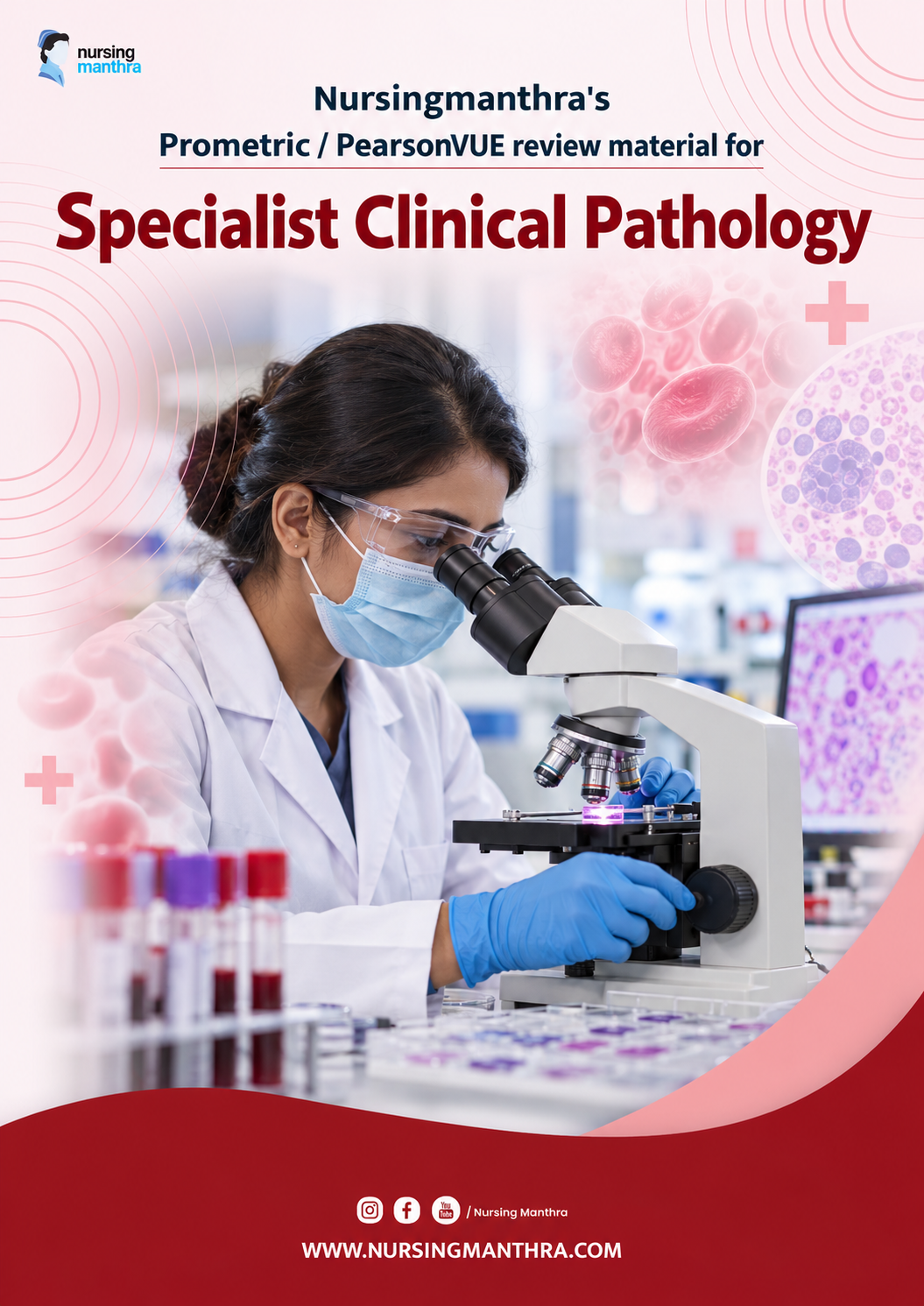
*NursingManthra’s Prometric / Pearson VUE Review Material for Specialist Clinical Pathology*
AED250.00
Important Access & Usage Terms
Please read the following conditions carefully before purchasing NursingManthra study materials.
- Read-Only PDF: Study materials are provided as read-only PDF files. Downloading, printing, copying and sharing are not permitted.
- Non-Refundable: Payments for digital study materials are non-refundable, subject to applicable consumer law.
- Individual Access: Access is provided exclusively to the registered candidate.
- Correct Gmail Address: Candidates must provide a valid Gmail address at the time of purchase to receive access.
- Copyright Protection: Unauthorised reproduction, recording, redistribution, resale, screen reproduction or sharing of the materials is strictly prohibited.
About the material: NursingManthra provides independent educational review materials for examination preparation.
Description
2,000 Advanced MCQs with Answers & Detailed Rationales
NursingManthra’s Specialist Clinical Pathology Prometric / Pearson VUE Review Material is a comprehensive, examination-focused question bank developed for physicians preparing for the Specialist Clinical Pathology licensing examination, including candidates appearing through Prometric/Pearson VUE-based healthcare licensing systems.
The material contains 2,000 carefully developed MCQs covering the major knowledge domains listed in the Specialist Clinical Pathology examination syllabus. The questions are designed at a moderate-to-very-difficult level, with particular emphasis on clinical reasoning, laboratory interpretation, differential diagnosis, pathology correlations, investigation selection, laboratory quality, and decision-making rather than simple factual recall.
This is not intended to be only a collection of straightforward one-line questions. A substantial proportion of the material is developed using complex clinical scenarios, laboratory reports, hematological findings, microbiological results, biochemical patterns, transfusion scenarios, molecular findings, quality-control situations and laboratory-management problems similar to the type of analytical thinking expected from a specialist-level candidate.
Question Format
Every MCQ is presented in an easy-to-review examination format:
Question → Multiple Options → Correct Answer → Detailed Rationale
The rationale explains why the selected answer is correct, while also helping candidates understand important concepts, diagnostic reasoning, laboratory principles and common examination traps. This allows the material to function both as a 2,000-question practice bank and as a comprehensive revision resource.
Detailed Syllabus Coverage
The 2,000 questions provide extensive coverage of the Specialist Clinical Pathology syllabus, including:
- Hematology: complete blood count interpretation, peripheral smear findings, anemia, hemoglobinopathies, coagulation disorders, platelet disorders, thrombosis, bone marrow examination, laboratory investigation of hematological abnormalities and interpretation of complex hematology results.
- Malignant Hematology – Leukemia & Lymphoma: acute and chronic leukemias, myelodysplastic and myeloproliferative disorders, lymphomas, plasma-cell disorders, morphology, immunophenotyping, flow cytometry, cytogenetics, molecular markers, classification, prognostic factors and laboratory diagnosis.
- Surgical Pathology, Autopsy & Forensic Pathology: specimen handling, fixation, gross examination, histopathology, cytopathology concepts, tumor diagnosis, immunohistochemistry, tissue interpretation, autopsy principles, cause and manner of death, forensic specimens and medicolegal pathology principles.
- Bacteriology, Microbiology & Biochemistry: bacterial identification, culture media, staining, antimicrobial susceptibility testing, resistance mechanisms, infection diagnosis, specimen collection and processing, biochemical reactions and interpretation of microbiological investigations.
- Mycology & Parasitology: superficial, subcutaneous and systemic fungal infections, laboratory diagnosis of fungi, microscopic morphology, fungal cultures, protozoal and helminthic infections, life cycles, diagnostic specimens, microscopy, antigen testing and molecular diagnosis.
- Virology, Immunology & Serology: viral infections, viral structure and replication, diagnostic virology, serological markers, PCR-based diagnosis, immune mechanisms, immunodeficiency, autoimmunity, hypersensitivity, antigen-antibody reactions, immunoassays and interpretation of serological profiles.
- Cytogenetics & Molecular Studies: chromosomal abnormalities, karyotyping, FISH, PCR, RT-PCR, sequencing principles, molecular oncology, hematological molecular markers, genetic disorders, molecular testing methods, interpretation of results and laboratory limitations.
- Clinical Chemistry & Toxicology: electrolytes, acid-base disorders, renal and liver function tests, endocrine investigations, cardiac markers, diabetes, proteins, enzymes, lipids, tumor markers, therapeutic drug monitoring, toxicology, poisoning, laboratory interferences and interpretation of complex biochemical profiles.
- Blood Bank & Transfusion Medicine: ABO and Rh systems, antibody screening and identification, cross-matching, blood components, transfusion indications, compatibility testing, hemolytic transfusion reactions, massive transfusion, neonatal transfusion, autoimmune hemolysis, donor testing, component preparation and transfusion safety.
- Laboratory Management, Quality, Safety & Ethics: quality assurance, quality control, Westgard principles, internal and external quality assessment, laboratory accreditation concepts, pre-analytical/analytical/post-analytical errors, biosafety, infection control, occupational exposure, specimen management, laboratory statistics, equipment management, documentation, confidentiality, professional responsibilities and ethical decision-making.
Advanced Specialist-Level Question Design
The question bank is prepared specifically to provide higher-level preparation for Specialist Clinical Pathology candidates. Questions may require candidates to integrate several pieces of information rather than identify a single memorised fact.
For example, questions may present a patient’s clinical history together with CBC findings, peripheral smear abnormalities, coagulation results, bone marrow findings, flow-cytometry markers or molecular abnormalities and require the candidate to identify the most likely diagnosis or next investigation.
Similarly, microbiology questions may combine clinical presentation, specimen type, Gram stain, culture characteristics, biochemical identification and antibiotic susceptibility patterns. Clinical chemistry questions may require interpretation of multiple laboratory values and recognition of pre-analytical or analytical interference.
Transfusion questions include compatibility problems, antibodies and transfusion reactions, while laboratory-management questions focus on quality-control failures, patient safety, ethical responsibilities and corrective actions.
This approach helps candidates prepare for questions that test application, interpretation, prioritisation and clinical decision-making, rather than relying only on memorisation.
Total Content
Total Questions: 2,000 MCQs
Difficulty: Moderate, Difficult & Advanced Specialist Level
Format: Question + Options + Correct Answer + Detailed Rationale
Primary Purpose: Specialist Clinical Pathology Prometric / Pearson VUE Examination Review
Study Style: Examination practice + concept revision + clinical reasoning
The material can be used for systematic preparation, topic-wise revision, self-assessment and final examination practice.
Recommended Reference Orientation
The review material is developed around standard clinical pathology subject areas reflected in established postgraduate and laboratory medicine references, including major texts covering hematology, bacteriology, medical microbiology, practical hematology, pathology, clinical laboratory diagnosis, clinical chemistry and molecular diagnostics.
Candidates are encouraged to use this question bank together with current standard textbooks, professional guidelines and the latest examination requirements of the relevant licensing authority.
Reviews (0)
Related Products

Total pages- 580
Total MCQ –1480
Cost —200 AED


- Total pages – 1000
- Total MCQ –More than 2000
- Cost — 100 AED
Question bank Contents:
Total questions-2000 MCQ
Total pages- 699 Pages
It contains MCQ(multiple Choice Questions) with all options, correct answer and rational.
-Previously asked MCQ


Total pages – 609
Total MCQ – 1571
Cost – 150 AED

- Total pages – 1000
- Total MCQ –More than 2000
- Cost — 100 AED
Reviews
There are no reviews yet.