

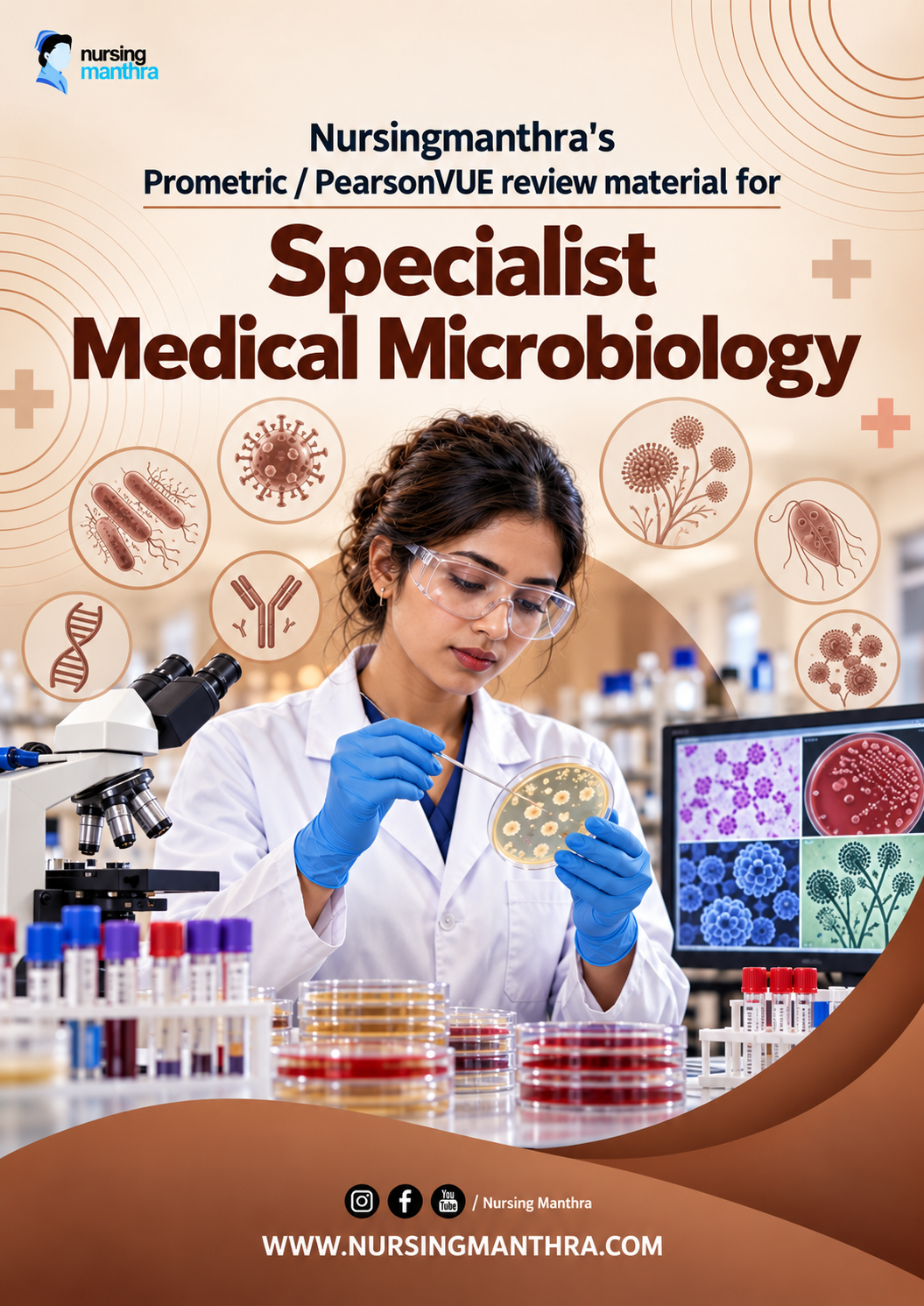
*NursingManthra’s Prometric / Pearson VUE Exam Review Material for Specialist Medical Microbiology*
AED250.00
Important Access & Usage Terms
Please read the following conditions carefully before purchasing NursingManthra study materials.
- Read-Only PDF: Study materials are provided as read-only PDF files. Downloading, printing, copying and sharing are not permitted.
- Non-Refundable: Payments for digital study materials are non-refundable, subject to applicable consumer law.
- Individual Access: Access is provided exclusively to the registered candidate.
- Correct Gmail Address: Candidates must provide a valid Gmail address at the time of purchase to receive access.
- Copyright Protection: Unauthorised reproduction, recording, redistribution, resale, screen reproduction or sharing of the materials is strictly prohibited.
About the material: NursingManthra provides independent educational review materials for examination preparation.
Description
2,000 Advanced MCQs with Answers & Detailed Rationales
NursingManthra’s Specialist Medical Microbiology Prometric / Pearson VUE Exam Review Material is a comprehensive examination-focused question bank developed for physicians and specialists preparing for Medical Microbiology licensing examinations conducted through Prometric / Pearson VUE-based testing systems.
The material contains 2,000 carefully developed MCQs covering the major subject areas of Specialist Medical Microbiology. Questions range from moderate to advanced and highly challenging specialist level, with particular emphasis on clinical interpretation, laboratory diagnosis, organism identification, antimicrobial susceptibility, molecular testing, infection control, immunology, serology and infectious-disease decision-making.
Rather than relying mainly on simple factual recall, the book contains a substantial number of complex clinical and laboratory scenarios. Candidates may be required to interpret culture results, microscopy findings, antimicrobial susceptibility patterns, serological profiles, molecular test results and infection-control situations before selecting the most appropriate answer.
Question Format
Every MCQ follows a consistent examination-oriented structure:
Question → Multiple Options → Correct Answer → Detailed Rationale
The rationale explains the important concept behind the correct answer and helps candidates understand the diagnostic or microbiological reasoning involved.
This makes the material useful both as a 2,000-question exam practice bank and as a structured revision resource for Medical Microbiology.
Detailed Syllabus Coverage
1. Bacteriology
Comprehensive coverage includes:
- Bacterial morphology and classification
- Gram-positive and Gram-negative organisms
- Aerobic and anaerobic bacteria
- Mycobacteria
- Spirochetes
- Intracellular organisms
- Bacterial virulence factors
- Pathogenesis
- Specimen collection and transportation
- Gram staining and other staining techniques
- Culture media
- Colony characteristics
- Biochemical identification
- Automated identification systems
- Blood cultures
- Urine cultures
- Respiratory cultures
- CSF microbiology
- Wound and sterile-site cultures
- Antimicrobial susceptibility testing
- MIC interpretation
- Resistance mechanisms
- ESBL
- AmpC
- Carbapenemases
- MRSA
- VRE
- Multidrug-resistant organisms
- Selection and interpretation of microbiological investigations
Many questions use clinical presentation + specimen information + Gram stain + culture findings + susceptibility results to test specialist-level reasoning.
2. Molecular Microbiology
Detailed coverage includes:
- PCR
- Real-time PCR
- RT-PCR
- Multiplex PCR
- Nucleic acid amplification testing
- DNA and RNA principles
- Primer concepts
- Molecular detection of infectious organisms
- Genotyping
- Sequencing
- Molecular epidemiology
- Resistance-gene detection
- Viral-load testing
- Molecular diagnostics in bacteriology
- Molecular diagnostics in virology
- Molecular diagnostics in mycology
- Laboratory contamination
- False-positive and false-negative molecular results
- Interpretation of Ct values and molecular reports
- Quality assurance in molecular laboratories
Questions focus on selecting and interpreting the most appropriate molecular diagnostic method in realistic clinical situations.
3. Parasitology
Coverage includes medically important:
- Protozoa
- Helminths
- Blood parasites
- Intestinal parasites
- Tissue parasites
- Malaria
- Leishmaniasis
- Toxoplasmosis
- Amoebiasis
- Giardiasis
- Cryptosporidiosis
- Strongyloidiasis
- Schistosomiasis
- Filariasis
- Tapeworm infections
- Trematodes
- Nematodes
Additional areas include:
- Life cycles
- Transmission
- Clinical manifestations
- Appropriate specimens
- Microscopy
- Concentration methods
- Antigen testing
- Serology
- Molecular testing
- Parasite morphology
- Epidemiological considerations
- Diagnostic differentiation
4. Virology
The virology section includes:
- DNA viruses
- RNA viruses
- Respiratory viruses
- Influenza
- Coronaviruses
- Herpesviruses
- Hepatitis viruses
- HIV
- Enteroviruses
- Arboviruses
- Childhood viral infections
- Oncogenic viruses
- Emerging viral infections
- Viral replication
- Viral pathogenesis
- Viral diagnostics
- Antigen testing
- Antibody testing
- PCR and molecular testing
- Viral-load monitoring
- Interpretation of serological markers
- Antiviral resistance
- Infection-control considerations
Complex questions may require candidates to interpret combinations of IgM, IgG, antigen, PCR or viral-load findings.
5. Mycology
Coverage includes:
- Yeasts
- Moulds
- Dimorphic fungi
- Dermatophytes
- Candida species
- Cryptococcus
- Aspergillus
- Mucormycosis
- Pneumocystis
- Endemic fungal infections
- Superficial mycoses
- Subcutaneous mycoses
- Systemic fungal infections
- Opportunistic fungal infections
- Fungal morphology
- Direct microscopy
- KOH preparation
- Fungal cultures
- Histopathological findings
- Antigen tests
- Molecular diagnosis
- Antifungal susceptibility testing
Special attention is given to fungal infection in immunocompromised and critically ill patients.
6. Infectious Diseases
This section integrates laboratory microbiology with clinical infectious disease and includes:
- Sepsis and septic shock
- Bloodstream infections
- Respiratory infections
- CNS infections
- Gastrointestinal infections
- Urinary tract infections
- Skin and soft-tissue infections
- Bone and joint infections
- Endocarditis
- Sexually transmitted infections
- Healthcare-associated infections
- Device-associated infections
- Opportunistic infections
- Infections in immunocompromised patients
- Travel-related infections
- Emerging infections
- Fever of unknown origin
- Antimicrobial selection
- Empirical therapy
- Targeted therapy
- Source control
- Antimicrobial stewardship
Questions frequently require integration of clinical presentation with laboratory findings to determine the causative organism, appropriate diagnostic test or next management step.
7. Immunology & Serology
Detailed coverage includes:
- Innate immunity
- Adaptive immunity
- Humoral immunity
- Cell-mediated immunity
- Antigens and antibodies
- Immunoglobulins
- Complement system
- Cytokines
- Hypersensitivity reactions
- Autoimmune disorders
- Immunodeficiency
- Transplant immunology
- Tumour immunology
- Vaccines and immune responses
- ELISA
- Agglutination
- Immunofluorescence
- Western blot principles
- Rapid immunoassays
- Serological markers
- Interpretation of antibody profiles
- Sensitivity and specificity of serological testing
- False-positive and false-negative serological results
Antimicrobial Resistance & Susceptibility Testing
The material provides extensive practice involving:
- Disk diffusion methods
- MIC
- Breakpoints
- Antibiograms
- Resistance mechanisms
- Beta-lactamases
- ESBL-producing organisms
- AmpC producers
- Carbapenem-resistant organisms
- Methicillin resistance
- Vancomycin resistance
- Multidrug resistance
- Intrinsic resistance
- Acquired resistance
- Selection pressure
- Interpretation of susceptibility reports
- Antimicrobial stewardship principles
Candidates may receive a culture identification and susceptibility panel and be required to determine the resistance mechanism or most appropriate therapeutic implication.
Infection Prevention & Laboratory Safety
Questions also incorporate essential aspects of:
- Standard precautions
- Transmission-based precautions
- Isolation
- Hand hygiene
- Healthcare-associated infections
- Outbreak investigation
- Sterilisation
- Disinfection
- Decontamination
- Biosafety
- Biological risk
- Laboratory-acquired infections
- Sharps injuries
- Occupational exposure
- PPE
- Specimen handling
- Waste management
- Quality assurance
- Laboratory errors
Advanced Specialist-Level Question Design
The 2,000-question bank is designed to test more than simple memorisation.
A question may provide:
Patient history + specimen type + Gram stain + culture appearance + biochemical findings + antimicrobial susceptibility
and require the candidate to determine the organism, resistance mechanism or appropriate additional test.
Another question may present:
Clinical presentation + serological markers + PCR result + antibody profile
and ask the candidate to determine whether the patient has acute infection, previous infection, immunity, reactivation or another stage of disease.
Other advanced scenarios include:
- Blood-culture interpretation
- Contaminant versus true bloodstream infection
- Resistant bacterial isolates
- Opportunistic infections
- Immunocompromised patients
- Molecular diagnostic discrepancies
- Laboratory outbreaks
- Infection-control failures
- Serological window periods
- Antimicrobial resistance mechanisms
- Mycological morphology
- Parasite identification
- Quality-control problems
The aim is to strengthen diagnostic reasoning, laboratory interpretation and specialist-level decision-making.
Material Overview
Total Questions: 2,000 MCQs
Difficulty: Moderate, Difficult & Advanced Specialist Level
Format: Question + Options + Correct Answer + Detailed Rationale
Primary Purpose: Specialist Medical Microbiology Prometric / Pearson VUE Examination Preparation
Study Approach: MCQ Practice + Clinical Scenarios + Laboratory Interpretation + Concept Revision
The material is suitable for:
- Topic-wise study
- Daily MCQ practice
- Self-assessment
- Identification of weak areas
- Intensive exam preparation
- Final revision before the licensing examination
Reviews (1)
1 review for *NursingManthra’s Prometric / Pearson VUE Exam Review Material for Specialist Medical Microbiology*
Related Products


- Total pages – 1000
- Total MCQ –More than 2000
- Cost — 100 AED
Delivery and Usage Conditions
-
- The study material will be shared with the candidate’s registered Gmail account after payment confirmation.
- The material is provided as a view-only PDF.
- It cannot be downloaded, printed, copied, forwarded, or shared with another person.
- Once the payment has been completed and access has been provided, the amount is non-refundable.
- Access is intended only for the registered purchaser.
Total mcq-2000
Question , option, answer and rational format
To view sample questions: https://nursingmanthra.com/dental-lab-technician-prometric-sample-questions/


Total pages- 580
Total MCQ –1480
Cost —200 AED

Total pages –
Total MCQ –
Cost — 150

- Total pages – 1000
- Total MCQ –More than 2000
- Cost — 100 AED
Prometric Exam Questions(CBT)
Total pages – 103
Total MCQ –400
Oral Exam Questions:
Total pages-15
Total viva questions-25
Cost — 100 AED
Dr . Varshini Tharakan –
Very happy with Nursing Mantra’s Specialist Medical Microbiology Review Material! The questions are well-prepared, especially the clinical scenarios and microbiology-related topics. Easy to follow and really helpful for exam preparation. Thank you, Nursing Mantra, for this wonderful material. Highly recommended!