By Shincy George | NursingManthra
Last reviewed: 12 October 2026
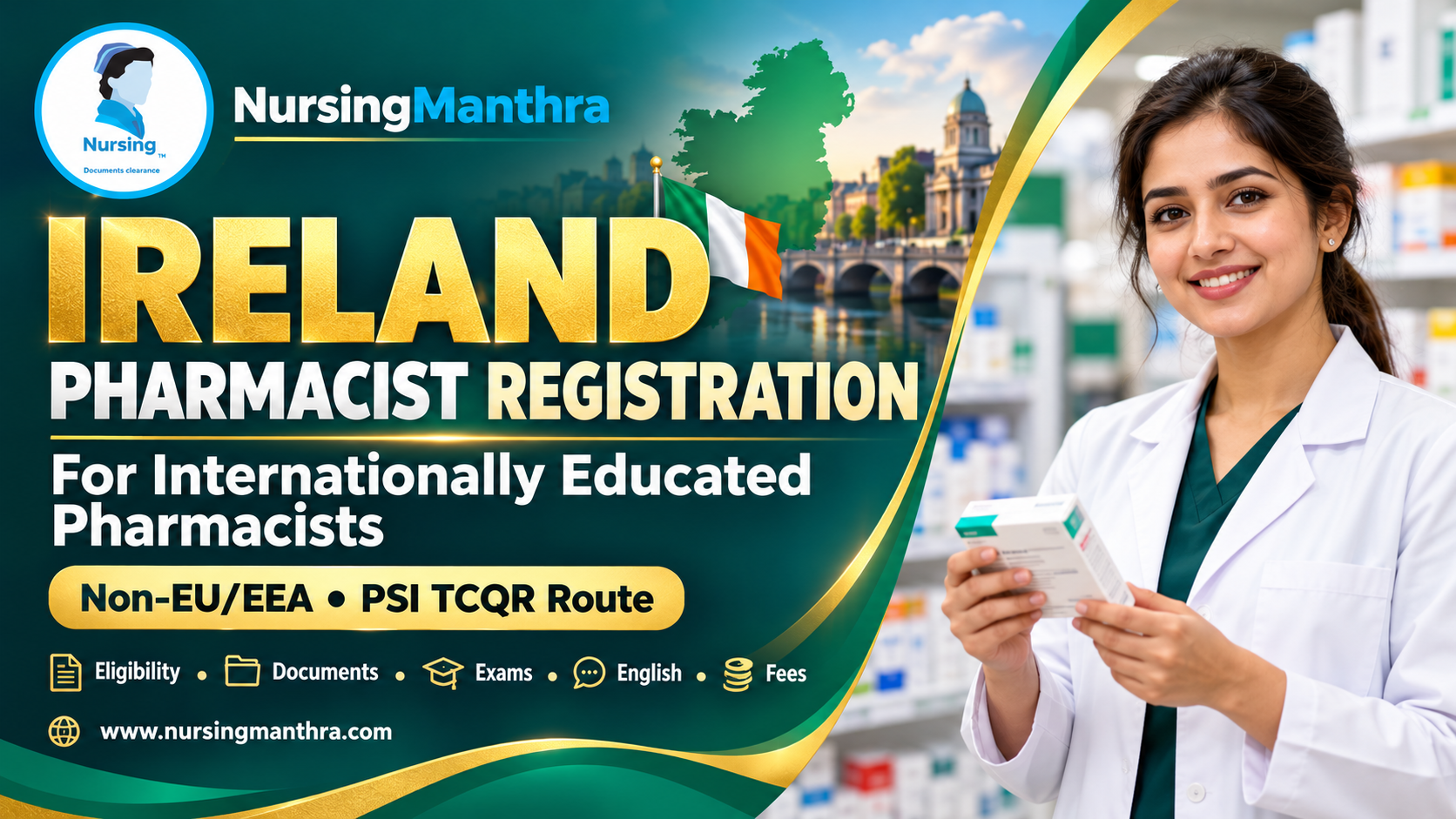
Thinking about working as a pharmacist in Ireland? Perhaps you have a pharmacy degree and years of experience, or you have continued your studies with a master’s degree or PhD. You may still be wondering where to begin—and whether you will need examinations.
For pharmacists qualified outside the European Union/European Economic Area, the usual starting point is the Pharmaceutical Society of Ireland (PSI) Third Country Qualification Recognition process, known as TCQR.
Before spending money, understand your route, prepare the evidence and allow time for assessment. This guide covers the Republic of Ireland; Northern Ireland has a separate regulator.
Who is this Ireland pharmacist registration guide for?
This guide focuses on pharmacists whose professional qualification was obtained outside the EU/EEA, regardless of nationality.
Outside the EU/EEA does not mean outside Europe. Some European countries fall outside these areas. UK qualifications generally fall under third-country arrangements, with transitional provisions for certain applicants.
A non-EU qualification already recognised in an EU country may qualify for consideration under another route when the applicant has the required professional experience. PSI’s published general-system guidance refers to three consecutive years within the preceding five years. Contact PSI to establish which route applies.
Can internationally educated pharmacists apply?
Applicants must have completed the education and training needed to qualify as a pharmacist in their qualifying country and be eligible to practise there. The competent authority must confirm eligibility. Current registration and practice in that country are not essential, but eligibility must be evidenced.
PSI evaluates qualifications, practical training, regulatory standards and relevant further education or experience.
There are two separate steps: recognition of the qualification, followed by registration as a pharmacist. A degree or overseas licence alone does not authorise practice in Ireland.
Does a master’s degree or PhD give an exam exemption?
There is no published automatic exemption based solely on holding a master’s degree or PhD.
Relevant postgraduate learning can contribute to the holistic assessment. Its content and supporting evidence matter; the award title alone does not settle the decision.
Depending on the assessment, the candidate may:
- Proceed to recognition without an examination.
- Need the MCQ component.
- Need the OSCE component.
- Need both components.
This is an individual assessment outcome, rather than a general “PhD exemption” or “master’s exemption.”
For example, a candidate with a professional pharmacy qualification and a research doctorate should provide evidence of both. A doctorate in a related field should not be treated as a substitute for a qualification that entitles the person to practise as a pharmacist.
Can a Diploma in Pharmacy holder apply?
Diploma-only eligibility needs individual clarification; it should not be advertised as guaranteed.
PSI’s current eligibility wording refers to a pharmacist qualification and eligibility to practise in the qualifying country. However, its application materials request primary degree evidence and NARIC academic comparability information. The sources reviewed do not provide a clear blanket acceptance or rejection rule for every diploma-only qualification.
The word “diploma” also varies between education systems: it can mean a short course or the formal document recording a longer professional qualification.
Before paying a non-refundable application fee, a diploma-only applicant should ask PSI for written guidance and provide:
- Exact qualification title and awarding institution.
- Country, entry requirements and course duration.
- Transcript and curriculum details.
- Practical training completed.
- Evidence of eligibility to practise as a pharmacist.
- Any further pharmacy qualifications and NARIC comparability information.
NursingManthra’s practical recommendation: clarify eligibility first. Do not assume that registration in the home country guarantees Irish recognition.
This is a cautious interpretation of the current published materials, not a confirmed PSI decision on an individual diploma.
Documents required: qualification recognition
Documents prepared by the applicant
| Document | What to prepare |
|---|---|
| TCQR1 | Completed application |
| TCQR2 | Correctly witnessed statutory declaration |
| TCQR3 | Certificate of identity |
| NARIC Ireland statement | Comparability statement identifying the pharmacy qualification |
| Passport | All pages of the current passport |
| Birth certificate | Copy, with translation where needed |
| Marriage/name evidence | Where applicable |
| Primary qualification | Formal pharmacy award certificate |
| Registration evidence | Relevant overseas registration certificate |
| CV | Education, training and employment history |
| Additional learning | Relevant postgraduate and CPD evidence |
| Experience evidence | Support for employment information relied upon |
| Translations | Certified English translations of non-English documents |
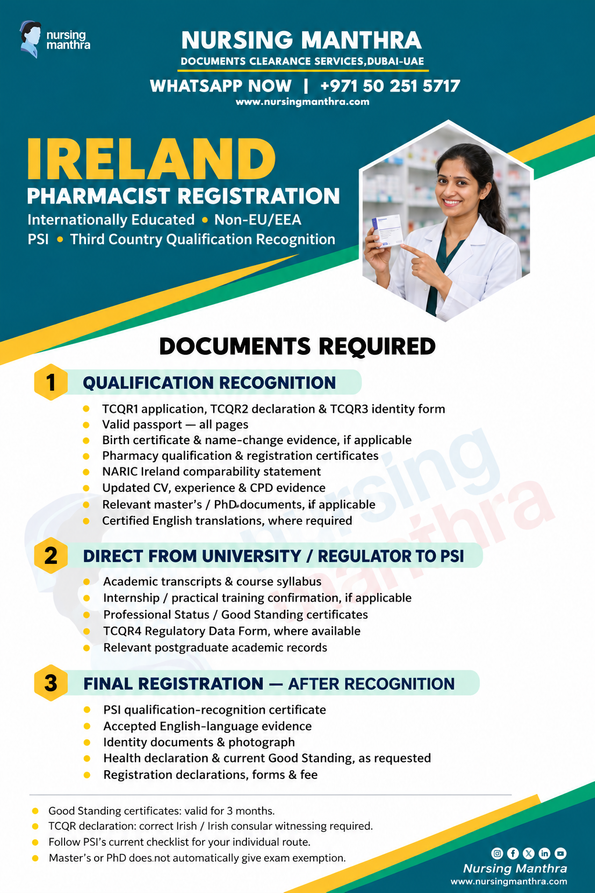
Documents sent directly by the issuing organisation
Arrange for academic transcripts, the programme syllabus, applicable internship certification, professional status/Good Standing certificates, the TCQR4 regulatory form and relevant postgraduate records to reach PSI directly.
Professional status evidence must also be requested from other jurisdictions where the applicant has been registered/licensed as a pharmacist or another health professional.
If internship was not a requirement of the qualifying programme or pre-registration route, state this accurately. PSI’s FAQ says undergraduate internship is not a mandatory prerequisite to applying.
Important document rules
Professional status certificates have a three-month validity.
The TCQR statutory declaration must be witnessed as required in Ireland, or abroad by an Irish diplomatic/consular official. An ordinary overseas notarisation should not be assumed sufficient.
Send the application to [email protected] with separately labelled PDF/JPEG attachments. Keep TCQR1 as one complete file; do not merge the entire document package or send cloud-drive links. Third-party emails should come from official institutional addresses.
If a competent authority cannot complete TCQR4, PSI’s current guidance permits assessment without it, but missing regulatory information may affect the outcome.
Step-by-step PSI registration process
1. Establish the route. Check where the professional qualification was awarded and whether previous recognition elsewhere affects the application route.
2. Prepare the recognition application. Complete the forms, obtain the comparability statement and arrange correctly witnessed declarations.
3. Request direct evidence. Contact universities and regulators early. Ask them to identify you clearly when sending documents.
4. Submit and pay the application fee. Use the payment link PSI issues.
5. Complete the holistic assessment. Submit relevant supporting evidence before assessment. PSI decides the required next steps.
6. Complete required examinations. Attend the relevant components if directed.
7. Obtain recognition and apply for registration. Follow the first-time registration instructions issued for your route.
Prepare a document tracker with the organisation, request date and submission date. It helps you follow up on missing evidence without losing track of the application.
MCQ and OSCE examinations for overseas pharmacists
RCSI provides the TCQR examinations in person in Dublin:
- MCQ Part A: Pharmaceutical calculations.
- MCQ Part B: Applied pharmacy practice.
- OSCE: Clinical and professional skills assessed through structured scenarios.
Required parts must be passed independently. Candidates receive preparation guidance and resources. Results are generally issued about four to six weeks after examination.
Prepare to explain the reasoning behind a decision. A safe answer needs more than recall: it should fit the patient’s circumstances and the professional responsibilities involved.
Documents for final pharmacist registration
After recognition, use the PSI registration portal and the instructions for your third-country application.
Prepare the following registration-stage pack, subject to the checklist PSI issues:
- PSI qualification-recognition certificate.
- Current identity documents and applicable birth/name evidence.
- Profile photograph and any required witnessed photograph forms.
- Accepted English-language evidence.
- Current professional status/Good Standing evidence where requested.
- Health declaration signed by a registered medical practitioner, where required.
- Registration declarations and any additional case-specific documents.
- First-registration payment.
PSI’s published first-time registration information includes health, identity, photograph and declaration requirements. The publicly available national-route checklist is not a complete TCQR registration checklist: confirm the correct forms, witnessing and original-document submission instructions for your case. Do not reuse the recognition-stage declaration without checking.
Three-month documents may need renewal if they expire during processing. Avoid ordering every time-limited certificate too early.
English-language requirements for pharmacists in Ireland
English evidence is needed at first registration, rather than initial qualification recognition.
When can education or work experience satisfy the requirement?
PSI accepts qualifying pharmacist training in a country where English or Irish is recognised as a native and first language. Alternatively, qualifying full-time registered practice for three of the preceding five years in such a country can satisfy the criterion, with independent evidence.
Otherwise, provide an accepted test.
Accepted English tests and minimum scores
| Test | Minimum requirements |
|---|---|
| IELTS Academic | Overall 7; Listening, Reading and Speaking 7; Writing 6.5 |
| OET Pharmacy | Listening, Reading and Speaking 350; Writing 300; meet PSI’s all-components requirement |
| TOEFL iBT | Total 95; Speaking 25, Writing 21, Reading 24, Listening 22 |
| Cambridge C1 | Total C1/180; listed components and Use of English 180 |
Results are valid for two years. Super-scoring permits two same-format sittings within six months if base scores and final minimums are met. One-skill retakes are not accepted.
From June 2026, English-medium university letters are no longer accepted. Home-based tests are generally excluded, with the stated exception for the OET on-computer speaking delivery.
Check the full official table before booking or combining results.
Total fees for Ireland pharmacist registration
The following are October 2026 published rates for the standard TCQR route.
| Fee | Amount |
|---|---|
| Initial application | €500 |
| Holistic assessment | €1,000 |
| MCQ only | €2,250 |
| OSCE only | €2,750 |
| Both examinations | €3,000 |
| First registration | €698 |
| Annual continued registration | €491 |
| Assessment appeal, if applicable | €300 |
Estimated authority total by assessment outcome
| Outcome | Recognition plus first registration |
|---|---|
| No examination required | €2,198 |
| MCQ only | €4,448 |
| OSCE only | €4,948 |
| Both examinations | €5,198 |
These calculated totals exclude annual renewal, appeals, repeat examination arrangements and all personal expenses. They assume the listed rates apply when each payment is made. First registration rises to €732 from May 2027; annual continued registration rises to €515.
Pay each stage when requested. PSI’s FAQ states that refunds are not issued during the process.
Budget separately for language testing, translations, university/regulator charges, declaration arrangements, travel, accommodation and immigration. Any agreed NursingManthra service fee is separate.
How long does the process take?
PSI’s June 2026 FAQ gives approximate stage estimates:
| Stage | Published approximate time |
|---|---|
| Application stage | 4–6 months |
| Holistic assessment | 6 months |
| Examination stage | Up to 12 months |
These are indicative, not guaranteed. They should not be presented as a fixed completion date. Document delays and examination availability affect progress. The FAQ also sets a six-month window for completing the application file.
Registration, employment and immigration
Begin with recognition planning, but allow for the later job and immigration steps. PSI registration does not itself provide a job offer or permission to live and work in Ireland.
For travel and immigration questions, consult Irish Immigration. Avoid booking examination travel until your place and arrangements are confirmed.
Frequently asked questions
Does a PhD automatically remove the exam requirement?
No automatic exemption based solely on a PhD is published. Relevant evidence is considered through assessment.
Is an overseas master’s the same as automatic Irish registration?
No. Submit the professional qualification and relevant postgraduate records for the applicable route.
Is every diploma holder eligible?
A blanket answer is not supported by the published materials reviewed. Obtain guidance on the exact qualification before paying.
Is internship compulsory to start TCQR?
The current FAQ says it is not a mandatory prerequisite. Describe any training completed—or explain when none was required.
Can I apply before passing English?
English proof is required at registration. Plan test timing around its two-year validity.
Is Good Standing needed again at registration?
Follow PSI’s registration-stage instructions. Earlier certificates may have expired and need renewal.
Will registration in another country exempt me?
It may affect the route, but does not automatically settle Irish recognition. Ask PSI before applying.
Contact Nursing Manthra
WhatsApp: https://wa.me/971502515717
UAE: +971 502 515 717
India: +91 6828756689
Website: https://nursingmanthra.com/
Candidates may share their educational and professional documents for an initial review.
About the Author
Shincy George, RN, MSN (Cardiothoracic Nursing), SCFHS-RN, DHA RN, MOH UAE RN, NCLEX-RN (USA), is the Founder of Nursing Manthra Academy.
With extensive international clinical and academic experience, she is dedicated to guiding healthcare professionals through global licensing pathways. Through Nursing Manthra, she supports internationally educated healthcare professionals in achieving their career goals across Canada, USA, UAE, Middle East, UK, Ireland, Australia, New Zealand, and other countries.
Her mission is to simplify complex licensing processes and empower healthcare professionals with the right knowledge, guidance, and support to succeed globally.