By Nursing Manthra | Updated 19 November 2026
If you trained as a nurse outside Canada, you may be wondering whether your diploma and work experience can help you become a Licensed Practical Nurse (LPN) in Alberta. Start with two questions. Can your nursing school document your clinical training? And can you show recent graduation or recent nursing practice? The answers will help you prepare for the Alberta regulator’s assessment.
The College of Licensed Practical Nurses and Health Care Aides of Alberta (CLHA) regulates LPNs in Alberta. It reviews international qualifications and decides whether your education and competencies are substantially equivalent to those expected of an Alberta LPN. You need CLHA registration and a valid practice permit to work as an LPN in the province. CLHA international applicant pathway
How much nursing experience do you need?
CLHA lists two ways to meet its recent-practice requirement.
| Option | What to provide |
|---|---|
| Recent nursing graduation | Evidence that you graduated within the past four years |
| Recent nursing practice | Evidence of at least 1,000 nursing practice hours in the past four years, with employer verification as directed by CLHA |
There is no universal minimum of one or two years of employment under this rule. If you are relying on work experience, ask your employer to confirm your actual hours and nursing duties. If you graduated recently, the graduation route may satisfy the recent-practice requirement. CLHA still assesses your education and the other registration requirements. CLHA practice-hours requirements
Step 1 — Choose a credential assessment route
You can apply directly to CLHA with an accepted Educational Credential Assessment (ECA) or apply through the National Nursing Assessment Service (NNAS) and use its advisory report. Check the current CLHA handbook before ordering a report, especially if you already have an ECA for immigration. Confirm whether the provider and report type are accepted and how the report should be submitted. CLHA may ask for a more detailed assessment. The registration decision rests with CLHA. CLHA International Applicant Handbook
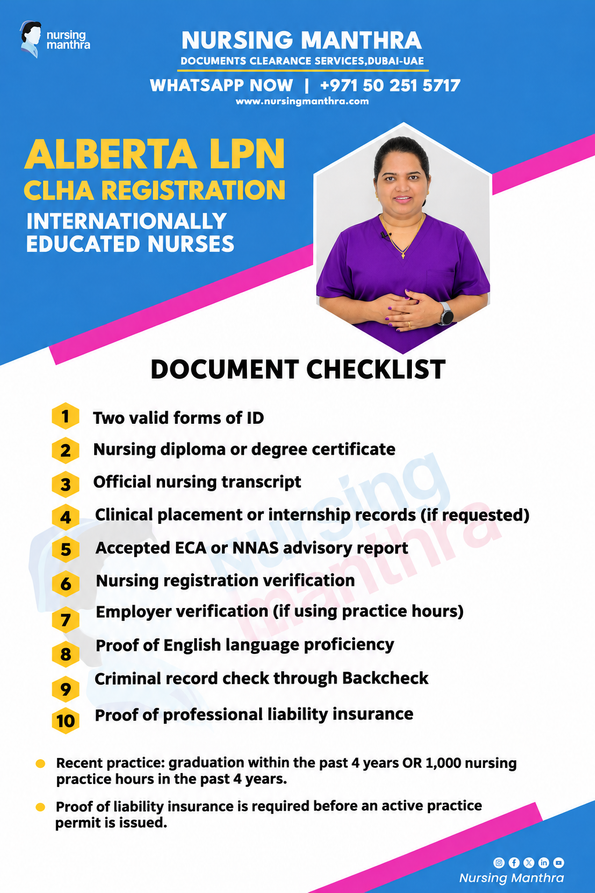
Step 2 — Get your documents ready
| Document | What to prepare |
|---|---|
| Identification | Two valid forms of ID that meet CLHA’s requirements. |
| Nursing education | Diploma or degree, official transcript and the credential report for your chosen route. Keep your course descriptions and clinical placement or internship records available if requested. |
| Nursing registration | Arrange verification from the regulator in each jurisdiction where you hold or previously held registration, as directed. CLHA specifies current verification within the last six months. |
| Employment verification | If using practice hours, ask your employer to complete CLHA’s Verification of Employment form. Have a record of your job title, dates, duties and total hours available. |
| English proficiency | Gather evidence under CLHA’s English language policy. |
| Criminal record check | Follow CLHA’s instructions for completing the check through Backcheck. |
| Professional liability insurance | Provide evidence before an active practice permit is issued. |
If your transcript lists hours under “Lab” or “Practical,” ask your school for a signed breakdown separating skills-lab sessions from supervised patient care. Include placement sites, specialties and hours where available. This is especially helpful for diploma and nursing technician graduates whose course titles may differ from those used in Canada. CLHA applicant handbook and document guidance
Step 3 — Meet the English language requirement
CLHA considers several forms of evidence, including eligible education taught in English and employer verification that you provided health services primarily in English. If you plan to take a test, CLHA lists CELBAN, IELTS Academic, OET and PTE Academic. Check the current policy for the required scores in each skill and how to submit results before booking. CLHA English language requirements
Step 4 — Submit your application through MyCLHA
Create a MyCLHA account from the official international applicant page. Under Provisional, select Apply and begin the international application. Complete every field, submit the application and pay the CAD $340 application fee. Check the portal for outstanding items, especially documents that must come from a school, employer or regulator. CLHA says applications and related components remain active for six months, and delays may mean some documents need to be updated. CLHA application instructions
Step 5 — Complete any assessment CLHA requests
If CLHA needs more evidence to determine whether your qualifications meet Alberta’s LPN standard, it may refer you for an Objective Structured Clinical Exam (OSCE). The assessment is in person in Edmonton, requires a CLHA referral and is paid for by the applicant. Wait for the regulator’s instructions before making travel plans. CLHA international applicant guidance
Step 6 — Obtain your provisional permit and pass the CPNRE
Once CLHA approves your provisional registration application, it will tell you how to register for the Canadian Practical Nurse Registration Examination (CPNRE). You need that approval before you can write the exam through this pathway. With a valid provisional permit, you may work under supervision while awaiting the exam, subject to the permit conditions and your authorization to work in Canada. After you pass the CPNRE, CLHA moves eligible provisional registrants to the general register. CLHA CPNRE information
Alberta LPN application fees and processing time
| CLHA fee | Amount in Canadian dollars |
|---|---|
| Internationally educated nurse application | $340 |
| CPNRE, including the administration fee | $610 |
| Practice permit issued January 1 to June 30 | $350 |
| Practice permit issued July 1 to November 30 | $175 |
Budget separately for costs such as credential assessment, English testing, the criminal record check, insurance and any OSCE or travel. Check the current fee schedule before paying. CLHA applicant fee schedule
CLHA lists a service standard of five business days for initial review of a paid application and ten business days for a decision once all requirements are met. It also reports longer waits due to application volume. Allow additional time for third-party documents, any clinical assessment and exam scheduling. CLHA application timelines
Frequently asked questions
Can I apply with a two-year nursing diploma and one year of experience?
You can explore assessment with that background. If you graduated within four years, you may meet the recent-practice requirement through graduation. If you use employment to meet it, CLHA looks for at least 1,000 qualifying hours within four years. The regulator also reviews what you studied, your clinical training and the scope of your nursing work.
What if I am a nursing technician or my home-country registration is pending?
The CLHA international pathway is described for applicants educated and registered outside Canada. If your registration is pending, you have never been registered, or you hold a nursing technician credential whose regulatory status is unclear, email [email protected] with your exact qualification and registration status before paying for an assessment. CLHA international applicant contact
Need help preparing your Alberta LPN documents?
Nursing Manthra can help you review your nursing education, employment and registration documents and prepare them for the application. For licensing documentation assistance, contact Nursing Manthra on WhatsApp at +971 50 251 5717.
About the Author
Shincy George, RN, MSN (Cardiothoracic Nursing), SCFHS-RN, DHA RN, MOH UAE RN, NCLEX-RN (USA), is the Founder of Nursing Manthra Academy.
With extensive international clinical and academic experience, she is dedicated to guiding healthcare professionals through global licensing pathways.
Through Nursing Manthra, she supports internationally educated healthcare professionals in achieving their career goals across Canada, USA, UAE, Middle East, UK, Ireland, Australia, New Zealand and other countries.
Her mission is to simplify complex licensing processes and empower healthcare professionals with the right knowledge, guidance and support to succeed globally.