By NursingManthra | Information checked: 24 October 2026 | All fees are in Canadian dollars (CAD).
You may already be working confidently in an X-ray department, handling emergency cases, operating CT equipment and supporting patients through difficult examinations. Moving to Canada can still feel confusing. Which authority should you apply to? Is your qualification acceptable? Will passing the Canadian examination allow you to work anywhere?
The first decision is your intended province of practice. Canada combines national professional certification with provincial registration requirements. Understanding that distinction helps you avoid paying for the wrong assessment or preparing an incomplete application.
Does Canada have one radiographer licence?
No. CAMRT certification is not a single licence authorizing practice throughout Canada.
The Canadian Association of Medical Radiation Technologists (CAMRT) provides national certification in medical radiation technology. Provincial regulators issue registration or practice authorization in regulated jurisdictions. Professional associations provide services such as education and advocacy; association membership should not be confused with a provincial licence.
British Columbia and Manitoba currently have no statutory MRT regulatory college. Employer requirements and CAMRT certification remain important there. Other provinces have their own regulators, including Prince Edward Island and Newfoundland and Labrador.
What is a radiographer called in Canada?
For diagnostic X-ray practice, look for radiological technologist, medical radiological technologist or medical radiation technologist, depending on the province.
This guide focuses on diagnostic radiography. MRI, nuclear medicine and radiation therapy have distinct education, certification and registration requirements. Ultrasound also has a separate credentialing pathway. A broad “medical imaging” qualification should not be assumed to qualify its holder for every modality.
A radiographer is also different from a radiologist, who is a medical doctor.
October 2026 application update
CAMRT temporarily stopped accepting new internationally educated credential assessment applications on 12 October 2026 during its transition to a new portal. Reopening is anticipated in early November 2026; that is an expected date, not confirmation that applications have reopened. Existing applications continue to be processed.
Applicants should prepare their records and check the live announcement before submitting or paying. CAMRT also states that applicants must complete their own assessment application steps.
Eligibility: what will be assessed?
Education and clinical preparation
Your professional education must be assessed for the relevant Canadian specialty. The title of your diploma or degree alone cannot establish eligibility.
For example, Saskatchewan requires a program comparable to Canadian accredited preparation, with at least two years of academic and clinical education. PEI also specifies at least two years of MRT education or education accepted as substantially similar. These are examples of provincial requirements, not a guarantee that every two-year overseas diploma will be accepted.
Recent education or practice
There is no universal “two years of experience” rule for all Canadian radiographer applications.
Ontario requires relevant education or clinical practice within the five years immediately before applying. Saskatchewan generally requires graduation within three years or at least 1,200 practice hours in the relevant discipline during the previous five years. Other regulators apply their own currency rules.
A long gap, or recent work only in a different modality, can affect the route available.
Language, conduct and work authorization
Applicants must satisfy the destination regulator’s language, professional conduct and safe-practice requirements. They may also need criminal screening, professional liability insurance and a jurisprudence course covering local law and professional responsibilities.
Professional approval and immigration permission are separate. Passing an examination does not give you permanent residence or permission to work.
Documents to prepare
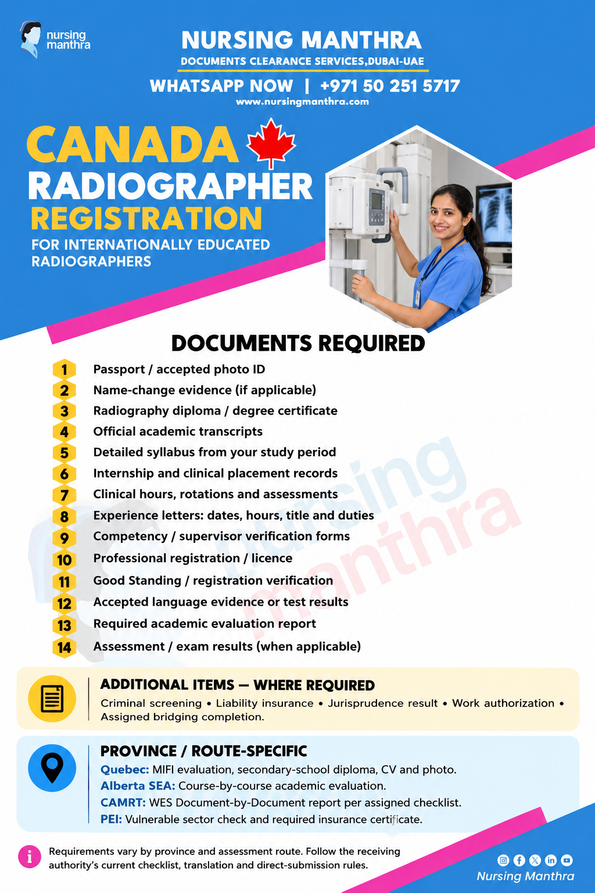
Use this as a preparation checklist. The receiving authority’s current checklist determines what is mandatory, how records must be certified and which documents must come directly from an institution.
| Document group | Records to prepare |
|---|---|
| Identity | Passport or accepted photo identification; name-change evidence where needed |
| Professional education | Final diploma/degree, official transcript and detailed syllabus from your study years |
| Clinical education | Internship and placement details, clinical hours, rotations and assessment records |
| Employment | Employer evidence of dates, hours, title, duties and specialty |
| Clinical competence | The authority’s self-assessment and supervisor verification forms |
| Professional history | Registration, good standing and disciplinary declarations where requested |
| Language | Accepted education-language evidence or valid test results |
| Additional registration items | Criminal screening, insurance, jurisprudence result and work authorization as applicable |
For Quebec, the published checklist additionally includes a MIFI comparative evaluation, secondary-school diploma, CV and recent photograph. Alberta’s assessment route requests a course-by-course academic evaluation and does not accept an immigration assessment for that purpose.
A practical document tip
Before requesting records, make a simple timeline of your education, internship and employment. Compare it with every certificate.
If an employer letter says “full time” but does not give practice hours, ask whether a revised letter is needed. If your university changed its course names, obtain a syllabus that matches your transcript and study period. Explain genuine name or date discrepancies with supporting evidence.
Keep original records and certified translations together. Do not apply one authority’s notarization or translation rules to every Canadian application.
Province-by-province radiographer registration
1. Ontario — CMRITO
Authority: College of Medical Radiation and Imaging Technologists of Ontario
Website: cmrito.org
International applicants apply directly to CMRITO. The route includes an online profile, education assessment, supporting documents, jurisprudence and completion of the approved examination requirement. For an overseas radiographer following the usual initial route, this generally involves CAMRT examination eligibility and certification.
Education must meet CMRITO’s assessment standard for radiography. English or French evidence is required, along with relevant recent education/practice and the remaining registration conditions.
Published fees checked:
- Application: $141.25, including HST.
- Education evaluation, if required: $282.50, including HST.
- Annual registration: $694.95, including HST.
- Initial registration is prorated according to the registration date and birthday.
Application, evaluation and a full annual fee total $1,118.70, before the certification examination and other expenses. This is a budgeting comparison, not an exact first-year invoice.
2. Alberta — ACMDTT
Authority: Alberta College of Medical Diagnostic and Therapeutic Technologists
Website: acmdtt.com
Start with ACMDTT. Applicants needing an initial assessment follow its Substantial Equivalency Assessment process. This is separate from registration.
If CAMRT or CMRITO has already assessed you and confirmed examination eligibility, or you have passed the certification examination, contact ACMDTT for the appropriate route before ordering another assessment.
Applicants must demonstrate an intention to live or work in Alberta and meet education, competence, language and other registration requirements.
Published College fees:
- Application: $100 per profession.
- Substantial Equivalency Assessment: $300, where required.
- Initial registration/practice permit: $450 per profession.
- Annual practice permit renewal: $450 per profession.
These three initial College charges total $850 when all apply. Academic evaluation, examination, insurance and any required courses cost extra.
3. Saskatchewan — CMRIPS
Authority: College of Medical Radiation and Imaging Professionals of Saskatchewan
Website: cmrips.org
Apply to CMRIPS before requesting CAMRT credential assessment. The College screens eligibility, including language, criminal screening and recent education or practice. Approved applicants proceed to CAMRT assessment and examination, then complete provincial licensure.
The College also requires jurisprudence. Its published pathway warns that initial screening through examination eligibility may take six months to one year or longer.
2026 provincial fees:
- Initial application: $130.
- Full practising membership/licensure: $460.
- Combined provincial amount: $590.
CAMRT assessment, examination, insurance and document costs are additional.
4. Manitoba — CAMRT assessment and employer requirements
Relevant organizations: CAMRT and CAMRT-MB
Website: CAMRT provincial directory
Manitoba currently does not have a statutory MRT regulatory college comparable to CMRITO. International applicants use CAMRT credential assessment and certification and must satisfy their employer’s hiring requirements.
Ask the employer to confirm required certification, membership, insurance, clinical competencies and onboarding checks. CAMRT-MB is a professional association, rather than a provincial licensing college.
There is therefore no provincial College application/licence fee to quote for this route. Budget for assessment, examination, relevant membership or insurance and employer requirements.
5. British Columbia — CAMRT certification and employer requirements
Relevant organizations: CAMRT and CAMRT-BC
Website: BC Health Careers
Diagnostic radiographers currently follow CAMRT assessment and certification rather than registration with a dedicated provincial MRT college. BC Health Careers states that internationally educated MRTs need CAMRT credential assessment and certification.
Confirm the employing health authority’s education, competency, insurance and onboarding requirements. Budget for certification-related expenses; professional association membership is separate from a statutory licence.
Modality-specific update: BC’s announced future regulation of radiation therapists should not be described as an existing diagnostic radiographer licensing requirement..
6. Quebec — OTIMROEPMQ
Authority: Ordre des technologues en imagerie médicale, en radio-oncologie et en électrophysiologie médicale du Québec
Website: otimroepmq.ca
Apply directly to the Ordre for diploma/training equivalence in radiodiagnostic. The committee may require further study, placements or other conditions before admission. Quebec has its own professional admission examination pathway; CAMRT certification alone does not complete Quebec registration.
French proficiency appropriate to professional practice is required. Applicants must follow the Ordre’s French-language evidence/OQLF requirements.
Fees: Request current equivalence, examination, permit, annual membership and insurance charges directly. The reviewed equivalence page provides a payment link after application acknowledgement, without a complete public all-in price. Additional training can substantially change the total.
The Ordre notes that the process can take months or years, depending on the applicant’s circumstances.
7. New Brunswick — NBRCMRT
Authority: New Brunswick Regulatory College of Medical Radiation Technologists
Website: nbamrt.ca
The current regulator uses NBRCMRT; its website retains the older NBAMRT domain.
International applicants undergo CAMRT assessment and, when eligible, the relevant certification examination. Provincial registration must also be completed before practice.
New Brunswick’s published full-practice information requires evidence of at least 500 practice hours in each certified specialty over the previous five years. Ask the College which requirements apply to your registration category.
Published application review fee: $125, separate from registration dues. Obtain the current full-practice dues directly; the reviewed fee page does not provide a complete initial-registration total.
8. Nova Scotia — NSRMIRT
Authority: Nova Scotia Regulator of Medical Imaging and Radiation Therapy
Website: nscmirtp.ca
The website retains its former NSCMIRTP domain. Contact NSRMIRT first for screening and pathway selection.
For the standard overseas route, NSRMIRT reviews initial eligibility and refers suitable applicants to CAMRT assessment. Examination and final provincial requirements follow. Conditional authorization may be available only when the regulator’s specific conditions are satisfied.
An expedited assessment pathway exists for applicants meeting specified education and current-registration criteria from Australia, Ireland, the Philippines, the UK, the USA, New Zealand or Nigeria. An overseas licence alone does not establish eligibility; India is not on the published country list. NSRMIRT must confirm the applicable pathway.
2026 fees:
- Initial application: $150.
- Full practising annual licence: $570.
- Six consecutive months or less: $285, where applicable.
9. Prince Edward Island — CAHPPEI
Authority: College of Allied Health Professionals of Prince Edward Island
Website: cahppei.ca
MRT practice has been regulated in PEI since 1 May 2021. Provincial registration is required.
International radiographers should coordinate CAMRT assessment/certification with CAHPPEI’s registration instructions. Requirements include education/examination approval, professional currency, English proficiency, work entitlement and provincial jurisprudence.
The College requires criminal screening including a vulnerable sector check and a current insurance certificate showing at least $2 million per occurrence and $2 million aggregate annually.
Published general registration fees:
- Application: $100.
- Registration, August–January applications: $350.
- February–April applications: $250.
- May–July applications: $100.
- Annual general renewal: $350.
- Jurisprudence examination: $0.
10. Newfoundland and Labrador — NLCMRT / NLCHP
Authorities: Newfoundland and Labrador College of Medical Radiation Technologists, within the Newfoundland and Labrador Council of Health Professionals framework
Website: nlchp.ca
Provincial registration approval is required before starting work. International applicants should coordinate CAMRT credential assessment/certification with the current NLCHP/NLCMRT application requirements.
The provincial regulations also require good-standing evidence where applicants are or have been registered in another jurisdiction.
Fees: Consult the linked 2026–2027 NLCHP schedule, including the relevant College membership charges. A reliable MRT-specific combined amount could not be verified for this article, so no older fee is presented as current.
What about Yukon, Northwest Territories and Nunavut?
CAMRT provides the credential assessment route for applicants targeting northern territories. Confirm the specific employer’s certification and local practice requirements before accepting a position.
Northwest Territories government MRT recruitment explicitly requires CAMRT certification/registration before employment. Do not interpret that as a separate licence for all three territories, or assume that one territory’s employment conditions apply to another.
English and French language requirements
CAMRT assessment: published English test options
| Test | Published minimum |
|---|---|
| IELTS Academic | Overall 6; speaking 6 |
| IELTS General Training | Overall 6; speaking 6 |
| TOEFL iBT | Total 73; speaking 21 |
| MELA | Reading, listening and speaking 8 each; writing 7 |
| PTE | Speaking 68; writing 69 |
| CELPIP General | Speaking 7; writing 7 |
CAMRT also accepts qualifying evidence that professional education and assessment were conducted in English or French, and lists French testing options.
These are CAMRT’s published thresholds. They are not one language standard for every regulator or immigration program. Confirm the accepted test version, score scale, validity period and result-delivery rules before booking.
Provincial differences to check
- Ontario: English or French education evidence or an approved language test. Published IELTS Academic/General thresholds are overall 6 and speaking 6.
- Saskatchewan: English education evidence or an accepted test. Its published IELTS thresholds are overall 6 and speaking 6; other approved options are listed in its policy.
- Nova Scotia: English education evidence, accepted evidence of predominantly English professional employment, or an approved test. Published IELTS thresholds are overall 6 and speaking 6.
- Alberta: Apply ACMDTT’s own language policy. It provides routes through approved English education, accepted IRCC testing or evidence satisfactory to the Registrar. Obtain written confirmation of your required scores.
- Quebec: Professional French requirements apply; an IELTS result does not satisfy the French requirement.
- PEI: Reasonable written and spoken English is required. Confirm acceptable evidence with CAHPPEI.
- New Brunswick and Newfoundland and Labrador: Confirm the regulator’s current evidence and test requirements alongside CAMRT requirements.
- BC and Manitoba: Check both CAMRT and employer expectations.
Fees: how much should you budget?
CAMRT assessment and examination charges
| Item | Published charge |
|---|---|
| Assessment application | $150 |
| Assessment review | $300 |
| Reassessment, if needed | $120 |
| Certification examination: published 2027 sittings | $980 |
| Remote proctoring | $88.63 plus applicable tax |
| Test-centre delivery | $171.75 plus applicable tax |
For a route requiring both CAMRT assessment charges and one examination attempt, the calculated subtotal is $1,518.63 with remote proctoring or $1,601.75 with test-centre delivery, before applicable tax and all other expenses.
Do not add CAMRT assessment fees automatically to Ontario, Alberta or Quebec assessment charges. Follow the assessment route assigned to you.
Example initial budgets
The following calculations use one remote-proctored examination and full-year provincial charges where relevant.
| Illustrative route | Listed-charge subtotal |
|---|---|
| Ontario: application, evaluation, full annual fee and exam/delivery | $2,187.33 |
| Alberta: application, SEA, initial permit and exam/delivery | $1,918.63 |
| Saskatchewan: CAMRT assessment/exam plus provincial application/licence | $2,108.63 |
| Nova Scotia standard route: CAMRT assessment/exam plus application/full-year licence | $2,238.63 |
| PEI: CAMRT assessment/exam plus application/full-year registration | $1,968.63 |
These are arithmetic planning examples, not complete quotations. Initial-year proration, the assigned route and actual invoices can change them. They exclude delivery-fee tax where applicable, academic evaluation, language tests, insurance, translations, criminal checks, courses, travel and immigration.
Other costs to include
Ask for prices for:
- The exact academic evaluation report your authority requires.
- University transcripts, verification and courier charges.
- Translation and certification of documents.
- Language testing or repeat testing.
- Professional liability insurance and applicable membership.
- Bridging, clinical placements or assigned courses.
- Examination repeats.
- Travel, accommodation and relocation.
There is no honest fixed “total Canada radiographer licensing fee” covering every applicant. Obtain an itemized budget after your province and assessment route are confirmed.
WES, immigration ECA and professional assessment
These serve different purposes.
CAMRT’s announced portal checklist calls for a WES Document-by-Document evaluation. Alberta’s own SEA route requests a course-by-course academic assessment and expressly rejects immigration assessments for that requirement.
An immigration Educational Credential Assessment does not itself establish clinical competence or professional registration eligibility. Order the report type and recipient arrangement specified by your receiving authority.
Examination, bridging and timelines
After receiving the required eligibility approval, follow the examination registration instructions. CAMRT registration involves payment to CAMRT and a separate delivery booking.
Published 2027 radiological technology examination dates are 11 January, 10 May and 13 September. Registration closes earlier. New applicants should not assume they can enter the next sitting simply because registration is open.
CAMRT currently advises IEMRT assessment submission at least three months before the relevant examination registration deadline.
If gaps are identified, ask which learning or clinical activity will satisfy them before paying for a course. CAMRT lists its National Experiential Bridging Program and radiography-related options at BCIT, Michener and NAIT. Availability, admission criteria and fees must be checked with the provider.
An examination-preparation course and a regulator-required clinical placement solve different needs. Confirm which one your assessment decision requires.
A practical application sequence
- Choose your intended province and exact specialty.
- Read that authority’s international applicant pathway.
- Obtain initial screening or instructions before ordering assessments.
- Prepare matching education, clinical and employment records.
- Confirm language evidence and required academic report type.
- Submit your assessment through the authorized route.
- Complete any assigned education or clinical requirements.
- Obtain examination eligibility and book the approved examination.
- Complete provincial registration, insurance and other conditions.
- Confirm active practice authorization and work entitlement before starting employment.
Keep copies of submissions, receipts and decision letters. A short written query to the correct regulator can prevent an expensive application mistake.
Frequently asked questions
Can an Indian radiographer apply?
Yes, an internationally educated applicant can seek assessment through the appropriate route. Approval depends on the individual education, clinical preparation, language evidence and provincial requirements.
Is a diploma automatically rejected?
No blanket degree-only rule should be assumed. Qualification level, duration, content and clinical preparation must be assessed. A diploma is not automatically accepted either.
Does Gulf experience help?
Documented relevant practice may support your application and professional currency. A DHA, DOH, MOHAP or other Gulf licence does not automatically convert into Canadian registration.
Is IELTS compulsory for everyone?
Not necessarily. Several authorities accept qualifying education-language evidence, and some accept other evidence. Obtain confirmation before relying on an exemption.
Can I work while waiting for the examination?
Only if the regulator grants an applicable provisional or conditional authorization and you meet its conditions, along with work authorization. Application submission or a job offer alone is insufficient.
Can I move to another province later?
Canadian labour-mobility routes may simplify registration for eligible practitioners already registered in a regulated province. You must still follow the destination authority’s current requirements. CAMRT certification and association membership do not create automatic Canada-wide practice authorization.
Which province is easiest?
Choose using your actual education, practice history, language evidence, finances and employment plans. A pathway suitable for one colleague may not fit another.
Planning your move with NursingManthra
Before spending on assessments, prepare your qualification title, study dates, internship details, recent practice hours and intended province. Those details make it possible to identify the right questions and organize an application accurately.
For document preparation and application guidance, contact NursingManthra through www.nursingmanthra.com. Assessment, examination eligibility and registration decisions remain with the responsible Canadian organizations. Where an authority requires personal submission, applicants must complete those steps themselves.
Editorial note: Requirements and fees were checked on 24 October 2026. Recheck the CAMRT portal announcement and the relevant regulator’s live fee schedule before submitting or paying. Amounts that could not be verified are identified rather than estimated as official charges.
About the Author:
Shincy George, RN, MSN (Cardiothoracic Nursing), SCFHS-RN, DHA RN, MOH UAE RN, NCLEX-RN (USA), is the Founder of Nursing Manthra Academy.
With extensive international clinical and academic experience, she is dedicated to guiding healthcare professionals through global licensing pathways. Through Nursing Manthra, she supports internationally educated healthcare professionals in achieving their career goals across Canada, USA, UAE, Middle East, UK, Ireland, Australia, New Zealand, and other countries.
Her mission is to simplify complex licensing processes and empower healthcare professionals with the right knowledge, guidance, and support to succeed globally.