By NursingManthra | Updated 23 October 2026
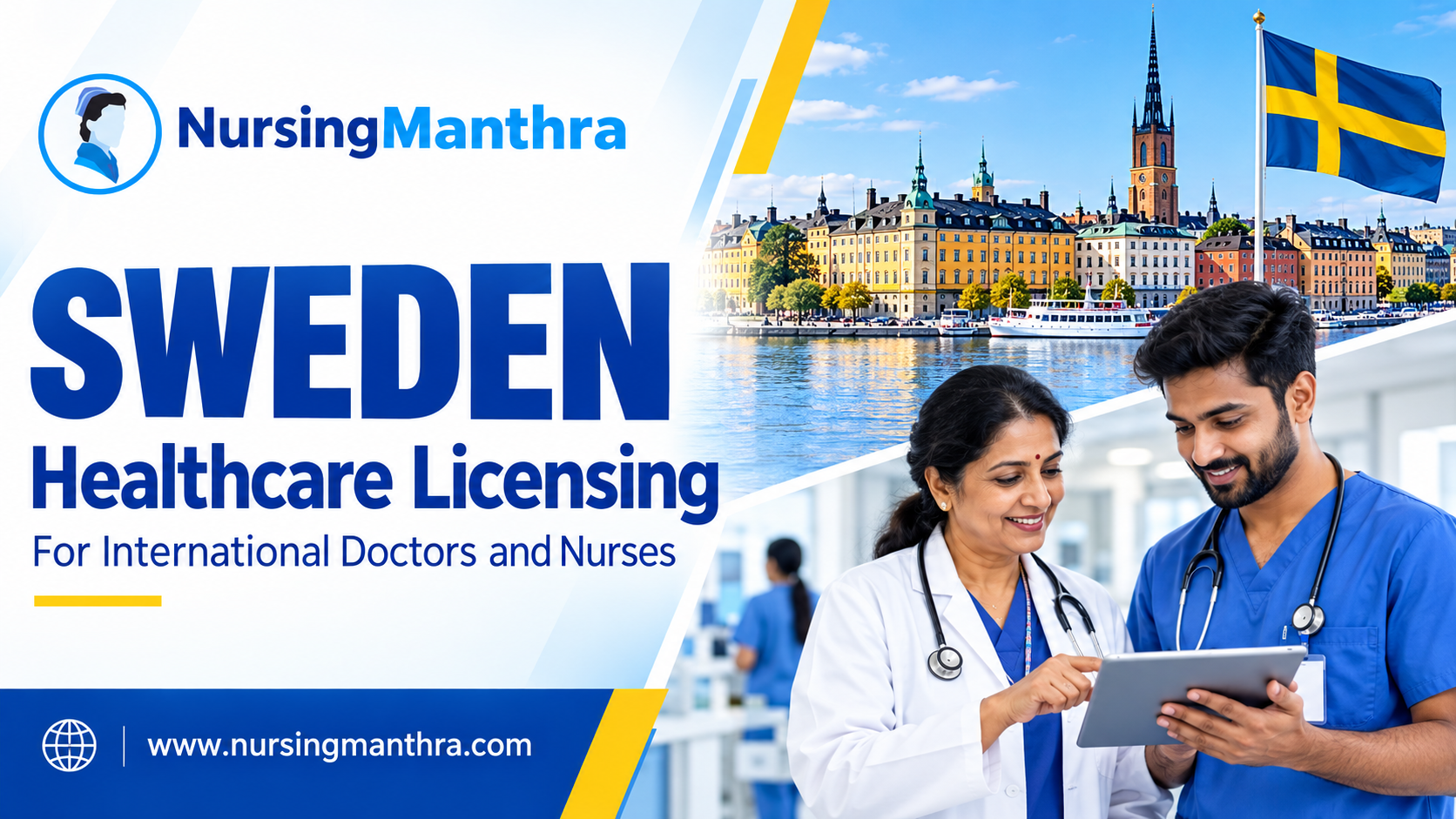
For an overseas doctor or nurse considering Sweden, it helps to think of licensing as a sequence of milestones. The first milestone is assessment of your education. The final milestone is a Swedish professional licence, or legitimation. Between those points, you may need language evidence, a proficiency examination, a Swedish laws course and clinical training.
Passing one milestone does not mean that the whole process is complete. A clear plan is especially important when you need to learn Swedish and arrange a clinical training position while managing costs.
This guide focuses on the usual routes for doctors and general nurses educated outside the EU and EEA. EU qualifications, prior European recognition and specialist qualifications require separate assessment of the applicable route.
The Swedish licensing authority:
Socialstyrelsen, the Swedish National Board of Health and Welfare, assesses applications and grants licences for the regulated professions within its remit. A home-country medical or nursing registration does not itself permit use of the equivalent protected Swedish professional title.
Check the exact Swedish profession before applying. A hospital employment title, an academic degree description and a licensed profession are not always the same thing.
Two main routes for non-EU and EEA applicants:
For doctors and general nurses, Socialstyrelsen describes a direct assessment pathway and a complementary university programme option. On the direct pathway, the five broad stages are education assessment, proficiency testing, a laws and regulations course, clinical training and the final licence application. University programme admission is separate and places are limited.
The programme option is not a promise that any overseas applicant can bypass assessment or obtain a guaranteed place. The university decides admission requirements and the training that applies.
Step 1 : Have your education assessed:
Submit the profession-specific assessment application with the required qualification and identity records. The authority compares the level, duration and content of education. An approval to proceed is not yet a licence.
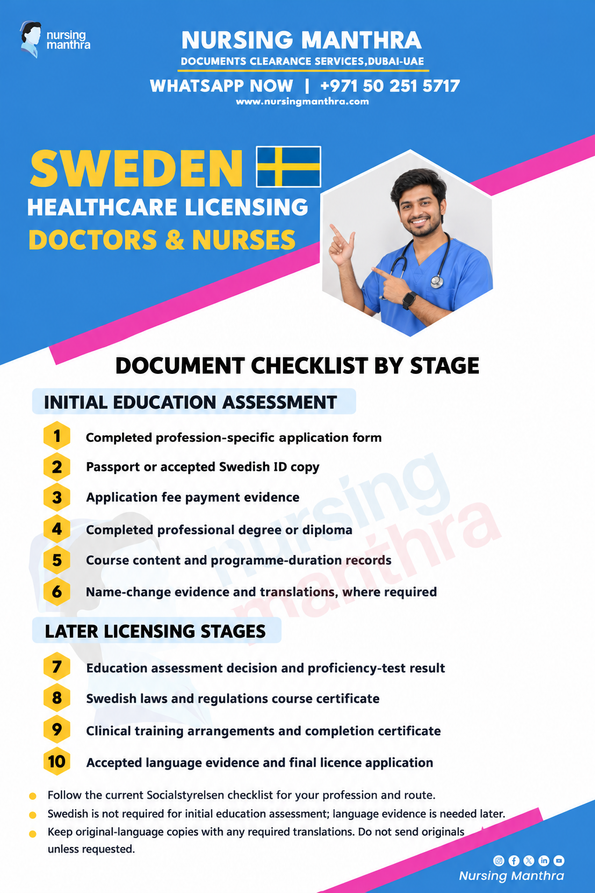
For initial assessment, the published doctor and nurse checklists include the application, passport or accepted Swedish ID, payment evidence, completed qualification, course and programme-duration records and name-change evidence where relevant. Follow the current instructions about copies and translation; do not send original documents unless requested.
Before submitting, check that the institution-issued record explains the programme adequately. A document that lists only examination marks may not answer a question about the duration or content of clinical training.
Step 2 : Learn Swedish and complete the proficiency test:
Swedish is not required for the initial education assessment, but it is needed for later stages. Published accepted routes include Swedish C1 and specified Swedish education evidence, with equivalent Norwegian or Danish proficiency and certain other documented assessment options. Use the exact rules on your profession page.
After the relevant education decision, follow the designated test provider’s instructions. Do not assume a nursing test is the medical test or that preparation courses determine official eligibility. Build time for registration dates, examination format and a possible repeat attempt.
For clinical communication, aim to understand more than memorised terminology. Practise explaining a treatment, responding to a worried relative, receiving a handover and documenting a clinical decision. These skills support the later professional stages.
Step 3 : Complete the Swedish laws and regulations course
The direct route includes a course on Swedish laws and regulations. Follow the approved course requirements and keep the completion evidence. An unrelated online ethics certificate is not automatically a substitute.
Plan your study around how professional obligations apply in practice: confidentiality, documentation, patient participation and safe working. The aim is to work safely within Sweden’s system, not simply to collect a certificate.
Step 4 : Complete the required clinical training:
On the published direct route, medical clinical training lasts six months and nursing clinical training three months. Applicants must find a suitable training position themselves. These are different requirements for different professions.
For medical clinical training, the relevant special authorisation must be arranged. Nursing guidance states that prior professional experience does not remove or shorten the stated clinical training requirement.
Before agreeing to a position, confirm the supervisor, workplace suitability, duties, dates, required authorisation and the official completion certificate. Discuss funding and living arrangements with the employer. Do not assume that Socialstyrelsen will arrange or finance your placement.
Step 5 :Submit the final license application:
Once the required stages are complete, submit the final application and the requested identity, language and completion evidence. Check the current rules for a Swedish personal identity or coordination number. Socialstyrelsen’s guidance explains how a coordination number can be requested where necessary; do not assume that the initial assessment requires you already to live in Sweden.
Read the final decision before describing yourself as fully licensed. Specialist qualification recognition is a separate matter from obtaining the basic medical or nursing licence.
Documents to organize by stage:
For the initial assessment, keep education and identity evidence together. For later stages, create separate folders for the assessment decision, proficiency result, laws-course certificate, clinical training arrangements and completion record, language evidence and final application.
Keep a record of the date and reference number of each submission. If the authority asks for clarification, respond against the same case rather than sending unlabelled duplicate files.
Documents already in Swedish, Norwegian, Danish or English generally do not require translation under the initial assessment guidance. Otherwise, use the accepted translation arrangements and retain both the original-language copy and translation.
This is different from assuming that every country in Europe demands a new translation into its national language. Read the actual Swedish checklist before paying a translator.
Application fees and other costs:
The initial doctor and nurse assessment pages list SEK 990. For the direct medical route, Socialstyrelsen explains that an already-paid SEK 990 assessment fee is not paid again simply because the final licence application is submitted.
The medical route involving a completed Swedish AT internship has a different published fee structure: SEK 3,300 in total, with SEK 2,310 additional if SEK 990 was already paid. These figures should not be applied indiscriminately to every doctor or nurse.
Budget separately for translations if required, language learning and testing, travel, accommodation and living costs during preparation and clinical training. Confirm any university programme charges with the institution. NursingManthra’s agreed service charge is separate from official and provider charges.
How long does it take:
Socialstyrelsen describes the direct doctor and nurse route as usually taking approximately two to four years, with variation according to personal circumstances. The complementary programme route has its own admission and training timeline.
A few weeks spent processing a final licence file should not be advertised as the duration of the entire overseas licensing journey. Language progress and securing an appropriate clinical position can be substantial parts of the plan.
What if you have European recognition already:
Socialstyrelsen publishes a separate route for certain non-EU qualifications recognised in another EU/EEA country with at least three years of certified professional practice in the country that first recognised them. Article 3.3 evidence and the full conditions matter. Do not treat any European employment or residence card as proof that this alternative applies.
Other regulated healthcare professions:
Select the exact profession on Socialstyrelsen’s website. The five-step doctor or nurse pathway should not be copied into every application for a physiotherapist, biomedical scientist, dentist or other regulated professional. The relevant education and testing decisions are profession-specific.
Nursing Manthra support:
For a preliminary discussion, provide your profession, country of education, qualifications, current registration, CV, language level and any previous Swedish or European decision. NursingManthra can assist with agreed document preparation and administrative application tasks. University admission, test preparation, placement procurement, employment and immigration support require separate confirmation.
Contact www.nursingmanthra.com (https://www.nursingmanthra.com/) or WhatsApp +971 50 251 5717. Final licensing decisions belong to Socialstyrelsen.
Official sources:
1. Socialstyrelsen non-EU/EEA doctor pathway (https://legitimation.socialstyrelsen.se/en/licence-application/outside-eu-eea/doctor-of-medicine-educated-outside-eu-eea/)
2. Socialstyrelsen non-EU/EEA general nurse pathway (https://legitimation.socialstyrelsen.se/en/licence-application/outside-eu-eea/nurse-responsible-for-general-care-educated-outside-eu-eea/)
3. Doctor initial education assessment (https://legitimation.socialstyrelsen.se/en/licence-application/outside-eu-eea/doctor-of-medicine-educated-outside-eu-eea/national-board-of-health-and-welfare/have-your-education-assessed/)
4. Nurse initial education assessment (https://legitimation.socialstyrelsen.se/en/licence-application/outside-eu-eea/nurse-responsible-for-general-care-educated-outside-eu-eea/national-board-of-health-and-welfare/have-your-education-assessed/)
5. Doctor clinical training (https://legitimation.socialstyrelsen.se/en/licence-application/outside-eu-eea/doctor-of-medicine-educated-outside-eu-eea/national-board-of-health-and-welfare/undergo-clinical-training/)
6. Nurse clinical training (https://legitimation.socialstyrelsen.se/en/licence-application/outside-eu-eea/nurse-responsible-for-general-care-educated-outside-eu-eea/national-board-of-health-and-welfare/undergo-clinical-training/)
7. Doctor final application and route-specific fees (https://legitimation.socialstyrelsen.se/en/licence-application/outside-eu-eea/doctor-of-medicine-educated-outside-eu-eea/national-board-of-health-and-welfare/send-your-application/)
8. Doctor route involving prior EU/EEA recognition and practice (https://legitimation.socialstyrelsen.se/en/licence-application/3-years-outside-eueea/doctor-of-medicine-educated-outside-EU-EEA-three-years-practice-within-EU-EEA/)
Independent application guidance. Licensing and immigration are separate decisions. Check current profession and route instructions before making payments or travel commitments.
About the Author
Shincy George, RN, MSN (Cardiothoracic Nursing), SCFHS-RN, DHA RN, MOH UAE RN, NCLEX-RN (USA), is the Founder of Nursing Manthra Academy.
With extensive international clinical and academic experience, she is dedicated to guiding healthcare professionals through global licensing pathways. Through Nursing Manthra, she supports internationally educated healthcare professionals in achieving their career goals across Canada, USA, UAE, Middle East, UK, Ireland, Australia, New Zealand, and other countries.
Her mission is to simplify complex licensing processes and empower healthcare professionals with the right knowledge, guidance, and support to succeed globally.