By NursingManthra | Updated 23 October 2026
If you are a laboratory professional planning to move to Australia, you may be wondering: “Which licence should I apply for? Will my Indian qualification be accepted? Do I need to write an examination?”
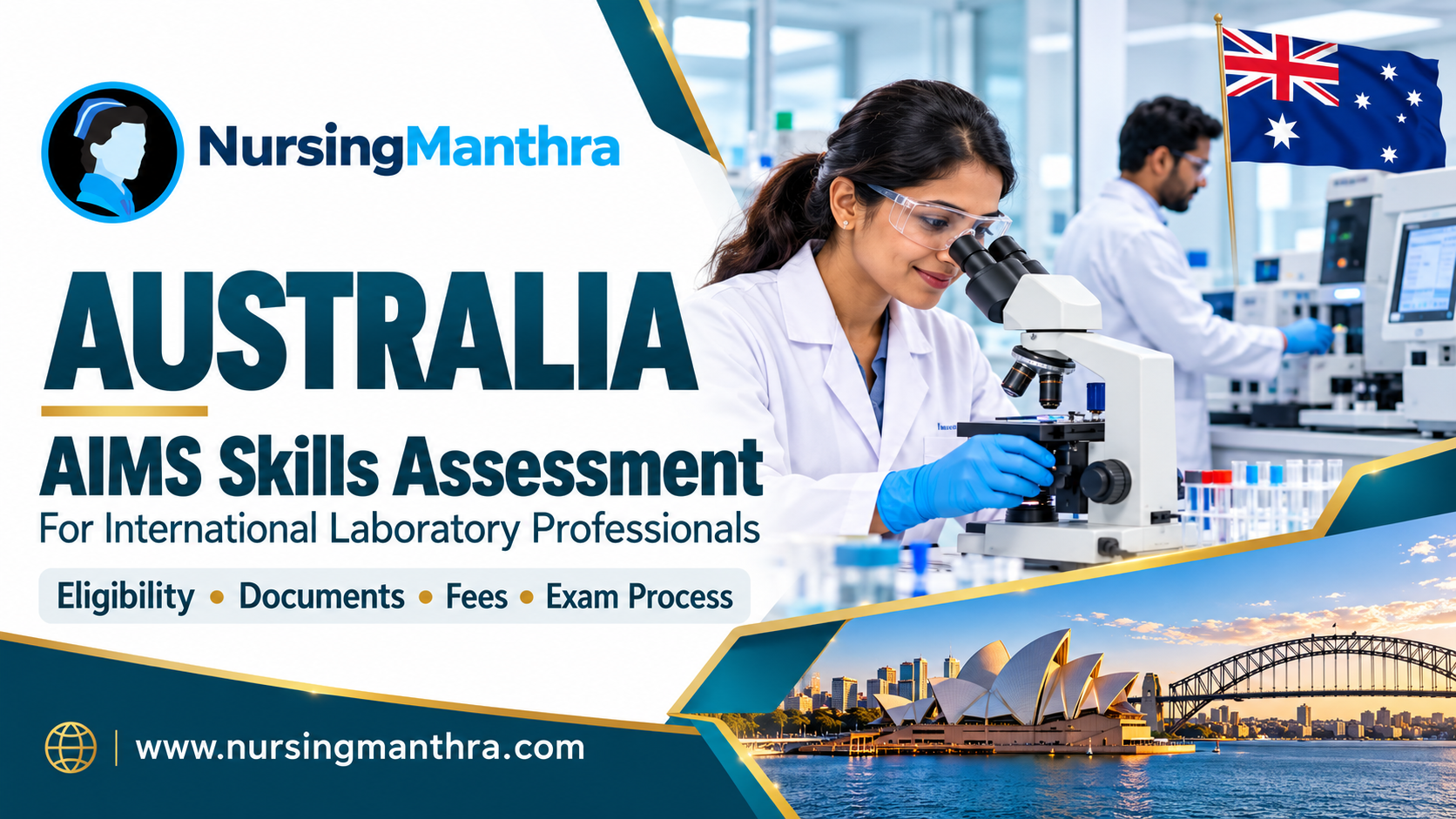
The first step is understanding the role of AIMS—the Australian Institute of Medical and Clinical Scientists.
AIMS assesses overseas laboratory qualifications and professional skills for specified migration occupations. Its assessment process is different from obtaining professional membership, securing employment or receiving a visa. Choosing the correct application at the beginning can help you avoid unnecessary expense and delays.
1. Is AIMS an Australian licensing authority?
Australia does not currently have statutory registration or licensing for Medical Laboratory Scientists and Medical Laboratory Technicians. Consequently, this pathway should be described as an AIMS skills assessment, rather than an AHPRA licence application.
For migration assessment, AIMS covers:
| Occupation | ANZSCO code |
|---|---|
| Medical Laboratory Scientist | 234611 |
| Medical Laboratory Technician | 311213 |
| Pathology Collector/Phlebotomist | 311216 |
| Medical Laboratory Scientist—IVF Embryologist specialisation | 234611 |
This article focuses on the Scientist and Technician pathways. Phlebotomy and embryology applicants should use their occupation-specific instructions.
Your job title at home does not, by itself, establish your Australian classification. Prepare your application around your actual qualification, training and laboratory responsibilities.
2. Eligibility for internationally educated applicants:
The main Scientist and Technician pathways differ:
| Pathway | Main published requirements |
|---|---|
| Scientist: AIMS-accredited qualification | An eligible accredited programme and subject pathway; no professional examination or postgraduate experience requirement under this option. |
| Scientist: acceptable non-accredited science qualification | Relevant degree-level education and normally two years of postgraduate professional experience, including one year wholly within the preceding five years. Assessment determines examination eligibility. |
| Scientist: postgraduate alternative | Relevant postgraduate qualifications and medical pathology experience; separate criteria and a Special Professional Examination apply. |
| Technician: qualification and experience route | Relevant qualification comparable to at least AQF Level 5, plus two years of diagnostic pathology experience wholly within the preceding five years. No professional examination is required. |
| Technician: New Zealand route | Current full—not provisional—Medical Laboratory Technician registration with New Zealand’s Medical Sciences Council. |
IMS evaluates individual files; these summaries do not establish automatic eligibility.
What does this mean for Indian applicants?
Before applying, organise the complete education sequence: diploma, bachelor’s degree, postgraduate qualifications and clinical training.
For example, a candidate with a diploma followed by a bachelor’s degree should explain both qualifications. Sending only the latest award may leave important questions about earlier study unanswered.
Do not assume that every BSc MLT, BMLT, microbiology, biochemistry or biomedical science programme leads to the same outcome. Use the current AIMS criteria to review your individual course.
3. English-language requirements
AIMS requires an English proficiency test report from all applicants, without exemptions, received within three years of the test date.
Its current application lists IELTS Academic or General Training, TOEFL, PTE Academic, Cambridge C1 Advanced and specified OET professions. AIMS links the required scores to Home Affairs’ Proficient English standard. For OET, check that your selected profession is accepted by AIMS.
For tests taken on or after 7 August 2025, published Proficient English scores include:
| Test | Listening | Reading | Writing | Speaking |
|---|---|---|---|---|
| IELTS Academic or General Training | 7 | 7 | 7 | 7 |
| PTE Academic | 58 | 59 | 69 | 76 |
| OET | 350 | 360 | 380 | 360 |
| Cambridge C1 Advanced | 175 | 179 | 193 | 194 |
| TOEFL iBT | 22 | 22 | 26 | 24 |
Earlier tests use different score tables. Check both the test date and current acceptance conditions, including TOEFL’s Australia-specific registration instructions.
Important: Home Affairs accepts some tests that are not listed in AIMS’ application. Visa acceptance alone does not establish AIMS acceptance. AIMS announced revised English-test guidance from 12 March 2026, so avoid relying on older preparation websites.
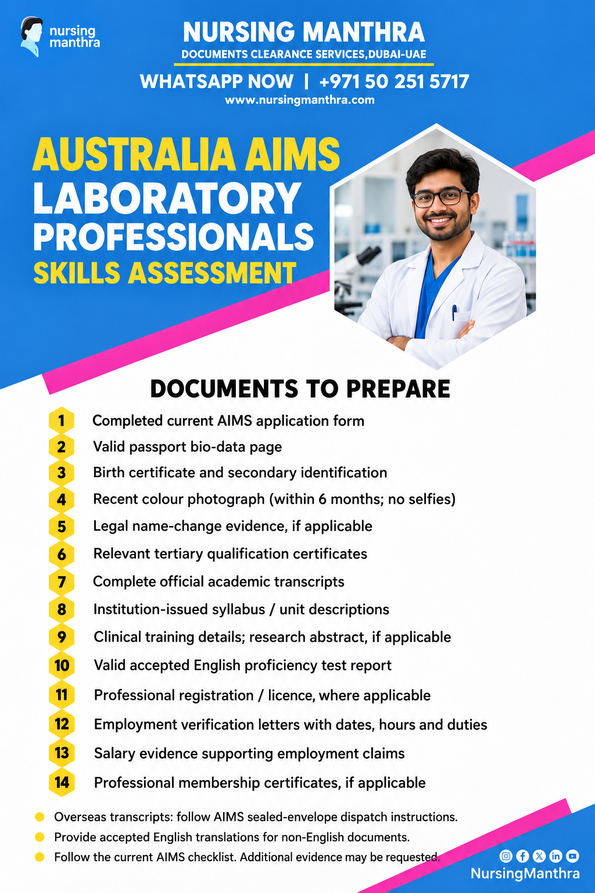
4. Documents to prepare
Build your file in clearly labelled sections.
Identity
- Valid passport.
- Recent professional photograph.
- Birth certificate and secondary identification.
- Legal name-change evidence, where applicable.
Education
- Qualification certificates for relevant tertiary study.
- Complete academic transcripts.
- Institution-issued syllabus or subject descriptions.
- Clinical training details.
- Research abstract and methods, where applicable.
Professional history
- Registration or licence evidence, where applicable.
- Employment verification and evidence of remuneration.
- Relevant professional membership records.
Use the current application checklist for the exact document and scan requirements.
Pay particular attention to overseas transcripts
AIMS’ application process requires overseas institutions to provide official transcripts in a sealed envelope. If the institution gives you the envelope to forward, preserve the seal and follow AIMS’ dispatch instructions. Uploading your own transcript scan does not replace this requirement.
As a practical preparation step, ask your university who handles overseas transcript requests, how long they take and whether tracking is available.
For employment records, check dates, weekly hours, job title, duties and employer contact details before submission. Keep supporting salary records organised so they can be matched to the relevant employment period.
5. How to apply: step by step
Step 1: Read the current occupation guidance
Start with the official AIMS Qualification and Skills Assessment page.
Step 2: Complete the current application
Use consistent names and dates throughout your records.
Step 3: Submit your documents and arrange transcripts
Follow the email-submission and institution-transcript instructions.
Step 4: Receive your reference and payment request
AIMS describes issuing a Lodgement Reference Number within ten business days, together with a separate assessment invoice.
Step 5: Complete verification
Respond to any requests concerning your documents.
Step 6: Receive the Stage 1 decision
Where examination eligibility is granted, AIMS supplies the relevant invitation and application form.
Keep a complete copy of everything submitted, including receipts and correspondence. Use your reference number when following up.
6. AIMS fees
The published fee schedule distinguishes applicants inside and outside Australia. GST depends on the applicant’s postal/residential address.
| Service | Outside Australia | Within Australia |
|---|---|---|
| Scientist/Technician skills assessment | AUD 900 | AUD 990 |
| Standard Scientist Professional Examination | AUD 800 | AUD 880 |
| Assessment amendment | AUD 200 | AUD 220 |
| Assessment appeal | AUD 200 | AUD 220 |
| Replacement assessment/examination letter | AUD 150 | AUD 165 |
| Examination deferral | AUD 100 | AUD 110 |
Assessment fees become non-refundable once processing starts. Charges can change; confirm the invoice before payment. The schedule does not separately identify the Special Professional Examination fee, so confirm that charge with AIMS.
For an overseas applicant requiring the standard examination, assessment plus one examination currently totals AUD 1,700. This calculation excludes English testing, translations, courier charges, preparation materials, repeat attempts and any consultancy service charge.
7. Standard Medical Laboratory Scientist examination
The standard examination contains 150 single-response MCQs over three hours.
Its published distribution is:
| Discipline | Questions |
|---|---|
| Anatomical Pathology | 14 |
| Chemical Pathology | 30 |
| Genomic/Molecular Pathology | 16 |
| Haematology | 30 |
| Immunopathology | 14 |
| Medical Microbiology | 26 |
| Transfusion Science | 20 |
| Total | 150 |
The current exam pack uses “Molecular Pathology,” while other AIMS material uses “Genomic Pathology.”
Candidates must attempt every section. Published rules require 75 correct overall, specified compulsory-discipline passes, and a pass in either Molecular/Genomic Pathology or Immunopathology. Results are also reported using a scaled score with a 500 cut score. Therefore, an overall percentage alone does not explain the full passing requirement.
How is the exam delivered?
AIMS publishes March and September sessions using online remote proctoring, with webcam and mobile-phone supervision. Follow the technical instructions and complete the required preparation checks.
The practical preparation should include a quiet room, dependable internet, suitable equipment and familiarity with the testing system—not only subject revision.
8. Special Professional Examination
The Special Professional Examination is a different assessment, intended for applicants whom AIMS approves for that pathway.
It includes essays and short answers over two hours, plus ten minutes’ reading time. Topics cover laboratory operations, accreditation, quality systems, specimen-related risks, safety, ethics and patient information. Its published pass mark is 50%.
Both examination packs list these usual deadlines:
| Session | Application deadline | Payment deadline |
|---|---|---|
| March | 1 December | 31 January |
| September | 10 July | 8 August |
Applications are due by 4 pm on the stated date; confirm the relevant time zone and session instructions with AIMS. Results may take up to ten weeks.
As of October 2026, plan around a future available sitting. Do not assume an assessment application submitted now will be completed before an examination deadline.
9. Preparing effectively for the examination
Start by checking which examination your AIMS letter actually authorises.
For MCQ preparation:
- Make a revision plan covering every discipline.
- Review why each incorrect answer is wrong.
- Practise interpreting results alongside clinical information.
- Keep a record of recurring knowledge gaps.
- Use timed practice to improve pacing.
For written preparation, practise explaining decisions clearly: identify the laboratory problem, describe the immediate action, justify it and explain how recurrence could be prevented.
A useful exercise is to take a familiar test from your workplace and ask: What could make this result unreliable? What would I investigate first? What would I document?
10. NursingManthra AIMS review material
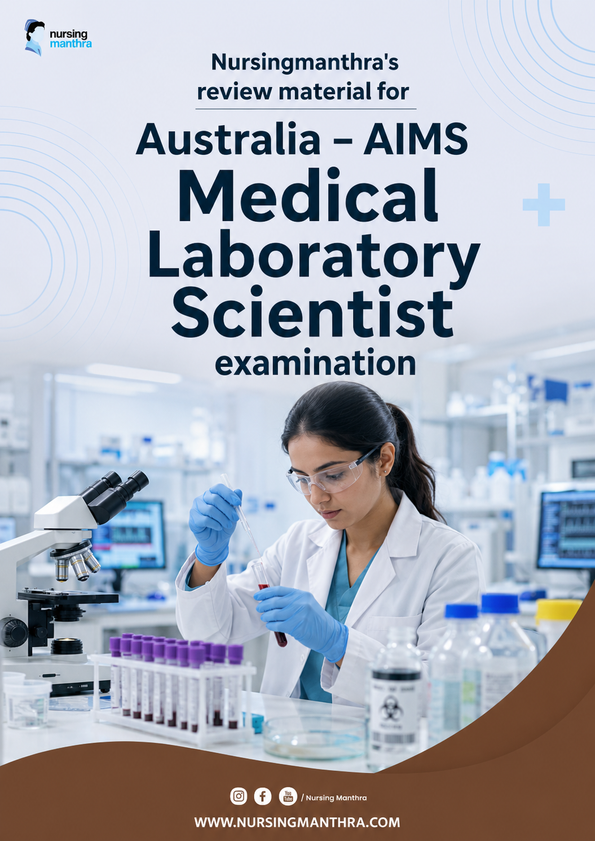
NursingManthra offers a dedicated resource for candidates preparing for the Australia AIMS Medical Laboratory Scientist examination.
👉 View NursingManthra’s Australia AIMS Medical Laboratory Scientist Examination Review Material
Check the product description and access terms before purchasing, and match your preparation to the examination named in your eligibility letter.
Independent educational resource: NursingManthra’s material is not an official AIMS publication and does not establish assessment eligibility or guarantee examination success.
11. Does a positive assessment guarantee a visa or job?
No. A skills assessment forms part of the requirements for relevant migration pathways. Home Affairs determines visa eligibility, and the assessment required depends on the visa category. immi.homeaffairs.gov.au
Before committing to a relocation plan, consider the assessment, employment search and immigration application as separate tasks with their own requirements and expenses.
Also remember that AIMS membership cannot replace a migration skills assessment. If an employer requests an assessment solely for employment purposes, clarify the appropriate service before paying.
12. How NursingManthra can assist
NursingManthra can assist with agreed document preparation and administrative application tasks.
For an initial discussion, share:
- Exact qualification and awarding institution.
- Country and dates of study.
- Internship details.
- Laboratory employment history.
- Registration status.
- English-test results.
- Any previous AIMS decision.
Service scope and consultancy charges should be confirmed separately from official fees.
📲 WhatsApp: +971 50 251 5717
🌐 Website: www.nursingmanthra.com
Requirements and fees may change. Follow the current AIMS instructions and your individual assessment decision.
For study materials-https://nursingmanthra.com/product/nursing-manthras-review-material-for-australia-aims-medical-laboratory-scientist-examination/