
By Shincy George, Managing Director, Nursing Manthra Consulting FZ LLC
If you are an MBBS doctor planning to work in Abu Dhabi, start by checking the dates on your internship certificate and experience letters. For most internationally trained doctors, the Department of Health – Abu Dhabi (DOH), formerly known as HAAD, looks for a recognised medical degree, a completed internship and two years of eligible clinical experience after internship. For Specialists and Consultants, DOH also checks the exact postgraduate credential, its PQR tier and any experience required after qualification. The licensing process runs through TAMM and ends with an active licence linked to a healthcare facility.
Who is eligible for the DOH GP title?
- Medical degree. Hold an MBBS, MBChB or recognised equivalent from an accredited institution.
- Internship. The DOH GP manual specifies one year of internship training and lists rotations in internal medicine, general surgery, obstetrics and gynaecology, and paediatrics.
- Clinical experience. The standard route requires two years of acceptable clinical experience after internship. DOH lists fields including family medicine, internal medicine, emergency medicine, paediatrics, general surgery, critical care, cardiology, and obstetrics and gynaecology. Your actual duties can affect the scope DOH approves.
- Professional registration and good standing. Be ready to document the medical registration or licence covering your practice. The unified PQR calls for a valid Good Standing Certificate issued within six months of application.
- Experience exceptions. The PQR provides a two-year window after internship for experience exemption for UAE nationals, children of Emirati women and non-UAE nationals who graduated from UAE universities. Most non-UAE nationals who graduated overseas must meet the standard experience requirement.
Specialist and Consultant eligibility by qualification tier
Start with the Recognized Specialty Certificates table in the unified PQR. Match the exact award, issuing body and specialty. The same degree abbreviation can lead to different outcomes depending on who issued it and how you trained. The current PQR generally calls for at least three years of full-time training for listed clinical residency, clinical master’s or clinical PhD routes. An unlisted qualification may be referred to the PQR Committee if it meets the applicable criteria.
| PQR tier | Specialist in the main specialty | Consultant in the main specialty |
|---|---|---|
| Tier 1 | No post-qualification experience under the recent-qualification route, subject to practice-gap rules | Two years after the main specialty qualification |
| Tier 2 | No post-qualification experience under the recent-qualification route, subject to practice-gap rules | Five years after the main specialty qualification |
| Tier 3 | Three years after qualification for most non-UAE nationals. One year for UAE nationals and children of Emirati women. | Generally ineligible, with a limited exception for qualifying physicians who enrolled before June 2017. |
The PQR specifies that the Tier 1 or 2 Specialist qualification should have been obtained within the previous two years for the no-experience route. For recognised subspecialties, the tables generally list one year after the subspecialty qualification for Tier 1 Consultants and four years for Tier 2 Consultants. Tier 3 Specialist applicants generally need two years after the subspecialty qualification if they are non-UAE nationals. UAE nationals and children of Emirati women may qualify without post-subspecialty experience, subject to practice-gap criteria. A clinical fellowship can follow a separate evaluation table, and non-UAE nationals must also satisfy applicable main-specialty experience requirements.
Tier 3 Consultant exception. The current PQR sets a narrow route for eligible pre-June 2017 enrolments. It includes at least ten years of licensed UAE Specialist practice in qualifying settings, two recent years of leadership or supervision, good standing and disciplinary history checks, indexed publications, recommendations, and the Consultant assessment. Surgical applicants must also provide the specified five-year logbook under this exception. Ask DOH to confirm whether your case qualifies before applying.
Unified PQR, physician requirements and recognised specialty certificates
Documents to prepare
| Document | What to check before uploading |
|---|---|
| Passport and recent photograph | Use clear copies and match your name to the application. |
| Grade 12 / Higher Secondary or Intermediate certificate | Keep this with your education records for document preparation and supply it if requested. |
| Medical degree and academic transcript | Keep the final degree ready and have the transcript available if requested. |
| Internship completion certificate | Include start and end dates and a rotation breakdown if it is on a separate document. |
| Clinical experience certificates | Request signed or stamped letters with job title, department, dates and employer contact information. Keep job descriptions and working hours available for review. |
| Medical registration or licence | Prepare the credentials for the home country and country of last practice where applicable, including credentials covering the work you claim. |
| Good Standing Certificate | Request it from the relevant regulator and check its issue date against the six-month rule. |
| Specialty qualification and residency records | For Specialists and Consultants, prepare your board, fellowship or specialty award, and residency completion certificate or transcript. The DOH manual specifies residency or transcript evidence for Tier 2 and Tier 3. |
| Surgical logbook and clinical privilege records | For surgical specialties, the standard DOH manual asks for a signed and stamped logbook for the past two years. Keep current privileges and facility credentialing records available where requested. |
| Updated CV | List internship and clinical employment separately. Use consistent dates across documents. |
| Existing PSV report and case number | Include these if requesting transfer or reuse of a previous report. |
| Exam exemption evidence | Upload the relevant pass records, accredited degree evidence or current professional registration for your route. |
| Supporting documents, if requested | Keep name-change evidence, translations, UAE ID details and a current BLS certificate available where relevant to your application or employer. |
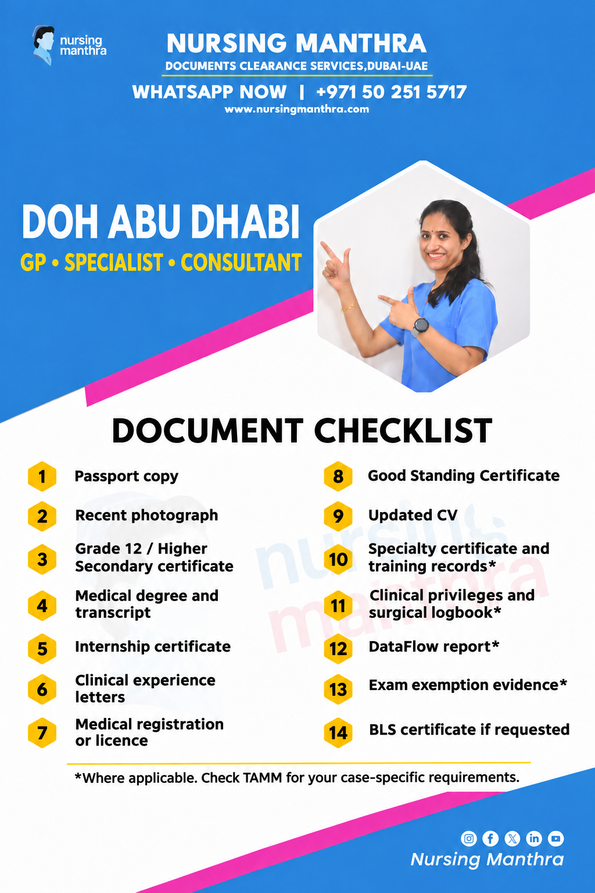
Check your TAMM task list for any case-specific requirements. DOH licensing FAQ
DOH GP licensing process step by step
- Check your eligibility before paying. Compare your medical education, internship, clinical experience, registration and any practice gap with the GP criteria. If you worked in several hospitals, check which periods you can document.
- Start through TAMM. Open the Department of Health services and select the healthcare professional licensing or new registration service. Follow the sign-in and identification steps shown for your case.
- Complete Primary Source Verification (PSV). Follow the DataFlow instructions to verify the documents required for your case. Verification checks credentials with their issuers. If you already have a report, ask about transfer and which documents need additional verification.
- Submit for DOH review. Link the verification results and upload any supporting documents TAMM requests. DOH reviews your application for the requested physician title and determines the assessment route.
- Take the exam or obtain exemption approval. If DOH assigns a computer-based exam, pay the required pre-booking charge in TAMM, then use the Pearson VUE link in your application to select the test centre and appointment. If you qualify for exemption, submit the supporting records for DOH to review before paying an exam fee.
- Link an eligible Abu Dhabi facility. When you have an employer, the facility completes its part of the linking process. Complete any security clearance and issuance steps shown in TAMM.
- Confirm your licence is active. Check that DOH has issued the licence under your approved physician title under the appropriate facility before starting clinical work.
Exam format and exemptions
The DOH licensing manual lists the GP computer-based test as 120 multiple-choice questions in 2.5 hours. For Specialists and Consultants, it lists a 100-question, three-hour CBT for selected titles and a 45–60 minute oral assessment for remaining specialties. Use the format and booking instructions assigned to your application.
All speciality related study materials available- https://nursingmanthra.com/study-materials/
GP exam exemption
The unified PQR lists the following GP exam-equivalency routes. DOH reviews your evidence and confirms whether it satisfies the requirement. An approved exemption covers the licensing assessment. Degree, internship, experience, credential verification and licence issuance requirements still apply.
| Country | Evidence listed in the PQR |
|---|---|
| Australia | Both AMC examinations, written and clinical, or graduation from an AMC-accredited medical course in Australia. |
| Canada | Licentiate of the Medical Council of Canada (LMCC). |
| Ireland | Both PRES components (MCQ and OSCE), graduation from an Irish Medical Council-accredited medical course in Ireland, or the listed route combining both PRES passes with valid general registration. |
| New Zealand | NZREX or graduation from a medical course in New Zealand accredited by the Medical Council of New Zealand. |
| UAE | Proof of passing the Emirates Medical Residency Entrance Examination (EMREE). |
| United Kingdom | Valid PLAB 1 and 2, graduation from a GMC-accredited UK medical course, or the valid GMC registration route for non-UK graduates whose PLAB exams are beyond the five-year validity period. |
| United States | Proof of passing USMLE Step 3. |
DOH Unified PQR and GP exam-equivalency table
Specialist and Consultant exam exemption
The current PQR applies two routes to both titles.
- Recognised Tier 1 specialty certificate from a country listed in the applicable exemption section. The list includes Australia, Austria, Belgium, Canada, Denmark, Finland, France, Germany, Iceland, Ireland, Luxembourg, the Netherlands, New Zealand, Norway, Singapore, South Africa, South Korea, Sweden, Switzerland, the UK and the US. Examples from the supplied tables include eligible Royal College fellowships, Canadian RCPSC or CFPC certification, Irish CSCST, UK CCST or CCT, and US ABMS board certification. Check the exact credential and tier in the current PQR.
- Recognised Tier 2 specialty certificate with all additional criteria met. This includes recognised subspecialty training or certification, more than ten years of relevant specialty practice, at least two years in a senior role in a teaching hospital, participation in an academic specialty training team, a valid licence and good professional standing, and documented clinical publications, research programme leadership or international conference activity as set out in the PQR.
The PQR generally accepts equivalency exam evidence within five years of issuance where the document has no stated validity. A practice gap longer than two years generally prevents exam exemption, with a stated exception for UAE nationals and children of Emirati women who satisfy the return-to-practice requirements. For a Consultant application, check the experience requirement separately and prepare privilege records if requested by DOH or the sponsoring facility.
Unified PQR, exam equivalency sections 21.3–21.8
Frequently asked questions
Can I apply immediately after my internship?
Most overseas-trained non-UAE nationals need two years of eligible post-internship experience. If you fall into one of the PQR experience-exempt groups, check the applicable time window.
Does my house job count towards the two years?
If DOH accepts your house job as your internship, count it as internship. Use subsequent qualifying employment to document the two years of clinical experience.
Does passing EMREE give me a GP licence?
A valid EMREE pass can support exam exemption under the GP table. DOH still needs to confirm that you qualify for the GP title and complete the licensing steps.
Is passing PLAB 1 or USMLE Step 2 sufficient for an exemption?
The listed exam routes call for both PLAB parts or USMLE Step 3. Other listed routes may apply if you have the corresponding qualifications.
What if I have been away from clinical practice for over two years?
Ask DOH to review your practice gap before paying for verification or an exam. Depending on the gap and your applicant category, continuing education, supervised training or limits on eligibility may apply. DOH Return Back to Practice Program
Can I start before I have a job offer?
A professional can start a new registration application. Final issuance involves linking to an eligible Abu Dhabi healthcare facility. Check your TAMM account for the deadline applicable to your case.
Can I reuse my DHA or MOHAP DataFlow report?
Ask about transferring the existing report to DOH. Keep the case number handy and be prepared to verify any documents the old report does not cover. DOH will assess your application under its licensing process.
How long does the process take?
Timing depends on how quickly your university, employers and medical regulators respond to verification requests, how soon an exam slot is available if required, and when your facility can complete linking and clearance.
Can a Specialist licence be upgraded to Consultant?
Apply for the higher title once your recognised qualification, tier and relevant post-qualification experience meet the Consultant criteria. Your current licence and job title are part of the supporting record. DOH decides the approved title.
Do I need the Grade 12 certificate?
Keep your Grade 12, Higher Secondary or Intermediate certificate in your preparation folder. Follow the upload checklist shown in TAMM for your application.
DOH physician study materials and application support
Nursing Manthra provides DOH General Practitioner exam preparation materials, can confirm availability for your specialty and helps doctors review their documentation for licensing. Contact us if you need help identifying your document gaps, understanding the DataFlow steps or checking which exam-exemption evidence to prepare.
Browse Nursing Manthra study materials · Contact Nursing Manthra on WhatsApp
Conclusion
Start with your internship and experience records. If your dates, qualifications and medical registration support the physician title you are applying for, prepare your verification documents and check whether a recognised exam or qualification makes you eligible for exemption. Once DOH approves your assessment route, follow the facility-linking and issuance steps in TAMM so you can begin work with an active licence.
About the author
Shincy George is a registered nurse, nurse educator and Managing Director of Nursing Manthra Consulting FZ LLC. She holds an MSc in Medical-Surgical Nursing with a focus on critical care. Through Nursing Manthra, she helps healthcare professionals understand licensing requirements, prepare their documentation and find study resources.