Texas Dental Assistant and RDA Registration: Eligibility, DANB CDA Exam, Pathway III, Required Documents, Fees, Application Process and Career Opportunities
Quick Answer
Can an internationally educated dentist with a BDS or MDS degree from India become a Dental Assistant in Texas, USA?
Yes. Internationally educated dentists, including BDS and MDS graduates from India, can pursue a dental assisting career in Texas without first obtaining a U.S. dentist license.
Two important pathways are available:
Pathway 1: Complete a Texas State Board of Dental Examiners (TSBDE)-approved Dental Assistant Radiology/X-Ray Certification course and examination, followed by the Texas registration application.
Pathway 2: Qualify for the Dental Assisting National Board (DANB) Certified Dental Assistant (CDA) examination through Pathway III, which explicitly recognizes graduates of dental degree programs outside the United States and Canada. After obtaining CDA certification, complete the additional Texas Board requirements and apply for registration.
A particularly important advantage for Indian BDS graduates is that DANB Pathway III does not require the 3,500 hours of dental assisting experience applicable to DANB Pathway II.
However, applicants must satisfy the other eligibility conditions, including CPR/BLS requirements, acceptable identification, and Texas registration requirements. A foreign dental degree does not automatically grant Texas dental assistant registration.
Important 2026 update: Texas requires qualifying documentation of U.S. citizenship, permanent residency, or federal work authorization for dental assistant registration. International applicants should verify these requirements before paying for examination or training.
1. Understanding Dental Assistant Registration in Texas
Dental assistants support licensed dentists with patient care, clinical procedures, infection prevention, dental radiography, instrument preparation, and other permitted duties.
Common responsibilities include:
- Preparing dental instruments and treatment rooms.
- Assisting the dentist during clinical procedures.
- Supporting infection control and sterilization.
- Preparing and positioning patients for dental procedures.
- Maintaining dental records and clinical documentation.
- Assisting with dental radiography when appropriately certified.
- Providing permitted chairside assistance.
- Following patient safety and confidentiality requirements.
Texas dental assistant responsibilities depend on the specific duties being performed and any required certifications.
Types of Dental Assistant Pathways in Texas
| Category | Explanation |
|---|---|
| Basic Dental Assistant | Performs permitted dental assisting duties under appropriate dentist supervision without a dental radiology certificate |
| Registered Dental Assistant (RDA) | Holds the applicable TSBDE dental assistant registration/radiology certification |
| DANB Certified Dental Assistant (CDA) | Holds national professional certification issued by DANB |
| RDA with additional permitted duties | May qualify for additional procedures or certificates after satisfying specific Texas requirements |
Important: Texas RDA registration and DANB CDA certification are different credentials.
A DANB CDA certificate does not automatically authorize dental radiography in Texas without meeting Texas registration requirements.
2. Are Indian BDS and MDS Graduates Eligible?
Internationally educated dentists from India may qualify through the relevant examination and registration pathways.
Examples include:
- Bachelor of Dental Surgery (BDS) graduates.
- Master of Dental Surgery (MDS) graduates who hold an underlying dental qualification.
- Dentists registered with Indian State Dental Councils.
- Dental graduates with clinical experience in India or other countries.
- Dentists living in the United States who have not obtained a U.S. dentist license.
- International dental graduates exploring an alternative dental healthcare career.
Important Clarification for Indian Dentists
A BDS or MDS qualification is not equivalent to a U.S. dental assisting registration.
However, completing a dental degree outside the United States or Canada is an expressly recognized educational route under DANB CDA Pathway III.
Candidates do not necessarily need to complete another full U.S. dental assisting diploma to become eligible for the national CDA examination.
Applicants should confirm the exact supporting documents required by DANB for their educational background.
3. Pathway 1 — Texas Board-Approved Dental Assistant Course and Examination
This pathway is suitable for eligible candidates who intend to obtain Texas Dental Assistant X-Ray Certification without completing the national DANB CDA examination.
Step 1: Verify Basic Eligibility
Applicants must meet the applicable Texas requirements, including:
- High school graduation or an accepted equivalent.
- Required identification and legal-status documentation.
- Successful completion of an approved training and examination route.
- Current hands-on BLS/CPR certification.
- Human-trafficking prevention training.
- Fingerprint-based background checks.
- Required professional license-history disclosures.
- NPDB self-query.
- Applicable application and registration fees.
Indian applicants should retain their Class 10 and Class 12 educational records, BDS certificate, and any relevant equivalency documents.
A foreign BDS degree does not automatically replace the Board’s requirement to establish acceptable secondary-school education.
Step 2: Choose a TSBDE-Approved Course and Examination Provider
The Texas State Board publishes a list of approved Dental Assistant X-Ray Certification course and examination providers.
Examples include:
- Texas Academy of General Dentistry — online course.
- Tarrant County College — online course.
- Dallas College.
- Houston City College.
- San Antonio College.
- Texas Dental Assistants Association.
- Texas A&M University/Baylor College of Dentistry.
Candidates must confirm whether a particular course is open to international applicants and whether there are additional residency, attendance, or practical-training requirements.
An online course should not automatically be assumed to permit examination or registration entirely from India.
Official provider list: https://tsbde.texas.gov/licensing/dental-assistants/texas-dental-assistant-schools/
Step 3: Complete the Course and Pass the Examination
Course content varies by provider but generally focuses on relevant Texas dental assisting and radiology competencies.
Typical subjects may include:
- Dental anatomy and terminology.
- Dental radiology and radiation safety.
- Patient and operator protection.
- X-ray positioning and imaging techniques.
- Infection prevention and sterilization.
- Relevant Texas dental laws and professional duties.
Candidates must complete the approved provider’s assessment and retain the official completion certificate.
The examination format, number of questions, duration, passing criteria, and retake policies are determined by the approved provider.
Step 4: Complete BLS and Human-Trafficking Prevention Training
Texas requires a current Basic Life Support course with a hands-on skills component.
An entirely online BLS course without the required practical demonstration is not sufficient for the TSBDE application.
Applicants must also complete a Texas Health and Human Services Commission-approved human-trafficking prevention course.
Step 5: Complete the Jurisprudence Assessment if Required
For the approved course/examination route, the Texas Jurisprudence Assessment is required if the course and examination were completed more than one year before the application.
Applicants using DANB CDA certification must complete the Jurisprudence Assessment within the required period.
Step 6: Submit the Texas Dental Assistant Application
Create an account in the Texas Board’s online licensing system.
Select:
Board: Texas State Board of Dental Examiners
Application: Initial Dental Assistant by Exam
Complete the requested information, pay the applicable fees, arrange fingerprints, and submit supporting documents as instructed.
Official application information:
https://tsbde.texas.gov/licensing/dental-assistants/registered-dental-assistant-x-ray-certification
4. Pathway 2 — DANB Certified Dental Assistant (CDA) Through Pathway III
This is an important alternative for internationally educated dentists, especially Indian BDS graduates who do not want to repeat a full dental assisting education program.
The Dental Assisting National Board administers the Certified Dental Assistant examination.
DANB CDA Eligibility Pathways
| Pathway | Eligibility |
|---|---|
| Pathway I | Graduate of a CODA-accredited dental assisting or dental hygiene program, plus accepted current hands-on CPR/BLS/ACLS |
| Pathway II | High school graduation or equivalent, at least 3,500 hours of approved work experience, plus accepted current hands-on CPR/BLS/ACLS |
| Pathway III | Eligible former DANB CDA holders or qualifying dental-degree graduates, including graduates of dental degree programs outside the U.S. or Canada, plus accepted current hands-on CPR/BLS/ACLS |
Why Pathway III Is Important for Indian Dentists
Under DANB’s published criteria, graduation from a dental degree program outside the United States or Canada is an accepted educational eligibility route.
Therefore, a BDS graduate from India may qualify under Pathway III without demonstrating 3,500 hours of dental assisting experience.
This does not mean that professional documentation, CPR certification, or other DANB requirements are waived.
Step-by-Step DANB CDA Application Process
Step 1 — Review Educational Eligibility
Confirm that the Indian dental qualification meets DANB’s Pathway III requirements.
Step 2 — Prepare Supporting Documents
Maintain clear copies of the BDS degree, relevant education records, identification, and other evidence requested by DANB.
Step 3 — Complete Accepted CPR/BLS/ACLS Training
DANB requires current hands-on CPR, BLS, or ACLS certification from an accepted provider.
Step 4 — Apply for the CDA Examination
Complete the CDA application through the DANB website and select the correct eligibility pathway.
Step 5 — Pay Examination Fees
Pay the official DANB examination fee.
Step 6 — Receive Authorization and Schedule the Examination
After approval, schedule the examination within the applicable testing window.
Step 7 — Pass the Required Examination Components
Successfully complete all three CDA examination components.
Step 8 — Obtain Current DANB CDA Certification
After all certification requirements have been satisfied, obtain the DANB CDA credential.
Step 9 — Complete Texas-Specific Requirements
For Texas registration, complete the TSBDE Jurisprudence Assessment and other application requirements.
Step 10 — Apply for Texas Dental Assistant Registration
Submit the Texas Board application and supporting documents for approval.
Official DANB website:
https://www.danb.org/exams/exam/cda-exam
5. DANB CDA Examination Pattern and Details
The DANB Certified Dental Assistant examination includes three components.
| Examination | Full Name | Main Subject |
|---|---|---|
| RHS | Radiation Health and Safety | Dental radiography and radiation protection |
| ICE | Infection Control | Sterilization, disinfection and infection prevention |
| GC | General Chairside Assisting | Chairside clinical assisting and dental procedures |
Current Combined CDA Examination Format
| Particulars | Details |
|---|---|
| Examination | DANB Certified Dental Assistant |
| Number of components | 3 |
| Combined questions | 245 |
| Combined testing time | 195 minutes |
| Testing window | 60 days |
| Examination language | English |
| Examination provider | Dental Assisting National Board |
| Examination fee | USD 450 |
| International dentist eligibility | Pathway III, subject to all applicable requirements |
Candidates should confirm available examination locations and any remote-testing options directly with DANB before arranging payment or travel.
RHS — Radiation Health and Safety
Important preparation subjects include radiation physics, radiation biology, patient protection, operator safety, dental radiographic procedures, positioning, imaging errors, and radiation-related quality assurance.
ICE — Infection Control
Major subjects include standard precautions, personal protective equipment, hand hygiene, cleaning, sterilization, disinfection, exposure prevention, sharps safety, environmental infection control, and instrument processing.
GC — General Chairside Assisting
Preparation subjects include dental anatomy, chairside procedures, instruments, dental materials, patient assessment, dental charting, restorative procedures, oral surgery support, and emergency-related assisting responsibilities.
Indian BDS graduates may already be familiar with many clinical concepts. However, they should study U.S. dental assisting standards, terminology, procedural responsibilities, and infection-control requirements.
6. Which Pathway Is Better for an Indian BDS Graduate?
| Comparison | Texas-approved course | DANB Pathway III |
|---|---|---|
| Main objective | Texas RDA/X-ray certification | National CDA certification, followed by Texas registration |
| Full U.S. dental assisting diploma mandatory | Not necessarily | No, for eligible foreign dental graduates |
| Foreign dental degree explicitly accepted as an exam eligibility route | Not a standalone exemption | Yes |
| 3,500 hours of dental assisting experience | Not generally required for approved course route | Not required under Pathway III |
| Examination | Approved course/provider examination | DANB RHS, ICE and GC |
| Texas Jurisprudence Assessment | Conditional on course timing | Required |
| Texas registration application | Required | Required |
| Portability | Texas-specific | National professional credential, subject to each state’s separate rules |
Nursing Manthra’s Recommendation
For eligible Indian BDS/MDS graduates who want only Texas Dental Assistant X-Ray Certification, compare TSBDE-approved course providers first.
For foreign dentists who want national CDA certification or a credential potentially useful in more than one state, DANB Pathway III may be more suitable.
Before spending money, confirm the applicant’s immigration/work-authorization documentation, educational eligibility, and the exact state registration requirements.
7. Documents Required for Indian and Other Internationally Educated Dentists
The following checklist combines Texas Board application requirements with documents that an internationally educated dentist should prepare for eligibility assessment.
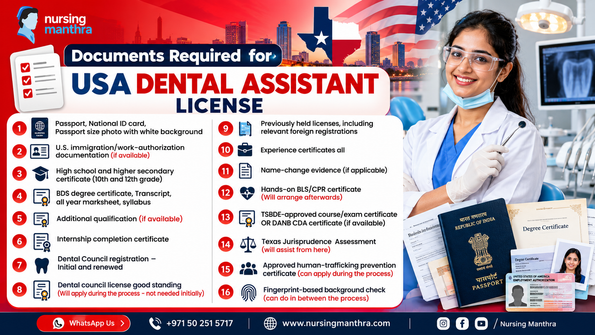
| Document | Requirement or purpose |
|---|---|
| Valid identification | Mandatory; must satisfy current TSBDE identification requirements |
| U.S. immigration/work-authorization documentation | Required where applicable under Texas rules |
| Passport-size photograph | 2 × 2 inches |
| High school certificate or equivalent | Required educational eligibility evidence |
| Indian Class 10 and Class 12 certificates | Useful supporting education documents |
| BDS degree certificate | Important for DANB foreign dental graduate pathway |
| MDS degree certificate | Additional qualification, if applicable |
| Dental academic transcripts | Prepare if requested for DANB or other review |
| Internship completion certificate | Supporting professional history, if requested |
| Indian Dental Council registration | Disclose professional registration history |
| Official professional license verification | Required for previously held licenses, including relevant foreign registrations |
| Name-change evidence | If names differ across documents |
| Hands-on BLS/CPR certificate | Mandatory |
| TSBDE-approved course/exam certificate OR DANB CDA certificate | Mandatory, according to selected pathway |
| Texas Jurisprudence Assessment | When applicable |
| Approved human-trafficking prevention certificate | Mandatory |
| Fingerprint-based background check | Mandatory |
| NPDB Self-Query | Mandatory |
| Application fee receipt | Mandatory |
Important for Indian State Dental Council Registration
If the applicant previously held dental registration in India, the Texas Board requires disclosure and appropriate verification of professional license history.
Applicants should be prepared to request an official verification from the relevant State Dental Council.
The verification must contain details such as the registration number, issue date, current status, expiry where applicable, and disciplinary history.
A simple photocopy of the Indian dental registration certificate is not a substitute for an official verification when the Board requires one.
Note: An Indian Dental Council Good Standing Certificate should not automatically be assumed to satisfy the Texas verification requirement. Confirm the required wording, information, and delivery method with TSBDE.
Important Documentation Precaution
Texas specifies particular submission methods for license verifications and NPDB reports. Applicants should not open sealed documents that the Board requires to remain sealed.
The NPDB report also has a limited acceptance period. Avoid ordering it too early.
8. Texas Dental Assistant and DANB CDA Examination Fees — 2026
The cost depends primarily on whether the applicant uses a Texas-approved course or the national DANB CDA examination.
Pathway 1 — Texas-Approved Course and Examination
| Fee component | Amount |
|---|---|
| TSBDE-approved dental assistant course and examination | Varies by provider |
| Texas Board initial application/registration | Current Board fee schedule |
| Hands-on BLS/CPR training | Varies by training provider |
| Human-trafficking prevention training | Free and paid approved options may be available |
| Jurisprudence Assessment, if required | Confirm current Board charge |
| Fingerprinting/background check | Varies |
| NPDB certified digital Self-Query | USD 3 |
| NPDB mailed paper copy, if required | Additional USD 13 |
| Indian Dental Council official verification | Depends on issuing council |
| Document translation, postage and related expenses | If applicable |
Cost planning: Obtain the current course price directly from a TSBDE-approved provider. Do not assume every dental assisting program advertised in Texas qualifies for the Board’s X-Ray Certification route.
Pathway 2 — DANB CDA Examination
| Fee component | Amount |
|---|---|
| DANB combined CDA examination | USD 450 |
| Hands-on CPR/BLS/ACLS | Provider-dependent |
| Texas Jurisprudence Assessment | Verify current fee |
| Texas Board initial registration | Current TSBDE fee schedule |
| Fingerprinting/background check | Varies |
| NPDB certified digital Self-Query | USD 3 |
| NPDB mailed paper copy, if required | Additional USD 13 |
| Professional license verification | Issuing authority’s fee, if any |
| Optional examination preparation materials | Provider-dependent |
| Additional document/shipping expenses | If applicable |
Known national examination cost: USD 450 for the combined DANB CDA examination.
Important: The USD 450 is the examination fee, not an all-inclusive Texas registration package.
The Texas Board may update fees at the beginning of each fiscal year, which starts on September 1. Verify the amount payable through the official fee schedule and application portal.
Official Texas fee schedule: https://tsbde.texas.gov/licensing/fee-schedule/
Official DANB CDA fees and application: https://www.danb.org/exams/exam/cda-exam
Official NPDB Self-Query: https://www.npdb.hrsa.gov/
9. Detailed Texas RDA Application Process
Step 1 — Create an Online Licensing Account
Visit the official Texas State Board of Dental Examiners website.
Open the Dental Assistant X-Ray Certification application section and proceed to the licensing portal.
Use your personal email address and create an account.
Step 2 — Select the Correct Application
Choose:
Texas State Board of Dental Examiners → Initial Dental Assistant by Exam
Do not choose the dentist licensure application unless the applicant is separately pursuing dentist licensure.
Step 3 — Enter Personal and Professional Details
Complete the information requested, including:
- Legal name and date of birth.
- Contact and address information.
- Required identification details.
- Educational background.
- Previous professional registrations and licenses.
- Examination or course details.
- Disclosure and background questions.
Ensure that the applicant’s legal name is consistent across documents.
Step 4 — Select the Appropriate Qualification Route
Submit evidence of either:
Option A: Successful completion of a TSBDE-approved dental assistant course and examination.
Option B: Current DANB CDA certification with the required Texas Jurisprudence Assessment.
Step 5 — Upload the Supporting Documents
Provide all documents requested in the application.
Certain documents, including professional license verification and NPDB records, may require special submission arrangements.
Step 6 — Pay the Texas Board Fee
Submit payment using the approved online payment method.
Retain the receipt and application reference.
Step 7 — Complete Fingerprinting
Follow the fingerprinting instructions issued after application submission.
Applicants living outside the United States should confirm their applicable fingerprint submission procedure directly with TSBDE before making arrangements.
Step 8 — Submit Outstanding Documents
Ensure that documents requiring separate submission are delivered correctly.
Check the application portal and email regularly for deficiency notices.
Step 9 — Application Review
TSBDE reviews eligibility, training, examination evidence, identity, professional background, and supporting documents.
Step 10 — Registration Approval
After approval, follow the Board’s instructions for registration issuance, verification, and any required activation or subsequent renewal.
Do not perform activities requiring Texas registration before the Board has authorized them.
10. How Long Does Texas Dental Assistant Registration Take?
The Texas Board indicates an approximate processing period of 3–4 weeks for a complete application.
This does not include the time required to:
- Complete the selected course or examination.
- Obtain BLS certification.
- Arrange Indian Dental Council verification.
- Obtain fingerprints.
- Complete other required training.
- Resolve documentation deficiencies.
For Indian applicants, the total timeline depends heavily on examination preparation, training availability, U.S. documentation, and professional verification.
Candidates should not treat the Board’s estimated processing time as a guaranteed overall completion date.
11. Can an Indian Dentist Apply from India?
Indian BDS graduates can investigate DANB Pathway III eligibility and prepare their supporting education documents from India.
However, there is an important distinction between:
Qualifying for an examination, receiving Texas registration, and obtaining authorization to work in the United States.
These are separate processes.
Texas’s 2026 rules require qualifying documentation of citizenship, permanent residency, or federal work authorization for registration or certification.
An Indian passport alone does not satisfy the Board’s published foreign-passport identification alternative without the accompanying qualifying U.S. documentation.
Candidates residing in India should therefore verify their individual circumstances with TSBDE and DANB before making examination or course payments.
Passing DANB CDA does not provide a U.S. work visa or guarantee Texas RDA approval.
12. Is INBDE Required for Indian Dentists Applying as Dental Assistants?
No.
The Integrated National Board Dental Examination (INBDE) is not part of the standard Texas dental assistant registration or DANB CDA Pathway III examination requirements.
INBDE is relevant to U.S. dentist licensure pathways.
An internationally educated dentist who wants to become a licensed dentist in Texas must separately satisfy the state’s requirements for foreign-educated dentist licensure.
The dental assistant pathway cannot be used as a substitute for dentist licensure.
13. Can Indian Dentists Work as Dental Assistants Without Texas RDA Registration?
Texas permits certain basic dental assisting activities that do not require a radiology certificate.
However, the precise duties a dental assistant may perform are regulated, and the person must work within the applicable legal and supervision requirements.
For dental X-ray positioning or exposure, Texas requires the applicable Board-issued radiology certification, subject to any legally recognized exceptions.
Regardless of the assistant’s registration status, an internationally educated dentist must also have appropriate U.S. work authorization.
A foreign BDS degree does not authorize the individual to perform procedures reserved for licensed U.S. dentists.
14. Does DANB CDA Certification Allow Practice in Other U.S. States?
DANB CDA is a national professional certification, but the legal requirements for dental assistants differ between U.S. states.
Some states recognize particular DANB credentials as part of their registration or expanded-function eligibility pathways.
Others require additional state examinations, education, registration, or radiology certification.
Therefore, a person certified by DANB should verify the exact requirements of the state where they intend to work.
Texas registration does not automatically authorize dental assisting duties in every other state.
15. Texas Registered Dental Assistant Renewal
Texas dental assistant registration generally follows a two-year renewal cycle.
Registered Dental Assistants must comply with the Board’s continuing education and renewal requirements.
The current TSBDE guidance indicates 12 continuing education hours per two-year renewal period, with at least six hours covering clinical dental assistant duties.
Additional renewal requirements include maintaining appropriate BLS certification and completing approved human-trafficking prevention training as applicable.
Candidates should regularly monitor the Texas Board website for amendments to renewal rules.
16. Frequently Asked Questions
Q1. Can a BDS graduate from India apply for the DANB CDA examination?
Yes. DANB Pathway III explicitly recognizes graduates of dental degree programs outside the United States and Canada, subject to the remaining eligibility requirements.
Q2. Is an MDS degree mandatory?
No. MDS is not listed as a mandatory qualification for DANB CDA Pathway III.
Q3. Is Indian clinical experience mandatory?
DANB Pathway III does not require the 3,500 hours of dental assisting experience associated with Pathway II.
Q4. Can a fresh BDS graduate apply?
A graduate may qualify educationally for DANB Pathway III if the degree and other requirements are accepted. Texas registration requires additional conditions, including qualifying legal-status documentation.
Q5. Is an Indian Dental Council license mandatory for DANB CDA?
DANB’s published Pathway III educational criteria focus on qualifying dental education and accepted CPR/BLS/ACLS. A current Indian dental license is not separately listed as a universal Pathway III condition.
However, previously held professional licenses must be disclosed and verified where required by the Texas Board.
Q6. Can a dentist with an expired Indian registration apply?
Potentially, yes. An expired Indian registration does not automatically eliminate eligibility based on graduation from a qualifying dental degree program. However, Texas requires appropriate disclosure and verification of previous professional licenses.
Q7. Is IELTS, OET or TOEFL mandatory?
These examinations are not listed as general mandatory requirements for Texas Dental Assistant X-Ray Certification or DANB CDA Pathway III. Individual training providers or employers may have separate language requirements.
Q8. Is the DANB CDA examination conducted through Prometric?
Candidates should follow DANB’s current scheduling instructions and authorized examination delivery arrangements. Do not assume that the examination is booked through Prometric without checking the official DANB authorization.
Q9. Can the DANB examination be completed from India?
Candidates must confirm the currently available approved testing locations and delivery arrangements with DANB. Educational eligibility does not guarantee examination availability in every country.
Q10. Is the Texas dental assistant examination the same as INBDE?
No. Dental assisting certification and dentist licensure are separate pathways with different examinations and legal scopes of practice.
Q11. Does passing DANB CDA guarantee a Texas RDA certificate?
No. Texas requires a separate application, jurisprudence assessment, and other eligibility documents.
Q12. Can a BDS graduate directly obtain a Texas dentist license after working as a dental assistant?
No. Dental assisting experience and registration do not replace the education, examination, and licensure requirements applicable to foreign-educated dentists.
Q13. Can I obtain Texas registration while holding only an Indian passport?
The Board’s acceptable identification and legal-status rules must be satisfied. An Indian passport alone does not establish U.S. work authorization.
Q14. Is a full dental assisting diploma mandatory for every Indian BDS graduate?
No. The DANB CDA Pathway III route expressly recognizes qualifying foreign dental degrees, and the Texas-approved course route may also be available without a full dental assisting diploma.
Q15. Can I perform dental X-rays before receiving Texas radiology certification?
Not independently under the ordinary certified dental assistant pathway. Texas regulates dental X-ray positioning and exposure and requires the applicable authorization.
17. How Nursing Manthra Can Assist
Nursing Manthra provides licensing and document-clearance guidance for internationally educated healthcare professionals.
For Indian and other foreign-trained dentists planning to pursue a Texas dental assistant pathway, document-assessment support may include:
- Reviewing available academic and professional documentation.
- Explaining the differences between Texas-approved training and DANB CDA eligibility.
- Identifying relevant application requirements.
- Guiding candidates on the required documentation and verification process.
- Assisting candidates in understanding application steps and authority communications.
Nursing Manthra is not a U.S. recruitment or immigration agency. Examination eligibility, certification, registration, employment authorization, and final approval are determined by the respective official authorities.
Contact Nursing Manthra
WhatsApp: https://wa.me/971502515717
UAE: +971 502 515 717
India: +91 6828756689
Website: https://nursingmanthra.com/
Candidates may share their educational and professional documents for an initial review.
Conclusion
Internationally educated dentists, particularly Indian BDS and MDS graduates, have viable pathways to pursue dental assisting qualifications in Texas.
The two main routes are the Texas Board-approved course and examination pathway and the DANB CDA examination through Pathway III.
DANB Pathway III is particularly significant because it recognizes graduation from dental degree programs outside the United States and Canada without requiring the 3,500 hours of dental assisting experience specified under Pathway II.
However, candidates must not confuse eligibility for an examination with the legal requirements for Texas registration or U.S. employment authorization.
Before beginning the process, verify your educational eligibility, identification, work-authorization documentation, examination arrangements, professional license verification requirements, and updated fees.
With appropriate preparation and a clear understanding of the requirements, internationally educated dentists can choose a suitable dental assisting pathway for their professional goals in Texas.
About the Author
Shincy George, RN, MSN (Cardiothoracic Nursing), SCFHS-RN, DHA RN, MOH UAE RN, NCLEX-RN (USA), is the Founder of Nursing Manthra Academy.
With extensive international clinical and academic experience, she is dedicated to guiding healthcare professionals through global licensing pathways. Through Nursing Manthra, she supports internationally educated healthcare professionals in achieving their career goals across Canada, USA, UAE, Middle East, UK, Ireland, Australia, New Zealand, and other countries.
Her mission is to simplify complex licensing processes and empower healthcare professionals with the right knowledge, guidance, and support to succeed globally.