Updated: August 2026
Are you a Registered Nurse holding a New York State RN license through NYSED and planning to move your nursing registration to Alberta, Canada?
The good news is that nurses who have already passed the NCLEX-RN and hold active nursing registration in New York may have a relatively straightforward pathway toward becoming a Registered Nurse in Alberta.
However, there is an important terminology difference to understand.
The nursing regulator in Alberta is the College of Registered Nurses of Alberta (CRNA). It is sometimes incorrectly referred to as “CRNE Alberta.” CRNE was the former Canadian nursing examination; the current registration examination for RNs in Alberta is the NCLEX-RN.
For nurses registered only in New York or another U.S. state and who have never been registered as an RN in Canada, the process is generally completed through the CRNA Substantial Equivalence pathway for internationally educated/internationally registered nurses, rather than the Canadian Equivalent Jurisdiction transfer pathway. CRNA’s list of equivalent jurisdictions currently contains the Canadian provinces and territories, not U.S. states.
This detailed Nursing Manthra guide explains the documents, eligibility requirements, fees, NYSED verification, NCLEX requirements, English requirement, work experience requirement and complete step-by-step process.
Quick Overview: New York RN to Alberta CRNA
For a typical applicant who:
- holds an active New York RN registration through NYSED,
- has already passed the NCLEX-RN,
- completed nursing education outside Canada,
- has never previously held Canadian RN registration,
the pathway will normally be:
New York NYSED RN → CRNA Substantial Equivalence Application → Alberta RN Practice Permit
This is not exactly the same as a U.S. “license by endorsement” application.
CRNA independently assesses whether the applicant meets Alberta’s registration requirements.
Can a New York RN License Be Transferred to Alberta?
Yes, a New York-licensed Registered Nurse can apply for RN registration in Alberta.
However, the New York license itself is not simply converted into an Alberta license.
The nurse must create an application with the College of Registered Nurses of Alberta and demonstrate that the required registration conditions have been satisfied.
One particularly important advantage for New York RNs is the NCLEX-RN.
CRNA states that applicants who have already passed the NCLEX-RN and have current registration in another jurisdiction generally do not need to undergo another competency assessment. CRNA also confirms that NNAS does not automatically have to be completed before starting a substantial equivalence application.
Therefore, nurses who obtained their New York RN license after passing the NCLEX-RN may have a considerably easier pathway than an applicant who has never taken the NCLEX.
Do I Need to Take the NCLEX-RN Again?
Normally, no.
If you have already passed the NCLEX-RN for your New York RN license, you do not have to repeat the examination simply because you are applying to Alberta.
CRNA accepts previous NCLEX-RN results, including results dating back many years. Its current guidance states that NCLEX-RN results beginning from 1982 are accepted.
For substantial equivalence applicants, CRNA may accept:
- the NCSBN Candidate Report showing successful completion of the NCLEX-RN; or
- qualifying verification of registration from the United States.
CRNA’s April 2026 Substantial Equivalence worksheet specifically lists these forms of evidence for the registration-exam requirement.
Important
A normal Nursys e-Notify report is not accepted as evidence of having passed the NCLEX-RN. If CRNA asks specifically for NCLEX evidence, follow the instructions inside your College Connect application.
Do I Need NNAS for New York RN to Alberta Transfer?
NNAS is not automatically mandatory.
This is one of the most important updates for internationally educated nurses applying to Alberta.
CRNA specifically states that applicants do not necessarily have to apply to the National Nursing Assessment Service before applying to CRNA if they qualify through another Substantial Equivalence pathway.
For an RN who already:
- passed the NCLEX-RN, and
- holds current nursing registration,
CRNA may allow the applicant to proceed directly through substantial equivalence without another nursing competency assessment.
What about education verification?
Education remains a registration requirement.
CRNA’s current materials allow education to be evaluated using accepted evidence such as an Education Credential Assessment (ECA) or an appropriate NNAS advisory report. Accepted ECA organizations include:
- International Qualifications Assessment Service — IQAS
- World Education Services — WES
- International Credential Assessment Service of Canada — ICAS
- International Credential Evaluation Service — ICES
- Comparative Education Service — University of Toronto — CES
CRNA also states that an existing qualifying ECA obtained for Canadian immigration purposes may be reused. The age of an accepted education-verification report does not by itself affect eligibility.
Important 2026 note
CRNA’s current FAQ indicates that NCLEX-RN plus current registration can qualify an applicant through a streamlined substantial-equivalence route, while its detailed permit worksheet still shows ECA/NNAS as accepted post-secondary education evidence.
Therefore, do not unnecessarily pay for a new NNAS or ECA before checking what your individual College Connect application requests.
If you already have a WES, IQAS, ICAS, ICES, CES or NNAS report, keep it ready.
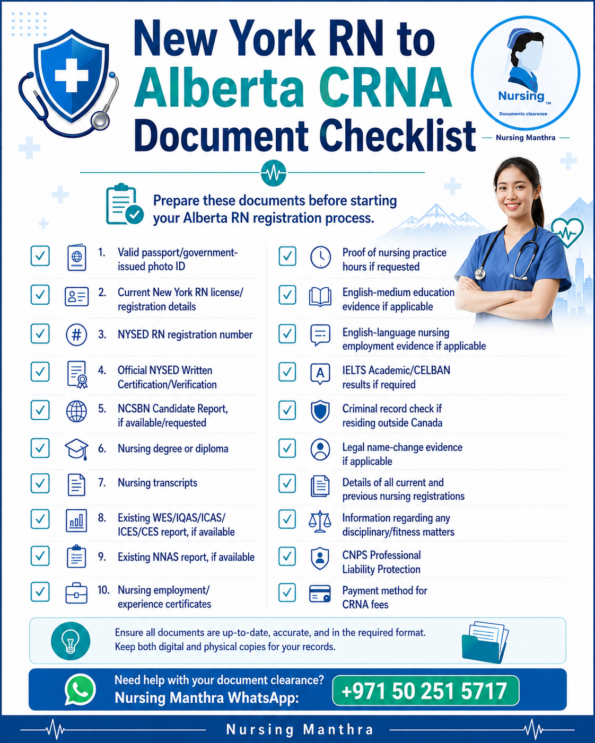
Documents Required for New York NYSED RN to Alberta CRNA
Depending on the individual applicant, CRNA may request some or all of the following.
1. Government-Issued Identification
You will need valid government-issued photo identification for identity verification.
Examples may include:
- Passport
- Canadian government ID, if applicable
- Other acceptable government-issued photo identification
CRNA uses an online identity-validation process. If online verification is unsuccessful, manual identity verification may be arranged.
2. New York RN Registration Details
Keep your New York registration information ready, including:
- Full legal name
- NYSED RN license number
- Registration details
- Current registration status
- Date of birth
- Any previous names used
- Any disciplinary or registration conditions, if applicable
A very important distinction exists in New York.
The New York professional license is generally valid for the lifetime of the holder unless revoked, annulled or suspended, but nurses must periodically maintain their registration to actively practise in New York.
For the Alberta process, having current registration in good standing is particularly useful.
3. Official NYSED Verification of Licensure
CRNA requires registration verification to come directly from the nursing regulatory authority when it is requested.
CRNA explains that the verification should confirm:
- legal name,
- date of birth,
- registration/licence identifier,
- registration status, and
- whether there are current conditions or restrictions.
Verification documentation must be sent directly from the regulatory body to CRNA.
How to obtain verification from New York
NYSED offers a Written Certification or Verification of Licensure service.
The current NYSED fee is:
USD $20
The certification can be requested by the licensee and can be sent directly to another licensing authority or jurisdiction.
Importantly, NYSED’s certification can include the applicant’s basis of licensure, examination information, NCLEX pass date and examination information.
This can be particularly helpful when transferring from NYSED to Alberta.
Does NYSED complete the CRNA verification form?
NYSED states that it generally does not complete another jurisdiction’s individual verification form. Instead, NYSED sends its standardized certification letter.
Therefore, if College Connect requests CRNA registration verification, follow the CRNA and NYSED instructions carefully and arrange for NYSED’s official certification to be sent directly to CRNA.
NYSED currently advises applicants to allow at least several weeks for written certification processing before requesting a status update.
4. NCLEX-RN Evidence
If requested, keep your:
- NCSBN Candidate Report, or
- qualifying official verification showing the NCLEX-RN basis of your U.S. registration.
CRNA allows the NCSBN Candidate Report to be submitted by the applicant when specifically requested. Most other official documents must be sent directly by the issuing authority.
5. Nursing Education Documents
Keep the following documents available:
- Nursing degree or diploma certificate
- Final nursing transcript
- Academic records
- Nursing program completion information
- Existing WES/IQAS/ICAS/ICES/CES report, if available
- Existing NNAS Advisory Report, if available
Do not send documents randomly before CRNA requests them.
CRNA instructs applicants to wait until the College Connect application identifies which evidence is required and how it should be submitted.
6. Nursing Experience / Currency of Practice
Having a nursing license alone does not automatically prove recent nursing practice.
CRNA has specific currency-of-practice requirements.
An RN may meet the requirement by having completed at least:
450 hours of nursing practice during the previous 2 practice years
OR
1,125 hours of nursing practice during the previous 5 practice years.
Other pathways can also satisfy currency, including certain recent nursing education, bridging, refresher or competence-assessment pathways.
If CRNA asks for proof, documents may include:
- Employer verification
- Experience certificate
- Number of RN practice hours
- Position/title
- Job description
- Supervisor or manager confirmation
- Official nursing transcript, where applicable
Only qualifying nursing practice completed while appropriately authorized to practise will normally count.
Important
Passing the NCLEX-RN does not itself satisfy the currency-of-practice requirement.
7. English Language Proficiency
Holding a New York RN license does not automatically mean every applicant will need IELTS.
CRNA offers multiple ways of satisfying English-language proficiency.
An applicant can meet the requirement through one of several pathways.
English-medium nursing education
You may qualify if you completed at least two years of full-time nursing education outside Canada, with theory and clinical education provided in English, within the previous five years.
Nursing practice in English
You may also qualify if, during the previous five years, you completed at least:
250 hours of nursing practice in a jurisdiction where healthcare services are provided in English.
Therefore, an applicant who has actually worked as an RN in New York or another qualifying English-speaking jurisdiction may be able to use nursing practice to satisfy the language requirement.
IELTS Academic
If IELTS is required, CRNA currently requires:
- Listening: 7.0
- Writing: 6.5
- Reading: 6.5
- Speaking: 7.0
- Overall: 7.0
CELBAN
Current minimum CELBAN scores are:
- Listening: 9
- Writing: 7
- Reading: 8
- Speaking: 8
IELTS and CELBAN results generally have a two-year validity period.
Important
Passing the NCLEX-RN does not count as evidence of English-language proficiency under CRNA’s current policy.
8. Criminal Record Check
All CRNA applicants must satisfy the good-character requirement.
If you currently live in Canada
The criminal record check is completed online through the CRNA application process using its third-party provider.
The cost is currently included within the application process.
If you live outside Canada
You may need to obtain a criminal record check from the relevant local law-enforcement authority and submit it according to CRNA instructions.
The external criminal-record-check cost is paid by the applicant and varies by country or jurisdiction.
9. Good Character and Fitness to Practice
Applicants must answer declarations relating to:
- Professional conduct
- Previous disciplinary action
- Current investigations
- Restrictions or conditions on registration
- Criminal history
- Fitness to practise
- Ability to provide safe nursing care
If there has been previous discipline, restrictions, criminal charges or other reportable circumstances, the application may require additional review.
It does not necessarily mean automatic refusal, but full and accurate disclosure is essential.
10. Alberta Jurisprudence and Mandatory Education
Before obtaining the Alberta RN permit, applicants must complete CRNA’s required education within College Connect.
This includes modules related to:
- Alberta nursing jurisprudence
- Protecting Patients from Sexual Abuse and Misconduct
The required e-learning modules are completed through College Connect, and their results are transmitted to CRNA.
The cost is included in the CRNA application fee.
11. Professional Liability Protection – CNPS
Before an active Alberta RN practice permit can be issued, applicants must obtain the required professional liability protection through the Canadian Nurses Protective Society (CNPS).
Current direct CNPS Professional Liability Protection and Core Services for an RN are:
CAD $88 + GST
CRNA receives confirmation after the required CNPS registration is completed.
CNPS professional liability protection is mandatory even if your future employer has separate liability coverage.
Step-by-Step Process: New York RN to Alberta CRNA
Step 1 – Confirm Your Correct CRNA Pathway
Visit CRNA’s Pathways to a Permit process.
A nurse who:
- was educated outside Canada,
- has never held Canadian RN registration, and
- currently holds New York RN registration,
will normally proceed through Substantial Equivalence.
Step 2 – Create a College Connect Account
College Connect is CRNA’s online applicant portal.
You will:
- validate your identity,
- create your applicant profile,
- provide demographic details,
- obtain your CRNA applicant/registration number, and
- pay the applicable account-creation fee.
Your CRNA number should be used when sending documents relating to your application.
Step 3 – Enter Your New York Registration Information
Provide complete NYSED registration information exactly as requested.
Make sure your:
- name,
- date of birth,
- nursing licence details, and
- registration information
match your official documents.
Any name differences should be supported with appropriate legal evidence where required.
Step 4 – Arrange NYSED Verification
Request the official NYSED Written Certification of Licensure and arrange for it to be sent according to CRNA’s requirements.
Current NYSED certification fee:
USD $20
Do this early because verification from an external regulator can become one of the longest parts of the process.
Step 5 – Provide NCLEX-RN Evidence
If requested by College Connect, provide the appropriate NCLEX evidence.
If you already passed NCLEX for New York, you normally do not repeat NCLEX-RN.
Step 6 – Complete Education Verification if Required
Follow the exact requirement appearing in College Connect.
You may be able to use:
- an existing accepted Canadian ECA,
- a new accepted ECA,
- an appropriate NNAS Advisory Report, or
- another evidence route specifically authorized by CRNA.
Do not start an expensive NNAS process merely because you have heard that all internationally educated nurses need NNAS. CRNA’s current process provides alternative substantial-equivalence routes.
Step 7 – Demonstrate Currency of Practice
Complete the required declaration concerning your nursing practice hours.
Keep employer evidence available if CRNA requests verification.
Step 8 – Meet English-Language Requirements
Determine whether you qualify through:
- recent nursing education in English,
- at least 250 hours of recent nursing practice in an English healthcare environment,
- IELTS Academic, or
- CELBAN.
If you already have qualifying New York RN work experience, an additional English examination may not necessarily be required.
Step 9 – Complete Criminal Record and Eligibility Requirements
Complete:
- good-character declaration,
- fitness-to-practise declaration,
- criminal-record-check requirement, and
- any additional information requested by CRNA.
Step 10 – Complete Alberta Mandatory Courses
Finish the assigned:
- Jurisprudence module, and
- Protecting Patients from Sexual Abuse and Misconduct education.
Step 11 – Purchase CNPS Professional Liability Protection
Complete your CNPS registration for Alberta and obtain the appropriate RN protection.
Step 12 – Pay the Alberta Practice Permit Fee
Once the other requirements are completed, pay the applicable CRNA permit fee and complete your final declarations.
After approval, your Alberta RN practice permit will allow you to practise as a Registered Nurse in Alberta, subject to immigration and employment authorization requirements.
CRNA Fees for 2026–2027
CRNA’s 2026–2027 practice year runs from:
October 1, 2026 to September 30, 2027
Current published fees, including GST, are:
| Expense | Approximate Cost |
|---|---|
| CRNA first-time account creation | CAD $183.75 |
| Full-year Alberta RN practice permit | CAD $483.00 |
| CNPS Professional Liability Protection | CAD $88 + GST |
| NYSED Written Certification | USD $20 |
| Alberta mandatory CRNA courses | Included |
| Canadian criminal record check through application | Included where applicable |
| ECA / credential evaluation | Depends on provider |
| NNAS, if used/required | Depends on NNAS services required |
| IELTS/CELBAN, if required | Depends on test provider/location |
| Criminal record check outside Canada | Variable |
CRNA’s 2026–2027 account creation fee is CAD $183.75, and a full-year active RN permit is CAD $483, both including GST.
The direct CNPS rate of CAD $88 plus GST brings the basic Canadian regulatory cost to approximately:
CAD $759.15
plus the USD $20 NYSED certification fee, before any optional or case-specific costs such as an ECA, NNAS, IELTS/CELBAN, overseas criminal record check, document courier charges or bank conversion fees.
Applications before September 30, 2026
Applicants starting during the remainder of the 2025–2026 practice year should note that a different fee schedule remains applicable.
The currently published 2025–2026 account-creation fee is CAD $236.25. Permits activated late in the practice year are prorated, for example:
- August 2026 effective permit: CAD $151.20
- September 2026 effective permit: CAD $100.80
A new practice year begins October 1, so applicants should carefully select their intended permit effective date within College Connect.
CRNA allows applicants to select a permit effective date within the following 90 days when starting an application.
How Long Does New York to Alberta RN Registration Take?
There is no single guaranteed timeline because much of the processing time depends on how quickly external documents arrive.
CRNA’s current guidance states that once all permit requirements have been completed and received, an application decision can take up to approximately four weeks.
However, the complete process may take longer when waiting for:
- NYSED verification
- ECA or NNAS
- University transcripts
- Employer verification
- English-language results
- Criminal record check
- Additional registrar review
For this reason, nurses should prepare their external verification documents as early as possible.
Do I Need a Canadian Job Offer Before Applying to CRNA?
No.
You do not need to already have:
- a Canadian employer,
- an Alberta nursing job,
- permanent residence, or
- a Canadian work visa
just to submit an application to CRNA.
However, obtaining an Alberta nursing permit does not by itself provide Canadian immigration or employment authorization.
You must have legal authorization to work in Canada before beginning employment.
Can a Nurse Apply While Living Outside Canada?
Yes.
You do not have to be physically present in Alberta or Canada to begin the CRNA application.
Most of the application is completed through College Connect.
Applicants residing outside Canada should pay particular attention to the criminal-record-check requirement because the process differs from that used for applicants already residing in Canada.
Is New York Work Experience Mandatory?
Not necessarily specifically New York experience.
What matters is satisfying CRNA’s currency-of-practice requirement.
Qualifying RN practice hours may have been obtained in another jurisdiction, provided the practice meets CRNA’s criteria.
For example, an internationally educated nurse may have:
- nursing education in India,
- RN experience in India or the Middle East,
- NCLEX-RN passed through New York,
- an active NYSED RN registration,
and may still be able to use eligible nursing practice hours from another jurisdiction toward CRNA currency requirements.
The documents and hours must satisfy CRNA’s criteria.
Important Difference: Having a New York License vs Working in New York
This distinction is especially important for internationally educated nurses.
Some candidates obtain a New York RN license after passing the NCLEX-RN but never actually work in the United States.
The New York RN registration may still be valuable for:
- proving current professional registration,
- demonstrating NCLEX-RN completion, and
- supporting the substantial-equivalence application.
However, it does not automatically establish:
- recent nursing practice hours, or
- English-language nursing practice.
These requirements must be assessed separately.
Common Mistakes to Avoid
1. Applying under the Canadian transfer pathway
New York is not one of CRNA’s Canadian equivalent jurisdictions.
A nurse registered only in New York normally needs the Substantial Equivalence pathway.
2. Calling the regulator “CRNE Alberta”
The regulator is CRNA — College of Registered Nurses of Alberta.
3. Rebooking NCLEX unnecessarily
If you have already passed NCLEX-RN, you normally do not repeat it.
4. Starting NNAS unnecessarily
NNAS is not automatically mandatory for every CRNA international applicant.
Check the pathway generated by College Connect first.
5. Assuming a New York license automatically waives IELTS
English proficiency is a separate registration requirement.
Actual recent nursing practice in an English-speaking healthcare environment may meet it, but merely holding the license does not necessarily do so.
6. Ignoring currency of practice
Passing NCLEX does not substitute for recent nursing practice requirements.
7. Sending documents yourself when primary-source verification is required
Except where CRNA specifically allows applicant submission, official documents should come directly from the issuing authority.
8. Allowing your current registration to lapse too early
If CRNA is relying on current U.S. registration, maintain the necessary registration status until the Alberta verification/application requirements are satisfied.
New York RN to Alberta CRNA Document Checklist
Frequently Asked Questions
Is NNAS compulsory for a New York RN applying to Alberta?
No, not automatically. CRNA now allows internationally educated nurses to use different Substantial Equivalence pathways depending on their existing credentials.
Do I have to take NCLEX again?
If you already passed the NCLEX-RN for your New York RN registration, normally no.
Is IELTS mandatory?
Not for every applicant. Recent English-medium nursing education or qualifying nursing practice in an English healthcare jurisdiction may satisfy the requirement.
Does having an NYSED license guarantee Alberta registration?
No. CRNA independently determines whether all Alberta registration requirements have been met.
Do I need Canadian experience?
Not necessarily. CRNA’s currency requirements focus on qualifying nursing practice and other recognized pathways, not exclusively Canadian nursing experience.
Can I apply from India, UAE, Saudi Arabia or another country?
Yes. You do not need to currently live in Alberta to apply.
Do I need a Canadian work permit before applying?
No. A work permit is not required merely to apply to CRNA, but appropriate Canadian immigration/work authorization is required before employment.
Can my old Canadian immigration WES report be used?
CRNA states that an accepted education-verification report previously obtained for Canadian immigration may be used if it is from one of CRNA’s accepted providers.
Need Assistance With New York NYSED RN to Alberta CRNA License Transfer?
The process may appear simple, but selecting the wrong application pathway, arranging incorrect NYSED verification, unnecessarily starting NNAS, submitting the wrong education assessment or misunderstanding CRNA’s currency and English requirements can cause delays and additional expense.
Nursing Manthra can assist you with the New York NYSED RN to Alberta CRNA licensing process, including:
- Initial eligibility review
- Document review
- CRNA application guidance
- New York NYSED verification guidance
- NCLEX documentation guidance
- ECA/NNAS pathway clarification
- Education document guidance
- English-language requirement review
- Nursing experience and currency-of-practice review
- Application follow-up and licensing-process assistance
📲 For Nursing License Transfer Assistance
Nursing Manthra WhatsApp: +971 50 251 5717
If you already hold a New York NYSED RN license and are planning to obtain your Alberta RN registration with CRNA, contact Nursing Manthra for step-by-step processing assistance.
Important Disclaimer
Licensing requirements, fees, assessment pathways and regulatory policies may change. The information in this article is based on publicly available CRNA and NYSED requirements reviewed in August 2026.
Every application is assessed individually by the relevant regulatory authority. Nursing Manthra provides application and documentation guidance; final decisions regarding eligibility and registration are made by the College of Registered Nurses of Alberta and other relevant authorities.
Applicants should always follow the requirements displayed in their individual CRNA College Connect application.
👩⚕️ About the Author
Shincy George, RN, MSN (Cardiothoracic Nursing), SCFHS-RN, DHA RN, MOH UAE RN, NCLEX-RN (USA), is the Founder of Nursing Manthra Academy.
With extensive international clinical and academic experience, she is dedicated to guiding healthcare professionals through global licensing pathways.
Through Nursing Manthra, she supports internationally educated healthcare professionals in achieving their career goals across Canada, USA, UAE, Middle East, UK, Ireland, Australia, New Zealand and other countries.
Her mission is to simplify complex licensing processes and empower healthcare professionals with the right knowledge, guidance and support to succeed globally. 🌍