Updated: October 2026:
Planning to work in Dubai as a physiotherapist, laboratory professional, radiographer or another allied healthcare professional? One of your first steps is understanding the DHA licensing process.
The process can feel confusing at the beginning. You may hear different terms—DataFlow, Prometric, Sheryan and eligibility letter—and wonder which one comes first.
This guide explains the application stages, the documents to prepare and the checks to complete before spending money on verification or examination booking.
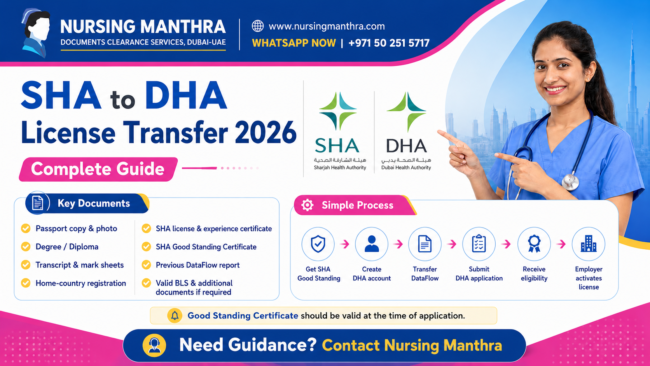
The usual pathway is: eligibility check → document verification and assessment, where required → DHA registration → licence activation by your employer. Clinical practice can begin only after the professional licence is issued.
Who Needs a DHA Allied Healthcare Licence?
Allied healthcare professionals seeking to practise in a DHA-regulated healthcare facility in Dubai must meet the licensing requirements for their approved professional title.
“Paramedical” is a broad term commonly used by applicants. DHA assesses the specific profession and title, so your application must match your qualification and clinical background.
Examples of allied healthcare fields include:
- Physiotherapy and occupational therapy.
- Medical laboratory sciences.
- Radiography and medical imaging.
- Respiratory care.
- Audiology and speech therapy.
- Optometry.
- Dietetics and nutrition.
- Anaesthesia technology.
- Dialysis technology.
- Other recognised clinical and technical disciplines.
The exact title matters. A technician, technologist, therapist and assistant may have different qualification, experience and supervision requirements.
Before applying, ask your intended employer which authority regulates the facility. This guide covers the DHA route.
DHA Eligibility Requirements for Allied Healthcare Professionals
DHA uses the Unified Healthcare Professional Qualification Requirements (PQR) to assess professional eligibility. There is no single qualification or experience rule covering every allied healthcare profession.
1. A recognised qualification
Your qualification must meet the requirements for the title you select. DHA considers the institution, programme recognition, study duration, course content and clinical training.
A course described as “paramedical” by a college does not automatically qualify its graduate for every related DHA title.
2. Relevant clinical experience, where required
Check the experience requirement against your exact professional title.
Where experience is required, the PQR specifies relevant, hands-on clinical work gained during licensed salaried or contractual employment. Teaching or non-clinical work does not generally satisfy that clinical experience requirement.
3. Professional registration, where applicable
Applicants must hold the relevant professional licence or registration from their home country and/or country of last employment, where applicable.
4. Academic transcripts
Your transcript helps DHA assess the subjects studied and determine the appropriate discipline.
The PQR also states that assistant allied healthcare professionals must work under a licensed allied healthcare professional rather than independently.
Can Fresh Graduate Allied Healthcare Professionals Apply?
Some can, depending on their professional title and the applicable requirements.
Do not assume that every allied healthcare applicant needs two years of experience. Equally, do not assume that every fresh graduate qualifies without experience.
In April 2026, MOHAP announced exemptions from six months of post-graduation experience for specified roles, including medical laboratory technicians and technologists, respiratory care technicians and healthcare assistants. The announcement covered eligible UAE and overseas graduates, with other specialisations subject to review.
For a DHA application, confirm how the current requirements apply to your qualification, title and graduation date through Sheryan or a DHA eligibility review.
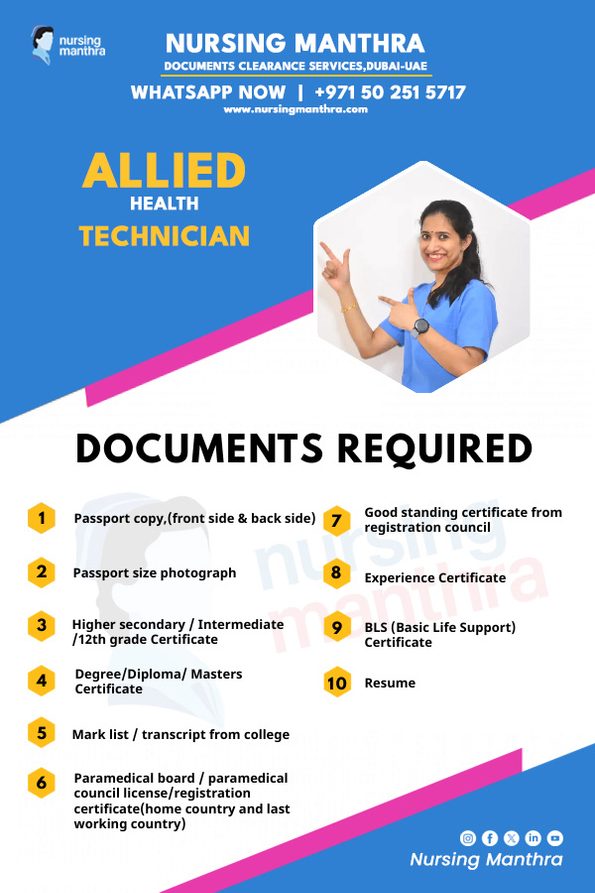
Documents Required for a DHA Allied Healthcare Application
Prepare the following documents, as applicable to your profession and application.
| Document | What to check |
|---|---|
| Valid passport | Name and personal details should match your application |
| Recent passport-size photograph | Use a clear professional photograph |
| Degree or diploma certificate | Submit the qualification relevant to your intended title |
| Academic transcript or mark sheets | Include the complete academic record |
| Internship or clinical training certificate | Prepare it where required for your qualification or title |
| Experience certificates | Include relevant employment periods where experience is required |
| Professional licence or registration | Submit applicable home-country or previous-country registration |
| Good Standing Certificate | Obtain it from the appropriate professional regulator |
| Previous DataFlow report | Keep the report and reference number if already verified |
| Assessment exemption evidence | Submit only if claiming an applicable exemption |
| Supporting documents | Provide name-change evidence, translations or additional records if requested |
DHA’s eligibility review checklist includes identification, qualifications, experience, professional registration and a Good Standing Certificate. Additional documents depend on the professional category.
Good Standing Certificate: What Does It Mean?
A Good Standing Certificate confirms your professional standing with the relevant regulator. It is different from a police clearance certificate.
The PQR generally requires the certificate to be no older than six months at the time of application. Where a country lacks a professional regulatory body, an officially issued employer certificate may be considered under the applicable rules.
What If My Profession Has No Registration Council?
Do not upload an unrelated registration or simply leave the issue unexplained.
DHA’s FAQ describes an official-letter route for applicants permitted to practise without professional registration. The letter must come from the relevant government agency and address permission to practise and professional conduct. Confirm the evidence required for your circumstances.
DHA Allied Healthcare Licence Process: Step by Step
Step 1: Identify Your Correct Professional Title
Start with your qualification and actual clinical work.
For example, a qualification in one laboratory discipline may not support every laboratory title. Similarly, experience operating particular imaging equipment does not by itself establish eligibility for every imaging specialty.
Check the relevant PQR category before choosing a title in your application.
Step 2: Create Your Sheryan Account
Sheryan is DHA’s online system for healthcare professional registration and licensing.
Use your own accessible email address and accurate personal details. Keep your account login and application references available for future updates and renewals.
Official portal: DHA Sheryan
Step 3: Complete the Self-Assessment Tool
Enter your qualification, professional registration and experience details accurately.
The automated result is a preliminary eligibility check. If the result does not reflect your circumstances, you can use Review Registration Eligibility and submit your documents for DHA review. A positive self-assessment result still requires completion of the registration process.
Step 4: Complete DataFlow Verification
DataFlow carries out Primary Source Verification (PSV) by checking submitted credentials with their original issuing organisations.
Depending on your application, verification may cover:
- Educational qualifications.
- Employment certificates.
- Professional licences or registrations.
- Other documents requested for licensing.
If you have a previous report, check the transfer requirements before paying for a new package. Previously verified documents may still need additional verification if the information has changed.
Practical tip: tell your university, former employer or registration authority to expect a verification enquiry. Ensure their contact details are correct.
Step 5: Complete the Required DHA Assessment
Your assessment requirement depends on your professional title.
DHA may require:
- A computer-based assessment.
- An oral assessment.
- Another assessment method applicable to the title.
- Evidence supporting an approved examination exemption.
Where a computer-based assessment is required, DHA directs applicants to Prometric. DHA also states that DataFlow and the CBT assessment can proceed in parallel.
Before booking, check the current instructions for your exact title:
- Examination format.
- Number of questions and duration.
- Passing requirement.
- Content outline and references.
- Identification rules.
- Booking, cancellation and rescheduling conditions.
DHA publishes a CBT assessment guideline; the retrieved official edition was updated in May 2026. Use the latest version available when booking.
Step 6: Submit “Get Registered”
After meeting the prerequisites, complete your Get Registered application in Sheryan.
Link your verification and assessment records, upload any outstanding documents and pay the applicable fee. Respond to DHA’s requests for clarification or additional assessment.
Once approved, you receive DHA professional registration.
Step 7: Receive Your DHA Registration
DHA registration confirms that you meet the requirements for the approved category, title and specialty. It is commonly referred to by applicants as an eligibility letter.
Registration is valid for one year. It must be activated into a professional licence before you practise.
You can use this stage to pursue suitable employment, but registration does not guarantee a job.
Step 8: Your Employer Activates Your Licence
The hiring healthcare facility submits the Activate Professional License application through its Sheryan account.
The process includes:
- Selecting your active professional registration.
- Obtaining your approval in the system.
- Meeting the facility and professional licensing prerequisites.
- Paying the applicable fees.
- Receiving the activated electronic licence.
DHA requires an active facility licence with the relevant service, valid medical malpractice insurance and the applicable employment documentation. Begin clinical practice only once the professional licence is issued and active.
How Much Does a DHA Allied Healthcare Licence Cost?
Budget for separate stages rather than assuming one fee covers everything.
Possible charges include:
- Eligibility review, if needed.
- DataFlow verification or report transfer.
- Examination or oral assessment.
- DHA registration.
- Licence activation.
- Additional verification or document preparation.
The amount varies by profession, verification package, assessment and licence duration. Check the current fee displayed for your selected category before payment.
If you use application assistance, ask for a clear breakdown of authority fees, third-party fees and service charges.
How Long Does the Process Take?
The full timeline depends on document readiness, responses from issuing organisations, assessment availability and DHA review.
DHA lists an average of 10 working days for Review Registration Eligibility and five working days for Get Registered. These are individual service timelines, not the duration of the complete licensing process.
Allow additional time if documents are missing, verification responses are delayed or further assessment is required.
Common Mistakes to Avoid
- Selecting a title that does not match your qualification.
- Applying experience rules from another profession.
- Assuming internship automatically counts as employment experience.
- Uploading incomplete certificates or unreadable scans.
- Leaving name or date differences unexplained.
- Booking the wrong examination.
- Assuming an existing DataFlow report automatically appears in Sheryan.
- Treating an examination pass or eligibility letter as permission to practise.
- Paying for training before confirming whether DHA will accept it for your circumstances.
A careful eligibility check at the beginning can prevent unnecessary applications and expenses.
DHA Exam Preparation for Allied Healthcare Professionals
Prepare for your specific professional examination. A general paramedical question bank may not cover the knowledge expected for your title.
For example, laboratory applicants should focus on their assessed laboratory discipline, while physiotherapy applicants should prepare around relevant assessment, treatment and clinical reasoning topics.
Use the official assessment outline to guide your revision. Practise questions with explanations, review weak areas and include patient safety, ethics and infection prevention where relevant to the examination.
Nursing Manthra Application Support and Study Materials
Need help understanding where to start?
Contact Nursing Manthra to enquire about DHA application guidance, document preparation, DataFlow support and study-material availability for your profession.
WhatsApp: +971 50 251 5717
Study materials: Explore Nursing Manthra Study Materials
When messaging, include:
- Your profession and qualification.
- Country and year of graduation.
- Internship or clinical training details.
- Professional registration status.
- Relevant work experience.
- Previous UAE examination or DataFlow history.
These details help us understand your starting point. DHA makes the final decisions on eligibility, assessment exemptions, professional titles and licensing.
Frequently Asked Questions
Is two years of experience compulsory for every allied healthcare professional?
No. The requirement depends on the exact professional title and applicable rules. Check your category rather than relying on a general statement about all paramedical professionals.
Can diploma holders apply?
Some titles accept specified diplomas, while others require a degree or additional qualifications. The subject, duration and recognition of your course matter.
Can I apply before finding a job?
The professional registration stages can generally be completed before employer-led licence activation. A hiring facility is required for activation under the standard employment route.
Does a positive DataFlow report guarantee approval?
No. Verification confirms the credentials checked. DHA separately assesses whether those credentials meet the requirements for the requested title.
Is the DHA exam the same for all paramedical professions?
No. Assessment requirements and examination content depend on the profession and title.
What if I have a gap in clinical practice?
A gap may trigger additional requirements under the PQR and DHA review. Confirm the accepted pathway before enrolling in a course or arranging clinical training.
Can I start working after passing the examination?
You must complete DHA registration and employer-led licence activation before beginning clinical practice.
Does a DHA licence guarantee employment?
No. Employers make separate recruitment decisions and may require interviews, experience or competency assessments.
Your best starting point is the correct professional title. Once that is clear, you can prepare the right documents and move through the application with greater confidence.
For application guidance and study-material enquiries, contact Nursing Manthra on WhatsApp: +971 50 251 5717.
Contact Nursing Manthra
For licensing guidance, document preparation, DataFlow assistance and examination study materials:
UAE / WhatsApp: +971 502 515 717
India: +91 6828756689
WhatsApp: https://wa.me/971502515717
Study materials: https://nursingmanthra.com/study-materials/
About the Author
Shincy George, RN, MSN (Cardiothoracic Nursing), SCFHS-RN, DHA RN, MOH UAE RN, NCLEX-RN (USA), is the Founder of Nursing Manthra Academy.
With extensive international clinical and academic experience, she is dedicated to guiding healthcare professionals through global licensing pathways. Through Nursing Manthra, she supports internationally educated healthcare professionals in achieving their career goals across Canada, USA, UAE, Middle East, UK, Ireland, Australia, New Zealand, and other countries.
Her mission is to simplify complex licensing processes and empower healthcare professionals with the right knowledge, guidance, and support to succeed globally.