Updated on : 28/10/2026
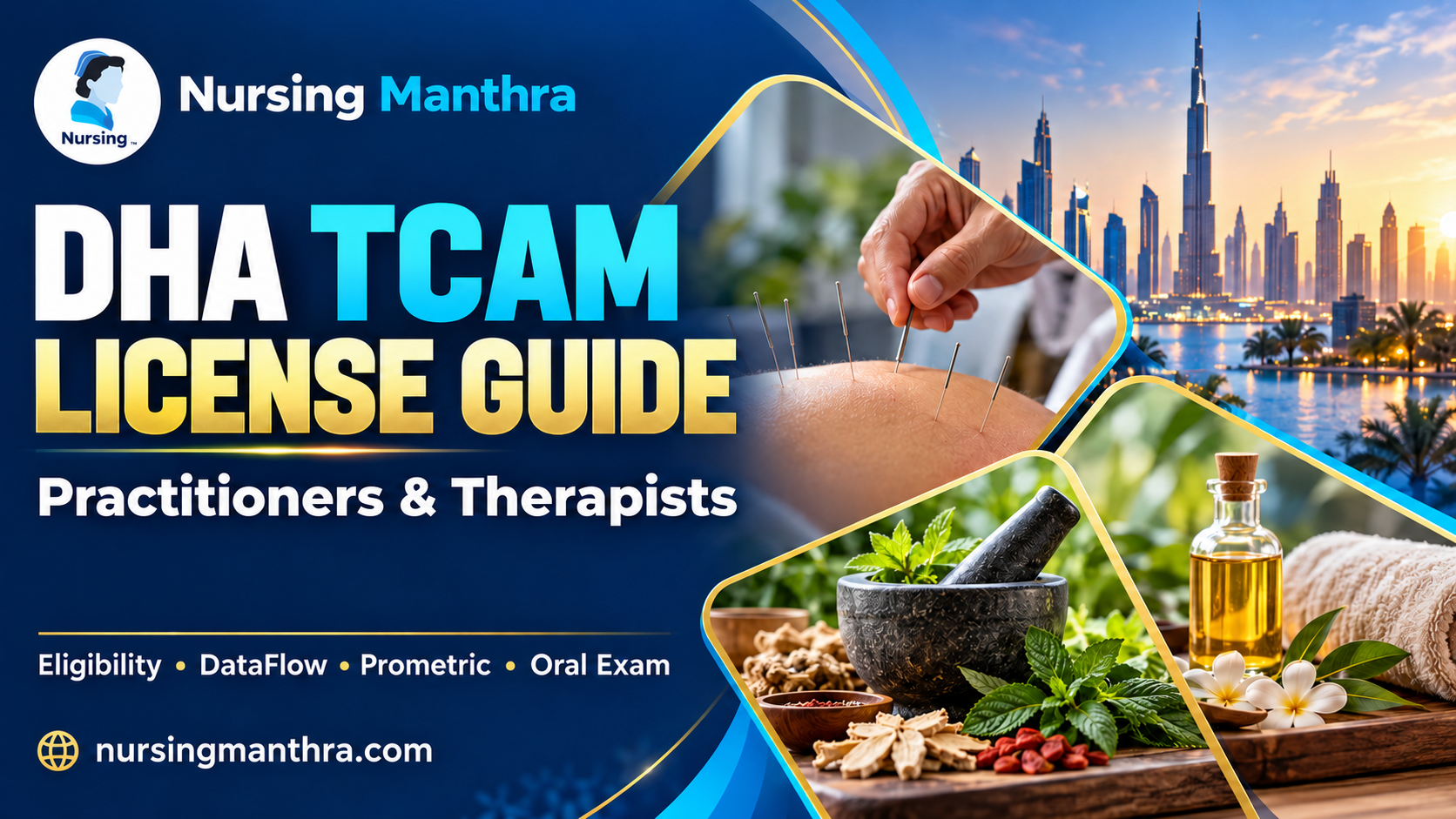
Planning to work in Dubai as an Ayurveda practitioner, homeopath, acupuncturist, Hijama therapist or another complementary medicine professional? Before you book an exam or pay for document verification, identify the DHA title that matches your qualifications.
The DHA TCAM license process involves more than passing an assessment. Your education, clinical training, professional registration and experience must support the title you apply for. After DHA registration is approved, a licensed healthcare facility must activate your professional license before you begin practising.
This guide covers practitioners and therapists, including Ayurveda Massage Therapist, with eligibility, documents, DataFlow, Prometric and oral assessment explained step by step.
What Are TCAM and TCIM?
TCAM is commonly used for Traditional, Complementary and Alternative Medicine. The current PQR and CBT guideline use TCIM: Traditional Complementary and Integrative Medicine. Sheryan pages may still use TCAM or T&CM.
These terms describe the licensing category; they do not mean every practitioner or therapist has the same scope. An Ayurveda practitioner, an Ayurveda massage therapist and a Hijama therapist apply for different titles.
The title approved by DHA determines what you may practise.
Which Professions Does This Guide Cover?
The current TCIM qualification chapter includes:
- Acupuncture Practitioner
- Ayurveda Practitioner
- Ayurveda Massage Therapist
- Chiropractor Practitioner
- Herbal / Oriental Medicine Practitioner
- Homeopathy Practitioner
- Naturopathy Practitioner
- Osteopathy Practitioner
- Traditional Chinese Medicine Practitioner
- Chinese Massage Therapist
- Unani Practitioner
- Hijama Therapist
- Traditional Japanese Medicine Practitioner
- Traditional Korean Medicine Practitioner
Select the title available for your credentials in Sheryan. A course completion certificate alone does not automatically qualify its holder for a healthcare license.
General DHA TCAM Eligibility Requirements
Applicants need a recognized, relevant qualification and the clinical experience required for the specific title. The PQR also addresses:
- Current home-country or last-country professional registration, where applicable.
- Complete academic transcripts showing theory and clinical training hours.
- A valid Basic Life Support certificate.
- Authority-approved extended scope for physicians applying to practise a TCIM discipline.
The scope provisions distinguish dry cupping under Traditional Chinese Medicine from Hijama within Unani practice. Additional training does not automatically authorize a treatment outside an approved title and scope.
Specific experience exemptions exist for eligible UAE graduates, UAE nationals and children of Emirati women. Overseas applicants should not assume those exemptions apply to them. Career gaps and the acceptability of experience also require assessment under the general PQR provisions.
Qualification and Experience Requirements by Profession
The following table summarizes common qualification routes. Minimum durations and training hours matter: a similarly named course is not automatically equivalent.
“Experience” below means the relevant post-qualification experience stated in the current TCIM table. Internship and clinical hours must also satisfy the qualification route.
| Professional title | Main qualification route | Experience |
|---|---|---|
| Acupuncture Practitioner | Five-year full-time acupuncture degree including internship; or an accredited minimum two-year/part-time equivalent route with 2,500 teaching hours or the specified NCCAOM/equivalent certification route | 2 years for the degree route; 3 years for the shorter route |
| Ayurveda Practitioner | BAMS/equivalent, minimum five years including internship, with 4,500 theory/practical hours and 1,000 internship hours; or a recognized 3–4-year programme with 2,500 hours plus 500 supervised internship hours | 2 years for the degree route; 4 years for the shorter route |
| Ayurveda Massage Therapist | At least 500 classroom hours or a one-year Ayurveda massage course | 2 years; supervised practice required |
| Chiropractor Practitioner | Recognized chiropractic qualification, minimum four years full-time and 4,200 contact hours | 2 years |
| Herbal / Oriental Medicine Practitioner | Relevant professional bachelor’s degree, minimum four years including internship | 2 years |
| Homeopathy Practitioner | BHMS/licentiate, minimum five years including internship; or accredited minimum three-year homeopathy programme | 2 years for the longer route; 4 years for the three-year route |
| Naturopathy Practitioner | ND/BNYS/BSc/equivalent, minimum four years including supervised clinical training | 2 years |
| Osteopathy Practitioner | Recognized osteopathy qualification, minimum four years and 1,000 supervised clinical training hours | 2 years |
| Traditional Chinese Medicine Practitioner | Recognized five-year qualification including a one-year internship; or a 3–4-year programme with 2,400 total hours, including 900 clinical practicum hours | 2 years for the degree route; 4 years for the shorter route |
| Chinese Massage Therapist | Relevant three-year TCM college/vocational route plus one-year supervised internship; or a 500-hour Chinese massage course plus one-year supervised internship | 2 years; supervised practice required |
| Unani Practitioner | BUMS/BEMS or the specified equivalent four-year qualification including supervised clinical practicum | 2 years |
| Hijama Therapist | Specific qualification/training routes and existing-license conditions; see the dedicated section below | 2 years |
| Traditional Japanese Medicine Practitioner | Physician route with accredited fellowship training and the relevant national examination | 2 years |
| Traditional Korean Medicine Practitioner | Accredited four-year training, comprising one year general practice and three years specialization, after passing the national examination | 2 years |
The full PQR includes additional physician privilege routes. Always match the complete row and footnotes to your own records.
Physician Extended-Scope Routes
An existing physician license is not, by itself, permission to practise another discipline. The PQR specifies additional training routes, including:
| Discipline | Additional training described in the PQR |
|---|---|
| Acupuncture | Accredited 800-hour or one-year programme |
| Ayurveda | Accredited full-time route with the specified professional examinations, 1,500 theory/practical hours and 500 supervised clinical hours |
| Chiropractic | Minimum 1,800 hours over 2–3 years, including 1,000 supervised clinical hours |
| Herbal / Oriental Medicine | Specified professional examinations, 1,500 theory/practical hours and 500 supervised clinical hours |
| Homeopathy | Minimum one-year programme |
| Naturopathy | Specified two-year route or three-year full/part-time route with at least 1,000 hours, including 400 supervised clinical hours |
| Osteopathy | Minimum one year full-time/part-time equivalent and 1,000 hours including supervised clinical training |
| Traditional Chinese Medicine | 2–3 years/equivalent with 1,300 hours, including 500 supervised clinical practicum hours |
| Unani | Two years/equivalent with 1,500 theory/practical hours followed by 750 supervised training hours |
The current TCIM table lists two years of relevant post-qualification experience for these routes. Older material showing “no experience required” for some physician pathways should not be used without checking the current PQR.
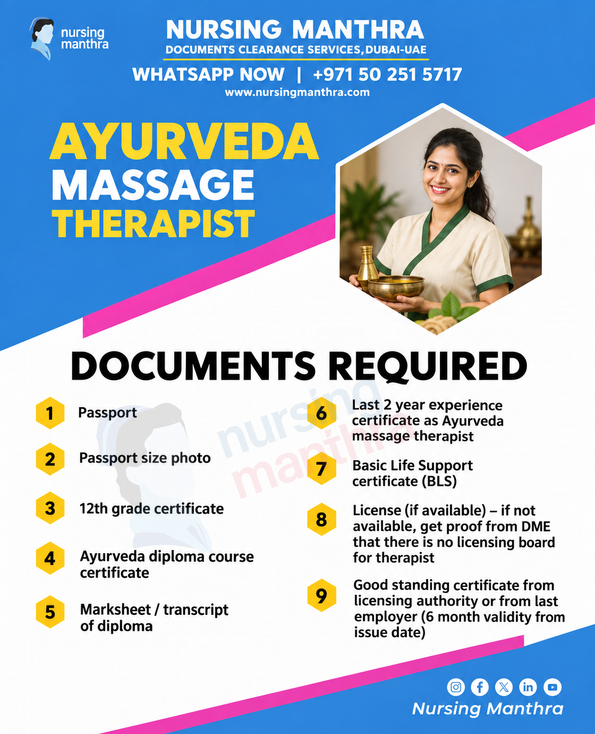
DHA Ayurveda Massage Therapist License
Ayurveda Massage Therapist is a separate professional title. The current requirement is a minimum 500 hours of classes or a one-year Ayurveda massage course, plus two years of related post-qualification experience.
The therapist must work under an Ayurveda Practitioner’s supervision. This title does not grant independent Ayurveda practitioner status.
Before applying, prepare the course certificate, curriculum, training hours, experience and any requested registration evidence. A general spa or wellness certificate should not be assumed to meet this clinical title’s requirements.
Chinese Massage Therapists likewise have a supervision requirement under a Traditional Chinese Medicine Practitioner.
DHA Hijama Therapist: Qualifications, Training and Scope
Hijama requires particular care because older documents circulate with different course-hour requirements.
The current PQR lists three qualification/training routes:
- High-school qualification plus an accredited two-year Hijama programme.
- Healthcare bachelor’s degree plus a one-year Hijama programme.
- A minimum BSc qualification, valid MOHAP/DHA/DOH/SHA professional license, and an Authority-approved Hijama programme with at least 25 CME hours.
The routes include evidence of 20 completed Hijama treatment cases, with specified curriculum content for the longer programmes. The table states two years of related post-qualification experience.
The footnotes matter: Hijama must be practised in a healthcare facility, and the title is added to an existing valid Authority license, except for the stated UAE-national/children-of-Emirati-women provisions. DHA must assess which route and restrictions apply.
What About the Older 50-Hour Hijama Requirement?
Older material may refer to 50 CME hours with practical cases. Do not present that as the universal current DHA minimum. For the existing licensed healthcare professional route, the current table specifies 25 CME hours and 20 cases, alongside the degree, license and other conditions.
A 25-hour or 50-hour certificate alone does not establish eligibility. If your course was completed abroad, have the curriculum, hours, accreditation evidence and case records ready for DHA review.
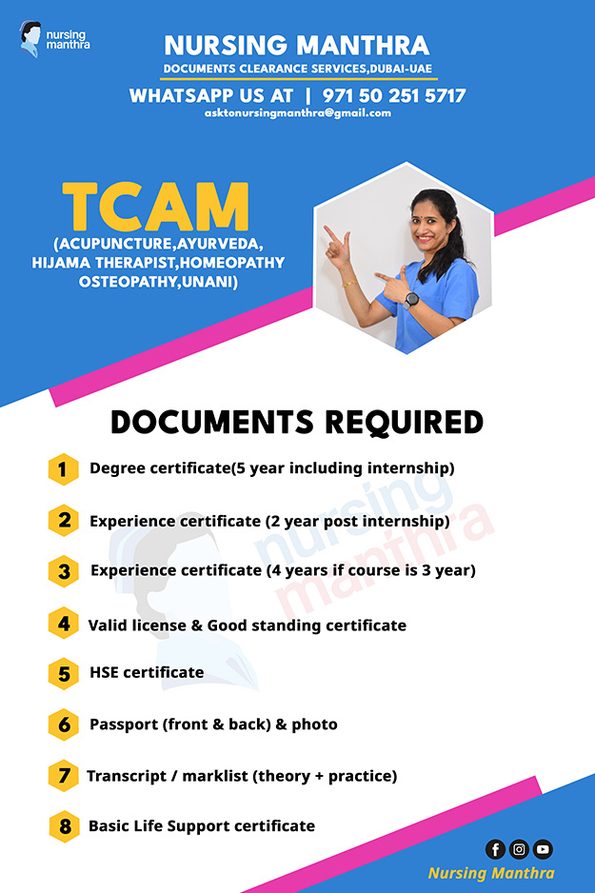
Documents Required for a DHA TCAM Application
Prepare clear, complete scans, with matching names and dates.
| Document | Why it matters |
|---|---|
| Valid passport and recent photograph | Identity and application records |
| Degree, diploma and additional qualifications | Evidence for the professional title |
| Complete academic transcript | Confirms subjects and theory/clinical hours |
| Internship/clinical training certificate | Supports the relevant qualification route |
| Current and relevant previous professional licenses | Evidence of lawful registration, where applicable |
| Experience certificates | Establish relevant practice dates and duties |
| Good Standing Certificate | Must meet the requested regulator and validity requirements |
| Valid BLS certificate | TCIM licensing requirement |
| Updated CV | Supports the professional history and oral assessment where required |
| DataFlow/PSV report | Links verified credentials to the application |
| Name-change evidence | Resolves different names across records |
| Course curriculum and case records | Particularly relevant to additional training and Hijama |
| Previous UAE license and examination records | Needed where relevant to an existing-license or exemption route |
DHA’s licensing manual specifies a Good Standing Certificate issued within six months of application submission. Additional evidence may be requested.
If documents are not in Arabic or English, upload the legally translated version along with the original. Do not arrange unnecessary blanket stamping solely on the assumption that every document needs it; follow DHA’s credentialing requests.
Official Application Websites
| Website | Use |
|---|---|
| DHA Sheryan | Professional account, assessment, registration and facility licensing |
| DHA professional services | Find the current service cards and requirements |
| DHA CBT eligibility ID | Generate the examination eligibility identifier when applicable |
| Prometric | Select DHA and follow the authorized booking route |
| DataFlow | Enter the relevant DHA verification service |
| Nursing Manthra study materials | Find preparation support for your profession |
Use the links within your Sheryan account and official service pages if a portal address changes.
DHA TCAM License Application: Step by Step
Step 1: Create Your Sheryan Account
Register using your own email and accurate passport details. Keep your DHA Unique ID, login and application references.
Check the title before proceeding. Selecting “Ayurveda Practitioner” when your training supports “Ayurveda Massage Therapist” can lead to the wrong assessment route.
Step 2: Complete the Self-Assessment Tool
Enter your qualifications, registration and experience. The automated service is free and provides an initial outcome.
If the result is unsuitable or does not reflect your credentials, use Review Registration Eligibility for DHA’s manual review rather than changing information to force a preferred outcome. The automated result is not a license.
Step 3: Start Primary Source Verification
Apply for the required DHA DataFlow package and upload the credentials requested for verification.
Use full, readable records. Check the spelling of institutions, employment dates and registration numbers against the originals.
Step 4: Complete the Assigned Assessment Route
If a CBT is required, follow the official eligibility and Prometric booking instructions. DHA allows the required CBT and PSV processes to run in parallel.
If your route is oral assessment, the booking option becomes available after DHA’s review of the registration application. Do not assume every TCIM applicant needs both exams.
Step 5: Submit “Get Registered”
Once the required PSV and CBT prerequisites are satisfied, link the records, complete the application, upload the requested documents and pay the fee.
Answer any DHA request for clarification. The credentialing team may ask for further records or reassess the appropriate title.
Step 6: Attend Oral Assessment if Mandated
Use “Schedule Oral Assessment” after the service becomes available. Submit the requested CV, select a date/date range and follow the confirmed instructions.
An oral requirement comes from DHA’s assessment of the position; purchasing an oral preparation package does not determine the examination route.
Step 7: Receive DHA Registration
Once approved and any required assessment is passed, DHA issues registration for the approved position.
This is often called an eligibility letter. The Get Registered service states a one-year registration validity. It still needs activation through a healthcare facility before practice.
Step 8: Activate the Professional License
The hiring facility applies through its Sheryan account. It must have the relevant licensed service, and the professional must give consent.
Complete the facility’s employment and other requirements, including appropriate malpractice cover. Check that the professional license is active before treating patients.
DHA TCAM Prometric Exams: Titles and Format
DHA’s September 2026 CBT guideline lists these five TCIM examinations:
| Title | Exam code | Questions | Listed duration | Pass score | Published fee |
|---|---|---|---|---|---|
| Acupuncture Practitioner | PAC6092 | 100 | 2 hours | 60% | USD 180 |
| Ayurveda Practitioner | PAY5852 | 100 | 2 hours | 60% | USD 180 |
| Hijama Therapist | HIJ5862 | 100 | 2 hours | 60% | USD 180 |
| Homeopathy Practitioner | PHO5832 | 100 | 2 hours | 60% | USD 180 |
| Unani Practitioner | PUN6062 | 100 | 2 hours | 60% | USD 180 |
The listed duration includes the registration/introduction process. The format is multiple-choice. DHA may change an assessment or its specifications; confirm your title and booking conditions in the live system before payment.
How to Book the Prometric Exam
- Complete the relevant DHA title and assessment checks.
- Note your DHA Unique ID.
- Generate the applicable CBT eligibility ID through the official route.
- Follow the DHA booking link to Prometric.
- Select the matching full exam title/code, centre and appointment.
- Pay the displayed fee and retain confirmation.
- Follow the identification and arrival instructions.
Keep passport details consistent across the DHA and examination accounts.
Suggested Preparation Areas
Use the official title-specific CBT coverage first. Then build a revision plan around core knowledge, safe assessment, contraindications, scope, documentation and referral.
For example, acupuncture preparation needs point location and safety; Hijama preparation needs infection control and risk recognition; Ayurveda, Homeopathy and Unani applicants should review their discipline’s clinical reasoning and limitations of practice.
These examples are study-planning guidance, not a replacement for the official blueprint.
DHA TCAM Oral Assessment
DHA’s CBT guideline states that specialties outside its listed CBT examinations are assessed orally, subject to the live assessment decision and applicable exemptions.
This is relevant to applicants exploring routes such as Ayurveda Massage Therapist, chiropractic, herbal/oriental medicine, naturopathy, osteopathy and Traditional Chinese Medicine. Confirm the exact position in Self-Assessment and Sheryan; a missing CBT entry does not establish that no exam is needed.
The oral service requires DHA’s conditional review and the requested CV. DHA decides whether the interview is in person or virtual. Its FAQ describes approximately 20–30 minutes for categories other than physicians/dentists, with results generally available within five working days.
How to Prepare for an Oral Assessment
Practise explaining a clinical case clearly:
- What information would you collect before treatment?
- What findings would make the treatment unsafe?
- Which symptoms need urgent referral?
- What are the limits of your approved professional scope?
- How would you explain consent and document your decision?
- When does a therapist need the supervising practitioner?
For massage therapists, focus on safe treatment boundaries and supervision. For practitioners, include clinical assessment, interactions and escalation. DHA does not publish an official oral question bank; these are suggested preparation themes, not promised exam questions.
Assessment Attempts and Exemptions
DHA’s service guidance normally applies a three-attempt limit across the UAE Authorities for the relevant position. Previous attempts must be declared. Do not treat this as three fresh attempts with every regulator.
The PQR and DHA policies govern exceptions, equivalency and reassessment. Ask DHA about an individual history before another booking. An oral assessment is not an automatic alternative after unsuccessful CBT attempts.
An existing UAE/Gulf license or years of experience does not by itself establish an examination exemption. Submit the evidence required for your specific route.
DHA DataFlow Process for TCAM Professionals
DataFlow contacts the issuing organizations to confirm credentials. The required documents depend on the regulator’s package and the records DHA requests.
A practical sequence is:
- Select DHA as the regulator through the official linked route.
- Enter identity and qualification details.
- Upload the documents requested for the package.
- Complete the authorization/consent.
- Pay and save the case reference.
- Respond to missing-information requests.
- Check the outcome and link the report in Sheryan.
A positive report confirms the verification outcome; DHA still decides professional eligibility.
Can an Existing DataFlow Report Be Used?
DHA recognizes reports from other authorities through its applicable transfer/linking process, but may request additional or updated verification.
A report does not simply expire after a universal fixed period; updated credentials or longer employment periods can need additional checks. Reusing PSV does not transfer the professional license itself.
Does DataFlow Replace Attestation?
No. DataFlow states that attestation/apostille is not required for its own PSV process. DHA, an employer or another authority may nevertheless request documents in a particular form. Follow each requirement separately.
DHA TCAM Licensing Fees and Timeline
Budget by stage rather than relying on one “all-inclusive DHA fee.”
| Stage | Fee guidance |
|---|---|
| Automated Self-Assessment | Free |
| Manual eligibility review | Check the current service/payment notice |
| DataFlow | Depends on package, additional records and issuing-authority charges |
| Listed TCIM CBT | USD 180 in the September 2026 guideline |
| Get Registered | Published DHA user guide lists AED 200 base fee; confirm current checkout and additional fees |
| Oral assessment | Published TCAM normal base fee AED 250; urgent base fee AED 2,000, subject to current service selection |
| License activation | Separate facility service; confirm the selected category and validity |
Knowledge/innovation fees and other applicable charges may be added. Consultancy support, study materials, travel, training and renewals are separate.
No single timeline covers PSV, examination availability, credentialing and facility activation. The Get Registered service lists five working days for its own review stage; that is not a guarantee that the entire licensing journey takes five days.
TCAM Prometric and Oral Exam Study Materials from Nursing Manthra
Nursing Manthra offers profession-specific preparation support for all TCAM/TCIM professions, including Prometric materials or oral assessment preparation according to the applicable examination route.
This includes support for Acupuncture, Ayurveda, Ayurveda Massage Therapy, Chiropractic, Herbal/Oriental Medicine, Hijama, Homeopathy, Naturopathy, Osteopathy, Traditional Chinese Medicine, Chinese Massage Therapy, Unani, and Traditional Japanese and Korean Medicine.
To find your materials:
- Visit Nursing Manthra Study Materials.
- Open the Prometric/Pearson VUE Study Materials section.
- Search for your profession.
- Contact Nursing Manthra to confirm the suitable material and purchase details.
For purchasing study materials, WhatsApp +971 50 251 5717:
https://wa.me/971502515717
Tell the team your exact professional title, regulator and whether DHA assigned Prometric or oral assessment. If your title is not visible on the website, contact the team for assistance.
Nursing Manthra materials are independent preparation resources. They do not replace DHA’s official requirements, and purchasing materials does not guarantee examination success or licensing approval.
Common Application Mistakes
- Applying for a practitioner title with therapist-level training.
- Assuming a short Hijama course is sufficient without the other conditions.
- Omitting transcript hours or clinical training records.
- Treating every TCIM profession as a Prometric title.
- Assuming CBT and oral assessment are both universally required.
- Submitting experience that does not match the requested discipline.
- Allowing good standing or BLS evidence to become unsuitable for the application.
- Confusing DataFlow verification, registration and license activation.
Check the documents as one consistent professional history before submitting.
Frequently Asked Questions
Can BAMS graduates apply for a DHA Ayurveda license?
A qualifying BAMS/equivalent is a listed route. The programme details, training hours, registration, experience and other requirements must still be assessed.
Can BHMS graduates apply for DHA Homeopathy Practitioner?
A qualifying minimum five-year BHMS/licentiate route including internship is listed, with two years of related post-qualification experience under the current table.
Is Ayurveda Massage Therapist the same as Ayurveda Practitioner?
No. It is a separate title, with its own course and experience requirements and supervision under an Ayurveda Practitioner.
Is Hijama an oral exam or Prometric exam?
The September 2026 CBT guideline lists Hijama Therapist, HIJ5862. Confirm the live route assigned for your position rather than relying on older oral-only advice.
Must all TCAM applicants complete Prometric and oral assessment?
No. DHA says one assessment is normally required per position—CBT or oral—unless the applicant’s current direction provides otherwise.
Can I begin DataFlow and CBT together?
DHA permits them in parallel where CBT is required. The registration application needs the required outcomes before it can be processed.
Can I practise after receiving the eligibility letter?
No. The relevant facility must activate the professional license, and the status must permit practice.
Does a foreign TCAM course automatically receive DHA approval?
No. Accreditation, duration, hours, clinical training, registration and title requirements all matter.
Are study materials available for my TCAM profession?
Contact Nursing Manthra for the Prometric or oral preparation resource suitable for your professional title. Browse study materials or WhatsApp the team.
Contact Nursing Manthra
For licensing guidance, document preparation, DataFlow assistance and examination study materials:
UAE / WhatsApp: +971 502 515 717
India: +91 6828756689
WhatsApp: https://wa.me/971502515717
Study materials: https://nursingmanthra.com/study-materials/
About the Author
Shincy George, RN, MSN (Cardiothoracic Nursing), SCFHS-RN, DHA RN, MOH UAE RN, NCLEX-RN (USA), is the Founder of Nursing Manthra Academy.
With extensive international clinical and academic experience, she is dedicated to guiding healthcare professionals through global licensing pathways. Through Nursing Manthra, she supports internationally educated healthcare professionals in achieving their career goals across Canada, USA, UAE, Middle East, UK, Ireland, Australia, New Zealand, and other countries.
Her mission is to simplify complex licensing processes and empower healthcare professionals with the right knowledge, guidance, and support to succeed globally.