By NursingManthra | : 26 October 2026
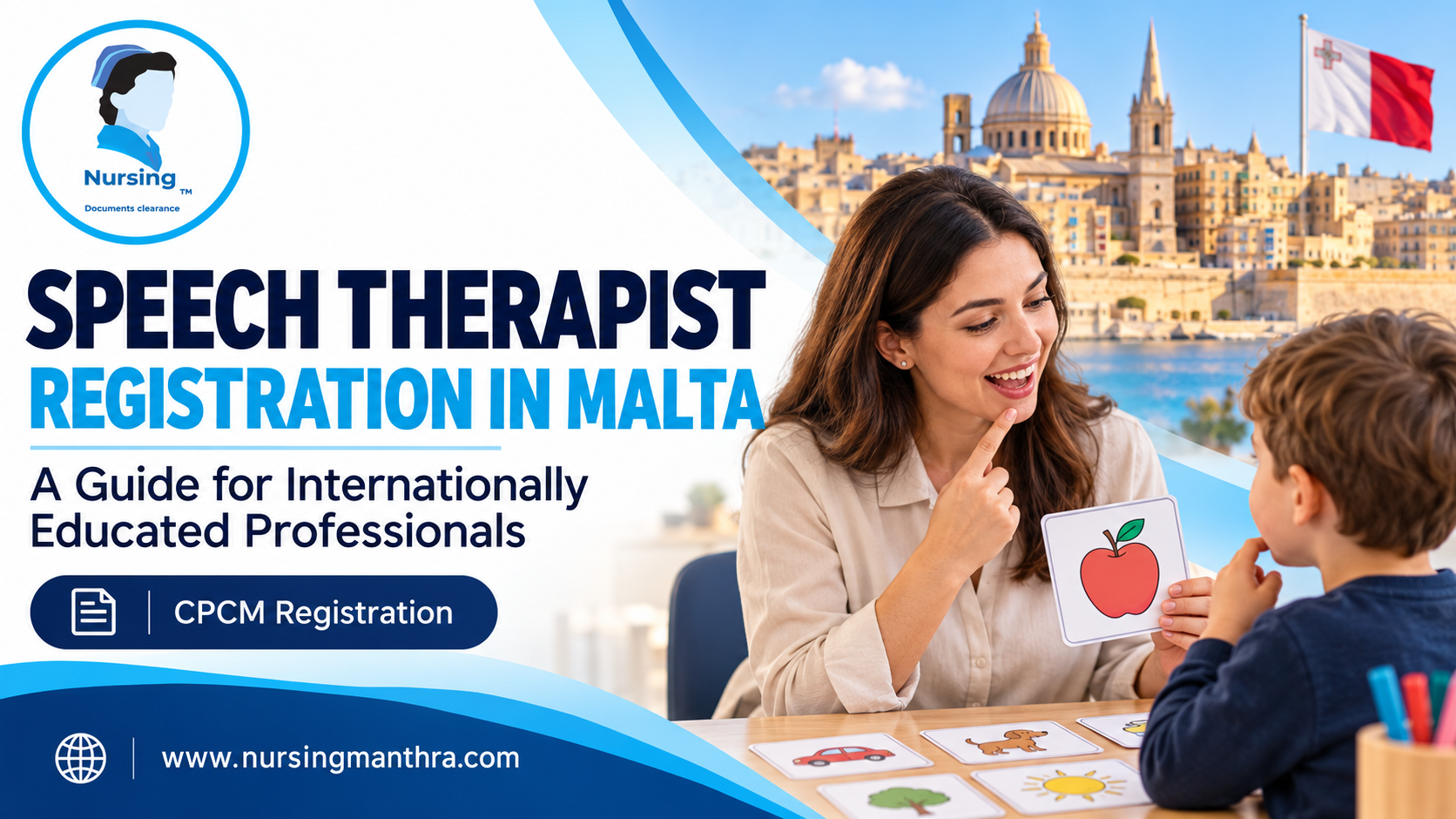
For a speech therapist planning a career in Malta, the first question is usually simple: “Will my qualification be accepted?” The answer needs more than a look at the degree certificate. A useful application tells the complete story of your education, clinical placements and professional practice.
This guide explains which authority to contact, how to prepare your documents, what to check about English evidence, and how registration fits into your employment plans.
Who registers speech therapists in Malta?
The Council for the Professions Complementary to Medicine (CPCM) regulates Speech Language Pathologists in Malta. Overseas applicants need their qualifications recognised by the Council and their names entered in the appropriate professional register before practising. CPCM evaluates applications from both EU and non-EU professionals.
Applicants should use the profession title Speech Language Pathologist when contacting CPCM, even if their home-country job title is Speech Therapist or Speech and Language Therapist.
Malta’s published education and clinical standards
CPCM’s speech-language pathology benchmark describes these entry standards:
| Area | Published benchmark |
|---|---|
| Qualification | Honours bachelor’s in Speech and Language Pathology, MQF/EQF Level 6, recognised by MQRIC |
| Education | Four-year programme recommended; curriculum specifies 6,000 learning hours over at least four years |
| Supervised clinical practice | At least 450 hours, covering children and adults, communication and swallowing difficulties |
| Additional clinical learning | 300 hours for client presentations and case-file studies |
Clinical evidence should distinguish speech-language placements from classroom activities and other practice.
For applicants collecting records, a practical approach is to ask the university for a signed breakdown of placement hours, clinical settings, patient groups and supervision. An internship certificate giving only start and finish dates may leave important questions unanswered.
Can Indian BASLP and MASLP graduates apply?
If you hold BASLP, MASLP or another overseas qualification, request an assessment of your individual education profile. Do not assume acceptance solely because another graduate from your country obtained registration.
For a combined audiology and speech-language programme, we recommend requesting a breakdown that clearly identifies speech-language pathology training. Keep audiology experience and speech-language experience separately identifiable in your supporting records.
If you completed postgraduate study, include it in your profile. However, avoid treating a master’s degree as a guarantee that any differences in undergraduate preparation will be accepted. Ask CPCM how it will consider your complete training history.
What is MQRIC, and how is it different from CPCM?
The Malta Qualifications Recognition Information Centre (MQRIC) operates within the Malta Further and Higher Education Authority (MFHEA). It compares academic and vocational qualifications with Malta’s qualifications framework.
| Body | Purpose |
|---|---|
| MQRIC / MFHEA | Academic qualification recognition and level comparison |
| CPCM | Professional assessment and registration |
| Employer | Recruitment and appointment |
| Identità | Applicable residence and employment permission |
A recognition statement should therefore be understood as one part of the preparation process. Confirm with CPCM which qualifications need recognition and what evidence it requires before paying for multiple assessments.
MQRIC applications are made through its online system. Its official page lists the following standard recognition charges at the time of checking: [4]
| Recognition category | Published fee |
|---|---|
| Programme already listed on the MQRIC database | €15 |
| New foreign programme not listed on the database | €65 |
Check the current category and payment amount when applying. These are MQRIC charges, not CPCM registration fees.
English and Maltese language requirements
The published benchmark accepts language evidence through several routes: recognised Maltese certification; education and supervised placements in English or Maltese; or qualifying English/Maltese professional practice for two years within the preceding five years in a country where that language is official. Listed test options include IELTS Academic 7.5, TOEFL iBT 100, and a Cambridge Advanced certificate. Other equivalent secure tests may be considered. Confirm current conditions with CPCM.
Is IELTS compulsory for every applicant?
Do not book a test or promise an exemption before asking CPCM which evidence it will accept for your circumstances.
If you plan to rely on a medium-of-instruction letter, our recommendation is to request a university letter that explicitly covers:
- The qualification and dates of study.
- The language of academic teaching and assessment.
- The language used during clinical placements.
- The language used for clinical supervision.
- An institutional contact for verification.
Send CPCM a clear explanation of the evidence you intend to use. A written response can help you avoid paying for an unsuitable test or submitting an incomplete language document.
For any test route, ask about component scores, validity, accepted versions and whether results must come from a single sitting. Do not infer those details from an overall score alone.
Also ask a prospective employer about the language used with its patients and families. Registration evidence and the communication needs of a particular vacancy should both be considered before accepting a role.
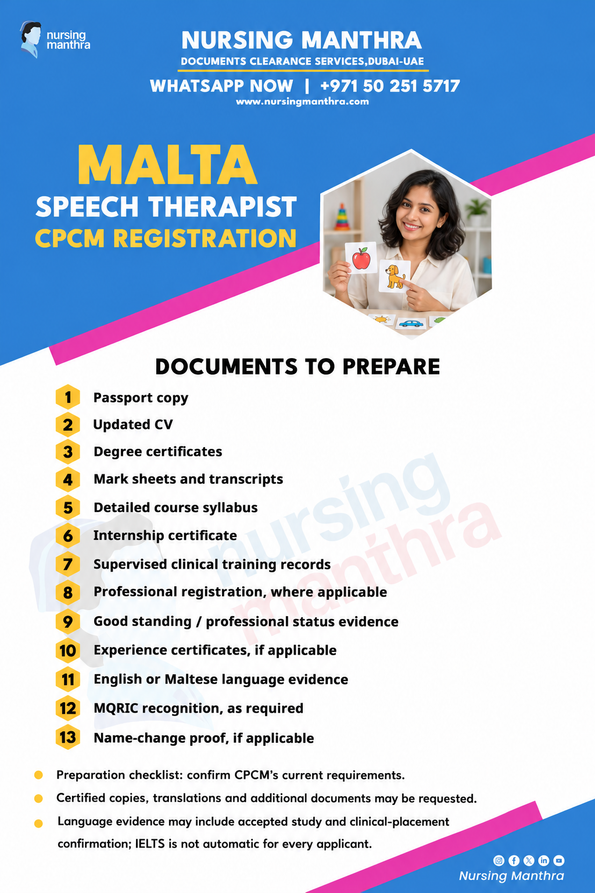
Documents to prepare
The table below is a preparation checklist. It is not a substitute for CPCM’s current official application checklist. Some items may apply only to particular applicants or be requested later.
| Document | Preparation advice |
|---|---|
| Completed CPCM application | Obtain the current version and follow its instructions |
| Passport | Use a clear copy of the identification page |
| Name-change evidence | Explain differences between passport and certificates |
| Degree certificates | Include the primary professional qualification and relevant postgraduate awards |
| Transcripts | Collect complete academic records |
| Detailed syllabus | Request the syllabus applicable to your study years |
| Clinical training records | Show supervised hours, placements, patient groups and clinical areas |
| Internship certificate | Include dates and supporting training details |
| Registration or licence | Prepare home-country and other professional registrations, where applicable |
| Professional status / good standing | Ask CPCM about issuing bodies, validity and direct-submission requirements |
| Employment certificates | Include dates, title, duties, hours and employer contacts |
| CV | Keep education and employment dates consistent |
| Language evidence | Prepare the evidence CPCM agrees to consider |
| MQRIC statement | Arrange the recognition evidence requested for your qualification |
| Translations / certified copies | Confirm required language, certification and legalisation arrangements first |
For Indian applicants, include RCI registration details where applicable. If registration is unavailable in your training country or circumstances, explain this to CPCM and request guidance on acceptable alternatives.
Step-by-step application preparation
Step 1: Create a clear professional profile
Write down your nationality, country of education, qualification, course duration, internship, current registration and employment history. This gives CPCM enough context to direct your enquiry.
Step 2: Request current instructions
Use the official registration page or contact the Registrar. Ask for the correct route for your nationality and country of qualification, the current form, fee, document requirements and submission method. The CPCM registration page also lists information about the granting of a licence by the President; ask whether any separate licensing step applies to your circumstances.
Step 3: Gather university and regulator records
Start with documents that may take time to obtain, especially transcripts, syllabus and clinical-hour statements. Before requesting good standing, confirm how recently it must have been issued and whether CPCM needs it directly from the regulator.
Step 4: Resolve inconsistencies before submission
Compare your passport, certificates, CV and employment letters. If dates or names differ, obtain a factual clarification from the issuing organisation. Keep originals and a clearly labelled copy of every item submitted.
Step 5: Submit and track correspondence
Follow the Council’s current submission instructions. Keep payment receipts, delivery evidence and reference numbers. Reply to document requests with a numbered response identifying each attachment.
Step 6: Follow the assessment outcome
CPCM may approve registration, request clarification or an interview, require supervised practice or an aptitude test, or refuse an inadequate qualification. Its benchmark does not establish a universal post-qualification experience minimum; evidenced experience may help address training differences. Employer requirements remain separate.
If an additional requirement is imposed, obtain written details about the approved provider, location, duration, assessment and costs before making arrangements.
Is there a compulsory licensing examination?
Avoid assuming that every applicant follows one examination route. The Council’s individual decision determines what the applicant must complete. Ask CPCM directly about any assessment specified in your decision letter rather than booking a generic exam or bridging course advertised elsewhere.
How much does the process cost?
A realistic budget should separate the following:
| Expense | How to confirm it |
|---|---|
| CPCM assessment, registration and applicable licensing | Request the current official fee instructions |
| MQRIC recognition | Check the applicable online recognition category |
| University documents | Obtain charges from the issuing institution |
| Good standing and verification | Check with the relevant regulator |
| Language test | Confirm accepted evidence before booking |
| Translation, certification and courier | Obtain quotations after confirming Council requirements |
| Any additional assessment or supervised practice | Budget only after receiving specific instructions |
| Immigration, travel and relocation | Confirm separately with the employer and relevant authorities |
A current CPCM registration fee and guaranteed assessment timeframe could not be verified from the accessible official material reviewed for this article. Request these directly rather than relying on an advertised package price.
Employment and work permission in Malta
Professional registration does not itself provide a job or residence permission.
For third-country nationals using Malta’s Single Permit route, an offer from an employer registered and operating in Malta is required. The employer must be registered with Jobsplus and submits the application online on the candidate’s behalf. Identità states that the applicant must be abroad or hold the required lawful status in Malta when applying.
If an entry visa is required, follow Identità’s instructions after approval in principle. Approval in principle, entry permission and permission to begin work should not be treated as interchangeable stages. Ask the employer to confirm when all conditions for starting employment have been met.
Common preparation mistakes
- Sending only a degree certificate without supporting training records.
- Combining audiology and speech-language hours without a breakdown.
- Assuming a general English-medium letter covers clinical supervision.
- Paying for a course before receiving a Council requirement.
- Treating academic recognition as professional registration.
- Assuming a job offer permits immediate clinical practice.
- Accepting promises of guaranteed registration or employment.
Official contacts and references
CPCM Registrar
Email: [email protected]
Telephone: +356 2595 3317
Website: https://cpcm.gov.mt/en/registration/
- CPCM — Registration, application information and contact
- BusinessFirst Malta — Professions Complementary to Medicine
- CPCM — Speech Language Pathology Benchmark, including language requirements
- MFHEA / MQRIC — Academic qualification recognition and published fees
- Identità — Single Permit eligibility and employer submission
How NursingManthra can assist
NursingManthra can assist with reviewing the available documents, organising the application file, preparing clarification requests and supporting the licensing documentation process within the service scope agreed with the applicant.
To begin a document review, share your CV, qualification certificates, transcripts, internship evidence, professional registration and experience certificates through the agreed secure submission channel.
Our assistance relates to documentation and registration processing. Recruitment, job placement and employer sponsorship are outside this service. Final decisions belong to CPCM and the relevant authorities.
Visit www.nursingmanthra.com for assistance with healthcare licensing documentation.
Contact Nursing Mantra
UAE / WhatsApp: +971 502 515 717
India: +91 6828756689
WhatsApp: https://wa.me/971502515717
About the Author
Shincy George, RN, MSN (Cardiothoracic Nursing), SCFHS-RN, DHA RN, MOH UAE RN, NCLEX-RN (USA), is the Founder of Nursing Manthra Academy.
With extensive international clinical and academic experience, she is dedicated to guiding healthcare professionals through global licensing pathways. Through Nursing Manthra, she supports internationally educated healthcare professionals in achieving their career goals across Canada, USA, UAE, Middle East, UK, Ireland, Australia, New Zealand, and other countries.
Her mission is to simplify complex licensing processes and empower healthcare professionals with the right knowledge, guidance, and support to succeed globally.