By NursingManthra | Updated 23 October 2026
Learning Norwegian is an important part of working in Norway, but a language result alone does not turn an overseas healthcare qualification into a Norwegian authorisation. For many applicants educated outside the EU and EEA, the process begins with assessment of education and continues through additional requirements before authorisation can be granted.
The practical question is therefore not simply, “Can I pass B2?” It is, “Will my qualification be accepted for the next stage, which requirements apply to my profession, and how will I complete them within the decision’s deadline?”
This guide explains the general position for internationally educated doctors and nurses. It focuses on non-EU/EEA qualifications, including Indian qualifications. Qualifications or professional rights already recognised within Europe need an individual route assessment.
Who issues the authorization:
The Norwegian Directorate of Health, or Helsedirektoratet, assesses applications for authorisation and licences for regulated healthcare professions. Start from its profession selector and choose both the profession and country-of-education route correctly. A general nurse application is not the same as an application for a healthcare worker or assistant role.
The final professional category matters. Do not accept an offer described as “nursing” without checking the protected title, duties and authorisation attached to that position.
The non-EU and EEA process:
The Directorate describes two main stages: assessment of the qualification, followed by completion of the additional requirements where the qualification is accepted for progression. An initial positive assessment does not itself confer full authorisation.
Step 1: Identify the route and prepare the application:
Choose the exact profession in the official portal. Read the document and verification instructions shown for your education country. Keep your details consistent across the degree, registration, passport and employment history.
Before submitting, make a record of the qualification you are asking Norway to assess. Include the full route to that award, rather than sending only the latest certificate if earlier professional education is relevant.
Step 2 : Submit and follow the qualification decision
Use the application channel linked by the Directorate and pay the fee applicable to your category. Keep the receipt, case number and full document set. Wait for the authority’s actual assessment before assuming that you are eligible to start a particular professional test or course
If clarification is requested, answer the exact question. A university-issued description of clinical placements is more useful than a general statement that the programme was recognised at home.
Step 3 : Meet the language requirement
For the standard additional-requirements route, the Directorate identifies Norwegian B2, with approved evidence and specified alternatives involving equivalent Norwegian, Swedish or Danish competence. Language must be completed before admission to the other additional requirements. Check all component and evidence rules, rather than relying on an overall course label.
Begin language planning early. Practising a patient history, consent discussion and written handover is useful preparation alongside examination work, but it does not replace the accepted language evidence.
Step 4 :Complete the requirements named in the decision
These include national subjects concerning Norwegian healthcare, legislation and society. Doctors and general nurses are among the professions with safe medication handling and proficiency-test requirements under the standard route. The exact obligations and any approved exemptions must come from the Directorate.
Do not book a course solely because another applicant attended it. Check admission criteria, the accepted provider, dates, cost and the evidence issued on completion. Confirm whether you need immigration permission for attendance or clinical activity.
Step 5: Submit completion evidence and obtain authorisation
The standard additional requirements must normally be completed within three years of the qualifying assessment decision, with three attempts at each required course or test. Follow the individual decision and any extension provisions. Completing the requirements within the deadline leads to submission of completion evidence against the existing case rather than an unnecessary fresh application.
Keep the deadline visible in your planning calendar. Count backwards from available language-test and professional-test dates, allowing for a possible repeat attempt.
Documents to prepare:
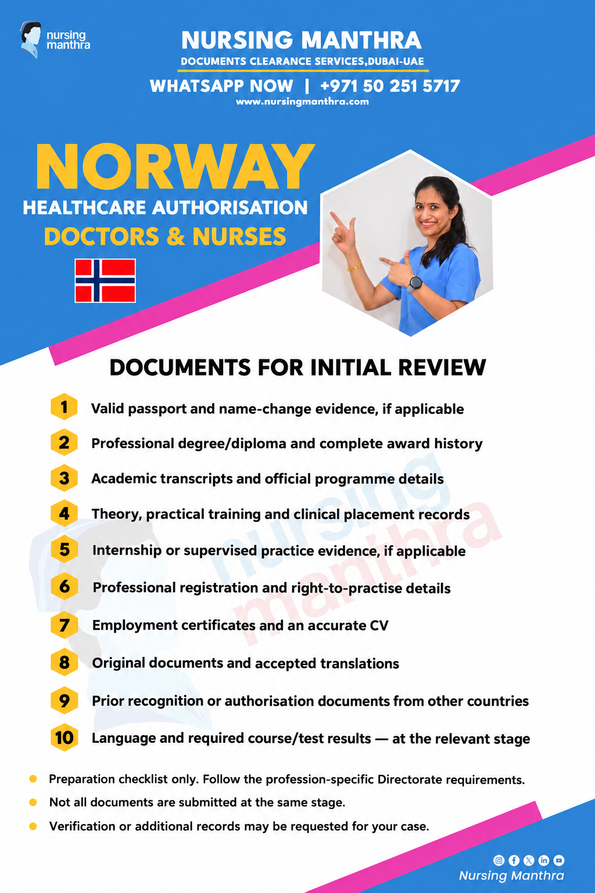
Use the exact profession-specific portal list for the actual application. A useful preliminary file includes:
- Valid passport and any name-change evidence.
- Professional degree or diploma and complete award history.
- Academic transcript and official programme details.
- Clear theoretical, practical and clinical placement information.
- Internship or supervised practice evidence where applicable.
- Current or previous professional registration and right-to-practise details.
- Employment certificates and an accurate CV.
- Original-language documents and translations in the form accepted by the Directorate.
- Prior recognition, authorisation or professional-status documents from other countries.
Later stages also require the appropriate language and course or test completion evidence. Do not assume that all these records are uploaded at the same time.
For a nurse with several qualifications, explain the sequence clearly: initial nursing qualification, subsequent degree or postgraduate programme, registration and employment. Ask the college for detailed records if the academic transcript does not show the clinical training adequately.
Verification and good-standing requests:
The Directorate may require verification through an agency or request records directly from an institution or employer. Its current general guidance identifies DataFlow as a verification service. Follow the current instruction for your profession and case; do not assume a verification package prepared for a Gulf authority automatically completes the Norwegian requirement. Additional records or a report reissue may be needed.
A positive verification report establishes findings about documents. It is not the Directorate’s educational equivalence or authorisation decision.
Application fee and wider costs:
The Directorate currently lists NOK 1,665 for an authorisation application based on education outside the EU/EEA. Recheck the payable amount when you apply.
That application fee is only one item in the budget. Allow separately for verification if required, translations, language study and testing, national-subjects or medication courses, proficiency testing, repeat attempts, travel and accommodation. Ask for a written quote showing any NursingManthra service charge separately.
Avoid paying a course provider before checking whether a particular decision or language result is needed for admission. A paid invoice does not establish eligibility for the authorisation route.
Processing time and realistic planning:
At the date of this guide, the Directorate’s general page lists 23 months for applications involving education outside the EU/EEA. The published queue and individual circumstances can change; additional requirements can extend the overall journey beyond the initial assessment. A job offer is not listed as a reason for prioritization.
Do not interpret that published time as a guaranteed individual completion date. Missing documents or verification can affect a case. Use the waiting period to improve language and organise the next-stage budget, while avoiding premature commitments to a course or start date.
Doctors nurses and other professions:
Medical practitioner and general nurse are separate application categories. Allied healthcare professionals must use their own profession route; the same proficiency examination and medication requirements should not be copied into every allied health file.
Specialist recognition or eligibility for a particular training post is a further question. Confirm the actual employment and professional requirements for the role you want rather than assuming basic authorisation establishes every specialist entitlement.
Common questions:
Can I apply while living outside Norway? Begin with the official application route and its identity or access instructions. Later courses, tests and clinical activities can require attendance and separate immigration arrangements.
Will B2 alone give me a licence? No. Language is one part of the relevant authorisation pathway.
Does European work experience change the route? It can be relevant when supported by the required full professional rights and evidence. Ask the Directorate to assess the actual history; recognition in one country is not a transferable Europe-wide licence.
NursingManthra support:
For a preliminary review, send your profession, qualification country, complete education history, registration status, CV, Norwegian level and any previous Norwegian decision. NursingManthra can assist with agreed document organisation and application tasks. Course admission, test results, authorisation, employment and immigration decisions remain with the responsible bodies.
Enquiries: www.nursingmanthra.com (https://www.nursingmanthra.com/) | WhatsApp +971 50 251 5717.
Official sources:
1. Directorate of Health profession and application selector (https://www.helsedirektoratet.no/english/authorisation-and-license-for-health-personnel)
2. Additional requirements for applicants educated outside the EU/EEA (https://www.helsedirektoratet.no/english/authorisation-and-license-for-health-personnel/Additional-requirements-for-applicants-educated-outside-the-EUEEA)
3. Fees processing times decisions and document verification (https://www.helsedirektoratet.no/english/authorisation-and-license-for-health-personnel/you-have-applied-or-received-a-decision-in-your-case)
Independent application guidance. The current profession-specific requirements and individual Directorate decision take priority over general summaries.
About the Author
Shincy George, RN, MSN (Cardiothoracic Nursing), SCFHS-RN, DHA RN, MOH UAE RN, NCLEX-RN (USA), is the Founder of Nursing Manthra Academy.
With extensive international clinical and academic experience, she is dedicated to guiding healthcare professionals through global licensing pathways. Through Nursing Manthra, she supports internationally educated healthcare professionals in achieving their career goals across Canada, USA, UAE, Middle East, UK, Ireland, Australia, New Zealand, and other countries.
Her mission is to simplify complex licensing processes and empower healthcare professionals with the right knowledge, guidance, and support to succeed globally.