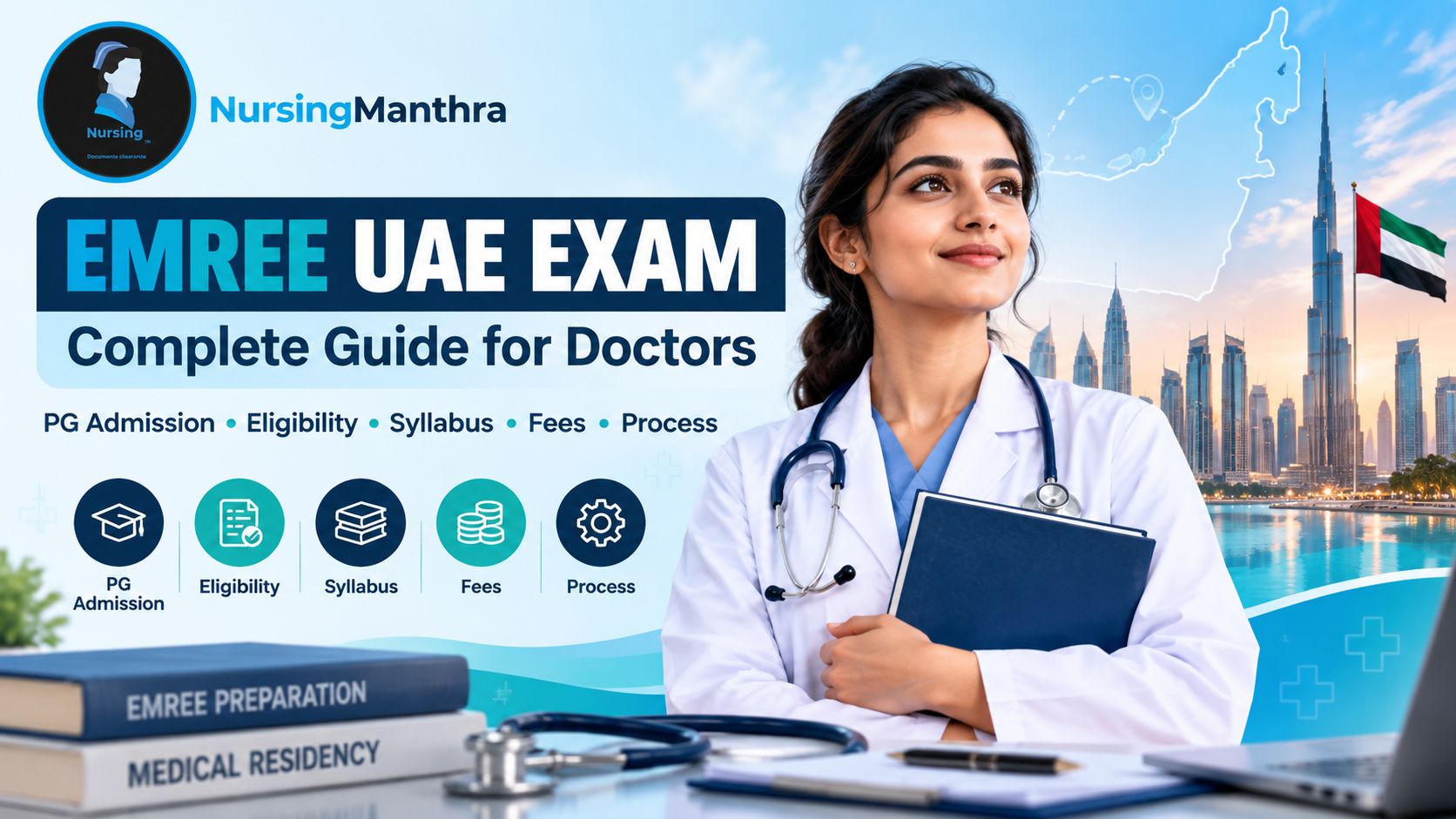
For an MBBS graduate who wants to complete postgraduate specialty training in the UAE, one of the most important examinations to understand is the EMREE – Emirates Medical Residency Entrance Examination.
There is often confusion between EMREE and the UAE licensing examinations. They are not the same examination. EMREE is primarily an entrance examination for medical residency/postgraduate specialty training, whereas the DHA/DOH/MOHAP professional assessment pathway is used for licensing doctors to practise in the UAE.
The UAE uses a unified residency entrance examination administered through the National Institute for Health Specialties (NIHS), UAE University
What is EMREE?
EMREE stands for:
Emirates Medical Residency Entrance Examination
It is the UAE’s common entrance examination used to assess doctors who wish to enter accredited postgraduate medical residency training programmes.
The examination evaluates whether a medical graduate has the clinical knowledge, decision-making skills and basic competencies expected before starting intensive residency training.
EMREE is mainly for doctors planning:
MBBS → Internship → EMREE → UAE Residency Application → Interview/Matching → Residency Training → Specialty/Board Training
Passing EMREE itself does not automatically give a residency seat. It makes the candidate eligible to proceed to the residency application process, subject to the particular authority’s admission criteria.
Is EMREE a DHA, DOH or MOHAP Licensing Examination?
No.
This is one of the most important points for candidates to understand.
| EMREE | UAE GP Licensing Examination |
|---|---|
| Used mainly for entry into residency training | Used to obtain professional registration/licensing as a doctor |
| National residency entrance examination | Licensing pathway depends on DHA, DOH, MOHAP/SHA |
| Conducted through NIHS/UAE University | Authority assessment may be through the relevant examination provider |
| Residency-focused | Employment/practice-focused |
| Experience requirement is different | PQR licensing experience requirements apply |
Therefore, a doctor planning to enter a UAE residency programme should not assume that the two-year GP licensing experience requirement also applies to EMREE.
Very Important for Indian MBBS Graduates: Is Two Years of Experience Required for EMREE?
No. Two years of experience is not required simply to sit EMREE.
In fact, the official EMREE portal states that final-year medical students are eligible to attempt the examination, provided they otherwise meet the relevant residency authority’s criteria.
For actual residency admission, successful completion of internship is generally required before the residency programme starts. For example, the current Abu Dhabi residency criteria require an internship completion certificate, although an official expected-completion letter may be accepted during application if internship will be completed by 31 August of the application year
So an Indian MBBS graduate does not normally have to work for two years after internship before attempting EMREE or applying for residency.
Why Do People Say Doctors Need Two Years of Experience?
This comes from the General Practitioner licensing pathway, which is different from the residency pathway.
Under the current UAE Unified Healthcare Professional Qualification Requirements, a non-UAE graduate applying for the General Practitioner title generally requires:
MBBS/MBChB or equivalent + one-year internship + two years of clinical experience after internship.
MOHAP also specifically states that general practitioners who graduated from universities outside the UAE must provide at least two years of clinical experience after internship for the GP evaluation pathway.
But for a doctor accepted into an approved residency programme, the licensing title is Resident, and the residency authority’s admission requirements apply.
Therefore:
For GP job/licensing: two years’ post-internship clinical experience is generally required for an Indian graduate.
For EMREE/residency: the candidate does not need to wait two years simply because she graduated outside the UAE.
This difference is extremely important for fresh MBBS graduates.
Current EMREE Examination Pattern
According to the official NIHS/UAE University examination information:
| EMREE Detail | Current Information |
|---|---|
| Examination | Emirates Medical Residency Entrance Examination |
| Profession | Medicine |
| Format | Computer-based MCQ examination |
| Questions | Usually 120 MCQs |
| Duration | 3 hours |
| 2025–26 Passing Score | 60% |
| Examination Fee | AED 1,000 |
| Attempts | Maximum 3 attempts during one academic year |
| Result validity | Maximum 2 years |
| Exam location | UAE University/NIHS examination centre, Al Ain |
| Result | Electronic result/transcript |
| Result processing | Normally within 10 working days |
The official website states that examination results are valid for a maximum of two years and that three attempts are permitted during the academic year.
The examination fee is currently listed as AED 1,000. Candidates should check the final payment page because the homepage describes this as excluding tax while the process page describes AED 1,000 as the online fee.
EMREE Pass Mark – Important Point
For the 2025–2026 EMREE cycle, the official passing mark is 60%.
However, passing EMREE and meeting the score required for a particular residency programme are not always the same thing.
For example, Abu Dhabi’s 2026 residency criteria state:
| Applicant Category | Minimum Residency Entrance Examination Requirement |
|---|---|
| UAE National | Pass result |
| UAE university graduate | 70 or above |
| International graduate | 70 or above |
Therefore, an Indian MBBS graduate applying as an international graduate to Abu Dhabi should not plan merely to score 60%. For the 2026 Abu Dhabi cycle, the required residency application score is at least 70.
This is why candidates should always check the admission criteria of the residency authority they plan to apply to.
EMREE Official Syllabus and Blueprint
The November 2025 official EMREE Blueprint gives the following subject distribution:
| Subject | Weight |
|---|---|
| Internal Medicine | 20% |
| Obstetrics & Gynaecology | 15% |
| Paediatrics | 15% |
| Surgery | 15% |
| Family Medicine | 15% |
| Psychiatry | 10% |
| Public Health / Preventive Medicine | 10% |
The official blueprint notes that the actual distribution can differ by approximately ±5% in individual categories.
The exam is therefore not based only on Internal Medicine, Surgery, Paediatrics and OBG. Family Medicine, Psychiatry and Public Health are also major examination areas.
What Type of Questions Are Asked in EMREE?
EMREE is designed to test clinical application rather than only factual memorisation.
According to the current blueprint, major physician competencies include:
| Competency | Approximate Weight |
|---|---|
| Fundamental scientific concepts | 10–20% |
| History & physical examination/clinical features | 10–20% |
| Diagnosis & investigations | 25–30% |
| Pharmacological treatment | 15–20% |
| Non-pharmacological management | 15–20% |
| Prevention & health maintenance | 5–10% |
| Professionalism, ethics & communication | 5–10% |
The examination evaluates both recall/comprehension and analytical reasoning/evaluation.
Candidates should therefore prepare for questions such as identifying the most likely diagnosis, selecting the next investigation, deciding the most appropriate treatment, managing emergencies, choosing preventive interventions and dealing with ethical or communication scenarios.
Difficulty Level of the EMREE
The current official blueprint proposes:
| Difficulty | Approximate Questions |
|---|---|
| Easy | 48 questions – 40% |
| Moderately difficult | 48 questions – 40% |
| Difficult | 24 questions – 20% |
| Total | 120 questions |
Therefore, preparation should focus on strong undergraduate clinical medicine, particularly diagnosis, investigations and management.
Important Topics Included in EMREE
The official 34-page blueprint is extensive. Some major areas include Internal Medicine topics such as cardiology, respiratory medicine, gastroenterology, neurology, infectious diseases, nephrology, endocrinology, rheumatology, hematology, oncology, acute care and geriatrics. Paediatrics includes general paediatrics, neonatology, development, immunisation, endocrinology and genetic/metabolic disorders.
OBG includes ectopic pregnancy, miscarriage, pre-eclampsia/eclampsia, antepartum bleeding, preterm labour, PROM, postpartum haemorrhage, antenatal care, intrapartum care, fetal surveillance, contraception, infertility, menopause, gynaecological disease and obstetric emergencies. Surgery includes perioperative care, infections, wounds, GI surgery, breast, thyroid, hepatobiliary disease, vascular surgery, paediatric surgery, trauma, orthopaedics, ENT, ophthalmology, urology and neurosurgery topics.
Family Medicine, preventive medicine, patient safety, ethics, communication and Psychiatry also form significant parts of the examination.
How to Register for EMREE
The examination registration itself is relatively straightforward.
| Step | Process |
|---|---|
| 1 | Create an account on the UAE University/NIHS Medical Board Examination portal |
| 2 | Complete your online registration information |
| 3 | Wait until an EMREE examination date is open for enrolment |
| 4 | Select the available examination |
| 5 | Complete online payment |
| 6 | Payment confirmation automatically enrols the candidate |
| 7 | Attend the examination in the UAE on the scheduled date |
| 8 | Download the electronic result after publication |
The official system states that enrolment is first come, first served and closes once available examination seats are full, even if the published registration deadline has not yet passed
Documents Needed for EMREE Registration
The public EMREE information page does not currently publish a detailed fixed upload checklist for every registration cycle. Candidates should complete the fields and document requirements displayed in their online examination account.
For identification, Emirates ID is preferable, but applicants who are not UAE residents can attend using a valid passport. Therefore, an Indian candidate does not need UAE residency or an Emirates ID simply to sit EMREE.
The official portal also confirms that obtaining a UAE visit visa for the exam is the candidate’s own responsibility. NIHS/UAE University does not arrange an examination visa.
Is IELTS/OET Required Before Writing EMREE?
Not for the EMREE examination itself.
The official EMREE FAQ specifically states that TOEFL is not required to appear for EMREE.
However, English-language proficiency may be required when subsequently applying for a residency programme.
For example, Abu Dhabi’s current requirements for international graduates are:
| English Test | Minimum |
|---|---|
| IELTS | 6.0 |
| TOEFL | 79 |
| OET | C |
EHS currently requires international graduates to provide English proficiency and specifies IELTS Academic 6, TOEFL iBT 80 or OET C+ in its residency requirements
Because requirements vary slightly between authorities, candidates should prepare their English test according to the residency programme they plan to target.
Documents Required After EMREE for UAE Residency Application
The exact checklist varies by authority, but an international MBBS graduate should generally prepare the following documents:
Valid passport, recent photograph, MBBS degree, complete academic transcript, internship completion certificate, valid EMREE result, English-language proficiency result, CV, credential evaluation where required, Primary Source Verification/DataFlow where required, attestation/equivalency documents where required, Statement of Purpose, recommendation letters if requested, and Emirates ID/UAE visa if available.
For example, EHS currently requests MBBS certificate, transcript, internship certificate, experience certificate if available, valid EMREE result, English-language score for overseas graduates, Statement of Purpose, two recommendation letters, passport, Emirates ID/visa if available, photograph, CV, birth certificate and PSV report.
Abu Dhabi currently requires passport, photograph, EMREE result, graduation certificate, transcript, internship certificate/expected-completion letter and CV, together with an ECE report and English test for international graduates.
Does an Indian MBBS Degree Need Evaluation?
For international graduates applying to Abu Dhabi in the 2026 cycle, DoH accepts an Educational Credential Evaluators (ECE) General with Grade Average Report for evaluating overseas academic results.
International graduates should therefore plan document preparation early because credential evaluation, PSV/DataFlow and certificate attestation can take additional time.
Current Abu Dhabi Requirements for an International MBBS Graduate
For the 2026 Abu Dhabi residency cycle, an international graduate had to satisfy important criteria including:
| Requirement | 2026 Abu Dhabi Criterion |
|---|---|
| Medical qualification | Accredited medical degree |
| EMREE | 70 or above |
| Academic result | GPA ≥3.0 or ≥80% |
| IELTS | ≥6 |
| TOEFL | ≥79 |
| OET | ≥C |
| Graduation | Within previous 5 years |
| Age | Below 30 years as of September 1 of application year |
| Internship | Completed by August 31 of application year |
| Practice discontinuity | Must comply with applicable PQR limit |
This is particularly important for Indian candidates because passing EMREE alone does not guarantee eligibility for Abu Dhabi residency.
EHS Residency Requirements
Emirates Health Services also accepts doctors into residency programmes.
Current EHS information requires the candidate to hold an accredited MBBS or equivalent degree, successfully complete internship, have less than five years since graduation and less than four years since internship, avoid a break from active clinical practice longer than 12 months, pass EMREE and satisfy the English-language requirement if graduating outside the UAE.
EHS Residency Application Fee
The currently published application fee is:
AED 600.
EHS states that successful registration means the candidate is eligible to be considered; it does not guarantee a residency position. Final selection also depends on interview performance and available training seats.
Abu Dhabi Residency Application Fee
For the current Abu Dhabi DoH residency programme:
No DoH application fee is charged.
Contracts, onboarding requirements and visa arrangements may subsequently depend on the training hospital. Department of Health Abu Dhabi
For the 2026 cycle, applications were open from 1 March to 31 March 2026, interviews took place during May–June, matching was completed in July and residency started on 1 September 2026.
What Happens After Passing EMREE?
The pathway is broadly:
Complete MBBS → complete/approach completion of internship → write EMREE → obtain required English score → prepare credential verification/evaluation → apply to eligible UAE residency authority/programme → eligibility screening → programme shortlisting → interview → rank/matching → residency offer → resident licence/onboarding → begin specialty training.
Passing EMREE is therefore only one part of the selection process.
Is Residency Admission Guaranteed After Passing EMREE?
No.
Residency training in the UAE is competitive.
Selection can depend on EMREE score, academic performance, year of graduation, internship, English-language performance, portfolio/CV, interview, recommendation letters, programme preference and the number of available training positions.
For Abu Dhabi, eligible candidates undergo screening, programme-director shortlisting, interviews and a formal matching process.
Therefore, candidates should treat EMREE as both a qualifying examination and an important competitive score, rather than simply aiming for the minimum pass mark.
What Specialties Are Available?
UAE residency programmes cover many major medical specialties. Current Abu Dhabi-approved programmes include areas such as Internal Medicine, Family Medicine, Emergency Medicine, General Surgery, Orthopaedic Surgery, Paediatrics, Obstetrics & Gynaecology, Psychiatry, Dermatology, Anaesthesia, Radiology, Neurology, Ophthalmology, Otolaryngology, Urology, Pathology, Paediatric Surgery and Community Medicine, although availability varies by hospital and annual intake.
Candidates should check the programme list for the particular admission year because some programmes can be restricted according to workforce requirements and applicant category.
How Long is UAE Residency Training?
The duration depends on the specialty.
As a broad UAE professional-training standard, medical residency programmes are generally three years or longer, while many surgical programmes can extend approximately four to seven years. Department of Health Abu Dhabi
The actual training duration must therefore be checked for the specific specialty.
EMREE Examination Cost and Other Expenses
The known official examination fee is:
EMREE Examination
AED 1,000
Additional expenses may include:
| Expense | Approximate/Applicable Cost |
|---|---|
| EMREE | AED 1,000 – check applicable tax at checkout |
| UAE travel/visa | Depends on candidate |
| IELTS/OET/TOEFL | Depends on test/provider/country |
| ECE credential evaluation | According to ECE charges |
| DataFlow/PSV | Depends on documents and authority |
| Certificate attestation | Depends on country/documents |
| EHS residency application | AED 600 currently |
| Abu Dhabi residency application | No DoH application fee currently |
| Dubai residency application | Check the current intake announcement before payment |
Therefore, there is no single fixed total cost for the entire UAE residency process.
EMREE Examination Result
Results are not normally given immediately after finishing the examination.
NIHS states that candidates receive an electronic statement showing the score and ranking within approximately ten working days.
The electronic PDF transcript is accepted by the participating UAE health authorities; NIHS does not issue a separate printed transcript.
How Long is EMREE Valid?
The current examination portal states:
EMREE result validity: maximum 2 years.
Candidates should therefore plan the exam in relation to the residency intake cycle rather than taking it too early without a residency plan.
How Many Times Can EMREE Be Attempted?
For the current cycle:
Maximum three attempts are allowed in one academic year until the candidate achieves a passing score.
Once a candidate passes, they cannot keep retaking the exam during the same academic year merely to increase the score. Candidates who previously passed in an earlier academic year are granted only one additional opportunity under the current policy.
Another important point is that the transcript records examination attempts, and the official FAQ states that attempts can be shared with the respective health authorities.
Candidates should therefore prepare properly rather than using the first attempt merely as a trial.
EMREE 2026–2027 Examination Dates
As of 28 September 2026, the official NIHS/UAE University examination portal is still displaying the 2025–2026 examination cycle.
The last physician EMREE date shown for that cycle was 14 June 2026, with the result scheduled for 18 June 2026.
The new 2026–2027 physician EMREE schedule has not yet been published on the official examination homepage.
Candidates planning the next residency intake should therefore keep checking the official NIHS/UAE University Medical Board Examination portal rather than relying on unofficial predicted examination dates.
Practical Advice for the Candidate Currently Completing MBBS Internship in Bangalore
For the situation you mentioned — an Indian MBBS graduate currently completing internship in Bangalore — there is no reason to wait for two years of employment simply because she wants to attempt EMREE.
A sensible route would be:
Complete or continue internship → start EMREE preparation now → monitor the next EMREE registration dates → sit EMREE → complete IELTS/OET if required → prepare MBBS/internship/credential documentation → apply for the appropriate UAE residency cycle once eligible.
She can even attempt EMREE as a final-year/final-stage student under the examination rules, although internship completion will normally be necessary before actually beginning residency.
If instead her aim is to come to the UAE and work as a General Practitioner rather than enter postgraduate residency, that is a different pathway, and because she is an Indian/non-UAE university graduate she would generally need two years of post-internship clinical experience for the GP title under the current UAE PQR.
In short:
PG/Residency route:
MBBS + Internship + EMREE + residency eligibility/selection.
No mandatory two-year work experience simply to write EMREE.
GP employment route:
MBBS + Internship + usually 2 years of post-internship clinical experience + licensing requirements.
EMREE vs GP Licensing – Easy Way to Remember
| Candidate’s Goal | Correct Route |
|---|---|
| “I want to do PG/specialisation in UAE” | EMREE → Residency Application |
| “I want to work as a GP in UAE” | UAE Professional Licensing Pathway |
| “I just finished internship and want UAE PG” | Can prepare/apply for EMREE; no need to wait 2 years solely for residency |
| “I finished internship and want GP employment” | Normally needs 2 years post-internship experience as an overseas graduate |
| “I passed EMREE – am I guaranteed PG?” | No; residency application, eligibility, interview and matching still follow |
Important Note for Candidates
EMREE rules, passing scores, examination dates, residency eligibility, age limits, GPA requirements, programme availability and application fees can change between admission cycles.
The 60% EMREE pass score relates to the 2025–2026 examination cycle. Individual residency authorities may set a higher score for admission. For example, Abu Dhabi required international graduates to have an EMREE score of at least 70 for the 2026 residency cycle.
Candidates should therefore verify the latest NIHS, DoH, DHA/Dubai Health and EHS announcements before submitting an application.
Dont worry about exam studymaterials. Nursingmanthra provides exam study materials: You can contact nursingmanthra whatsapp number for study materials.+971502515717.
If you need application support , you can contcat nursingmanthra whatsapp-+971502515717