By NursingManthra | Updated 23 October 2026
If you are planning a clinical career in Spain, begin by separating three questions: Is your basic qualification recognised? Are you registered with the appropriate professional college? And, if you want a specialist position, is the specialty recognised too?
These questions do not all go to the same office. For many non-EU university qualifications, the basic degree process is homologación through Spain’s universities administration. The Ministry of Health handles different procedures, including recognition of non-EU specialist healthcare qualifications.
This guide focuses on internationally educated doctors and nurses, particularly applicants with qualifications obtained outside the EU. Citizenship, the awarding country and any previous European recognition can change the applicable route.
Which authority handles which step:
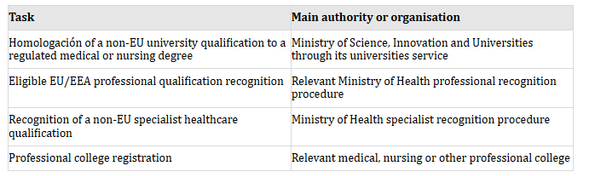
The distinction is important: a basic medical or nursing degree homologación application should not be described as a Ministry of Health specialist application.
Homologación and equivalencia are different:
Homologación is the recognition route linked to the regulated profession described in the official universities guidance. A general academic equivalence decision should not be assumed to grant the professional rights attached to a regulated medical or nursing degree. Choose the procedure matching the outcome you need.
Before applying, identify the Spanish reference profession, not simply the English title printed on your degree. Similar course names can hide different training structures and professional scopes.
Step 1: Check that the qualification matches the profession
The official doctor and nurse pages require a university qualification meeting the relevant professional and educational conditions. They assess training against Spanish requirements, including programme content and clinical preparation. A home-country registration certificate is useful evidence but does not determine the Spanish outcome.
For an Indian applicant, do not assume that an MBBS, BSc Nursing, Post Basic qualification or GNM will receive the same result as another candidate’s award. The complete education pathway and the applicable university-level requirements need review.
Step 2: Prepare academic records in sufficient detail
The official checklists call for identity and nationality evidence, the award, academic certification of programme duration and subjects or hours, relevant supplementary training or experience, payment and language evidence as applicable. Evidence of the right to exercise the profession in the issuing country may also be relevant
Ask your institution for a clear statement of theoretical and clinical preparation if the normal transcript is incomplete. Keep records explaining credit transfers and earlier study where they form part of the qualification being assessed.
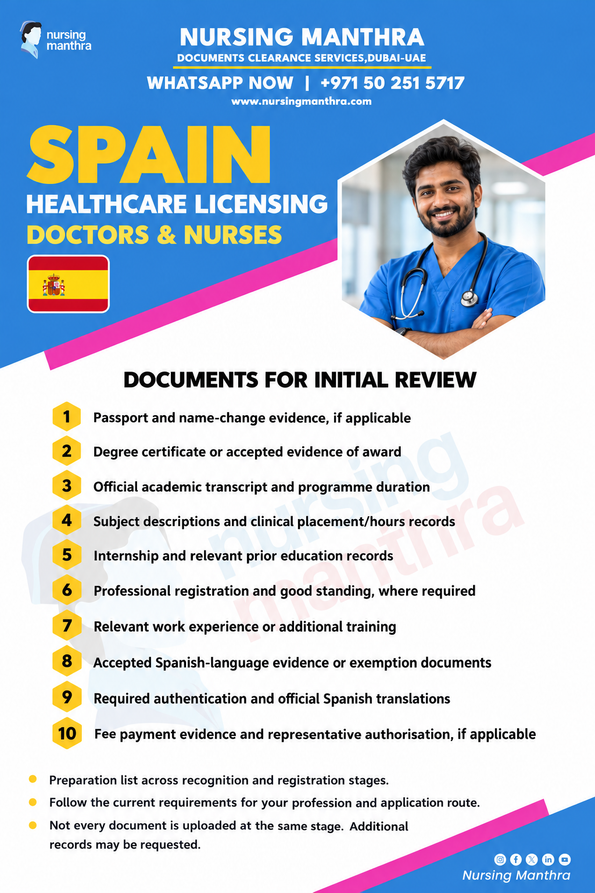
A useful preliminary file includes:
- Passport and name-change evidence where relevant.
- Degree certificate or accepted evidence of award.
- Official academic transcript and programme duration.
- Subject descriptions and clinical placement or hours information.
- Internship and prior educational records that explain the route to the degree.
- Professional registration and good-standing evidence where required for the applicable stage.
- Relevant professional experience or additional training.
- Accepted Spanish-language evidence, unless an exemption applies.
- Required authentication and official Spanish translations.
- Fee payment evidence and any representative authorisation.
- This is a preparation list across recognition and later registration stages. It is not a claim that every item must be uploaded in identical form with every homologación application.
Step 3 : Meet the Spanish language requirement
The official basic medical and nursing pages identify Spanish B2, subject to their stated exemptions. These can relate to nationality or specified education completed in Spanish. Check the accepted evidence and whether an exemption actually applies before submitting.
A general English qualification is not evidence of Spanish competence. For clinical work, develop listening, speaking and documentation skills beyond the minimum certificate. Additional regional language expectations can arise for particular employers or public recruitment; check the actual vacancy separately.
Step 4 : Arrange legalisation and translation correctly
Follow the Ministry’s country-specific authentication instructions and the accepted official Spanish translation requirements. Apostille and diplomatic legalisation are not identical processes to be purchased indiscriminately. The relevant exemption or route depends on the issuing country and document.
Do not crop stamps or remove back-page endorsements from scans. Keep the original, authentication and translation linked clearly so the reviewer can identify what has been certified.
Step 5 : Submit the homologación application
The universities guidance states that the procedure is submitted electronically. Follow the official electronic-office instructions and retain the submission receipt and file number. If using a representative, check the actual authorisation and digital identification rules rather than sharing personal access credentials informally.
Monitor the file and answer requests by the stated deadline. A request for a document is not the same as a final refusal. If the decision imposes supplementary requirements, follow the specific decision and approved completion arrangements before describing the qualification as fully recognised.
Step 6: Complete professional college registration:
Once the relevant qualification position is established, confirm registration with the competent professional college. Doctors and nurses use different colleges. The college can require additional identity, professional-status, payment and other records
As a local example, Madrid’s medical college lists foreign-degree recognition evidence and professional suitability documentation. Its online pre-registration guidance also describes an in-person completion stage. This should not be advertised as a national process guaranteed to finish entirely online.
Ask when good-standing or non-disqualification evidence must be issued and whether it needs authentication and translation. Order short-validity records at a sensible point rather than letting them expire during degree assessment.
Medical specialist recognition is a separate pathway:
A foreign MD, MS or other specialist qualification should not be assumed to be recognised because the basic medical degree has been homologated. Spain’s Ministry of Health runs a separate procedure for non-EU specialist healthcare qualifications. Its decisions determine professional effects for the specialty.
Keep specialty curricula, training rotations, examinations and experience evidence organised separately from the basic degree file. Specialist training admission, specialist recognition and eligibility for a particular public-sector job are different questions.
Fees and the wider budget:
The universities ministry currently publishes a €166.50 fee for homologación or an academic equivalence application, with payment options including the relevant Modelo 790-107 route. This is the application charge, not the total cost of becoming ready for practice.
Budget separately for official translations, authentication, language evidence, any required supplementary education, professional college entry and recurring fees, travel and immigration. College charges vary; use the receiving college’s current schedule instead of a national package estimate.
NursingManthra service fees should be quoted separately. Ask which application stages are covered and which official or third-party payments remain yours to pay.
How long can it take:
No single timescale reliably describes every overseas doctor or nurse. Completeness of the academic record, requests for clarification, supplementary requirements and later professional registration affect the journey. Do not treat a file submission receipt as evidence that you may start clinical work.
Keep the recognition, registration, employment and immigration milestones separate when discussing a start date with an employer.
Other healthcare professionals:
The official homologación list includes other regulated healthcare professions, including dentistry, pharmacy, physiotherapy, dietetics and speech and language therapy. Check whether your qualification corresponds to a listed regulated profession. If not, do not assume an academic equivalence decision will create the professional rights you want.
NursingManthra support:
For a preliminary discussion, send your exact qualification, awarding country, profession, registration history, CV, Spanish level and any previous European decisions. NursingManthra can assist with agreed document organisation and administrative application tasks. Universities, Ministries and colleges make the recognition and registration decisions; employment, examination, specialist and immigration services need separate confirmation.
Visit www.nursingmanthra.com (https://www.nursingmanthra.com/) or WhatsApp +971 50 251 5717.
Official sources:
1. Universities Ministry homologación overview (https://www.ciencia.gob.es/Universidades/validate/homologacion.html)
2. Official medical degree homologación requirements (https://www.ciencia.gob.es/Universidades/validate/homologacion/medico.html)
3. Ministry of Health non-EU specialist recognition (https://www.sanidad.gob.es/areas/profesionesSanitarias/profesiones/especialistasExtracomunitarios/home.htm)
4. Official nursing degree homologación requirements (https://www.ciencia.gob.es/Universidades/validate/homologacion/enfermero.html)
5. Official homologación fee and payment instructions (https://www.ciencia.gob.es/Universidades/validate/tasa.html)
6. Madrid medical college online pre-registration guidance (https://www.icomem.es/ventanilla-unica/colegiacion-online)
7. Spanish General Nursing Council recognition guidance (https://www.consejogeneralenfermeria.org/formacion-y-empleo/homologacion-y-reconocimientos)
Independent application guidance. Check the current Ministry, professional college and immigration requirements applicable to your qualification and intended role.
About the Author
Shincy George, RN, MSN (Cardiothoracic Nursing), SCFHS-RN, DHA RN, MOH UAE RN, NCLEX-RN (USA), is the Founder of Nursing Manthra Academy.
With extensive international clinical and academic experience, she is dedicated to guiding healthcare professionals through global licensing pathways. Through Nursing Manthra, she supports internationally educated healthcare professionals in achieving their career goals across Canada, USA, UAE, Middle East, UK, Ireland, Australia, New Zealand, and other countries.
Her mission is to simplify complex licensing processes and empower healthcare professionals with the right knowledge, guidance, and support to succeed globally.