By NursingManthra | Updated 23 October 2026
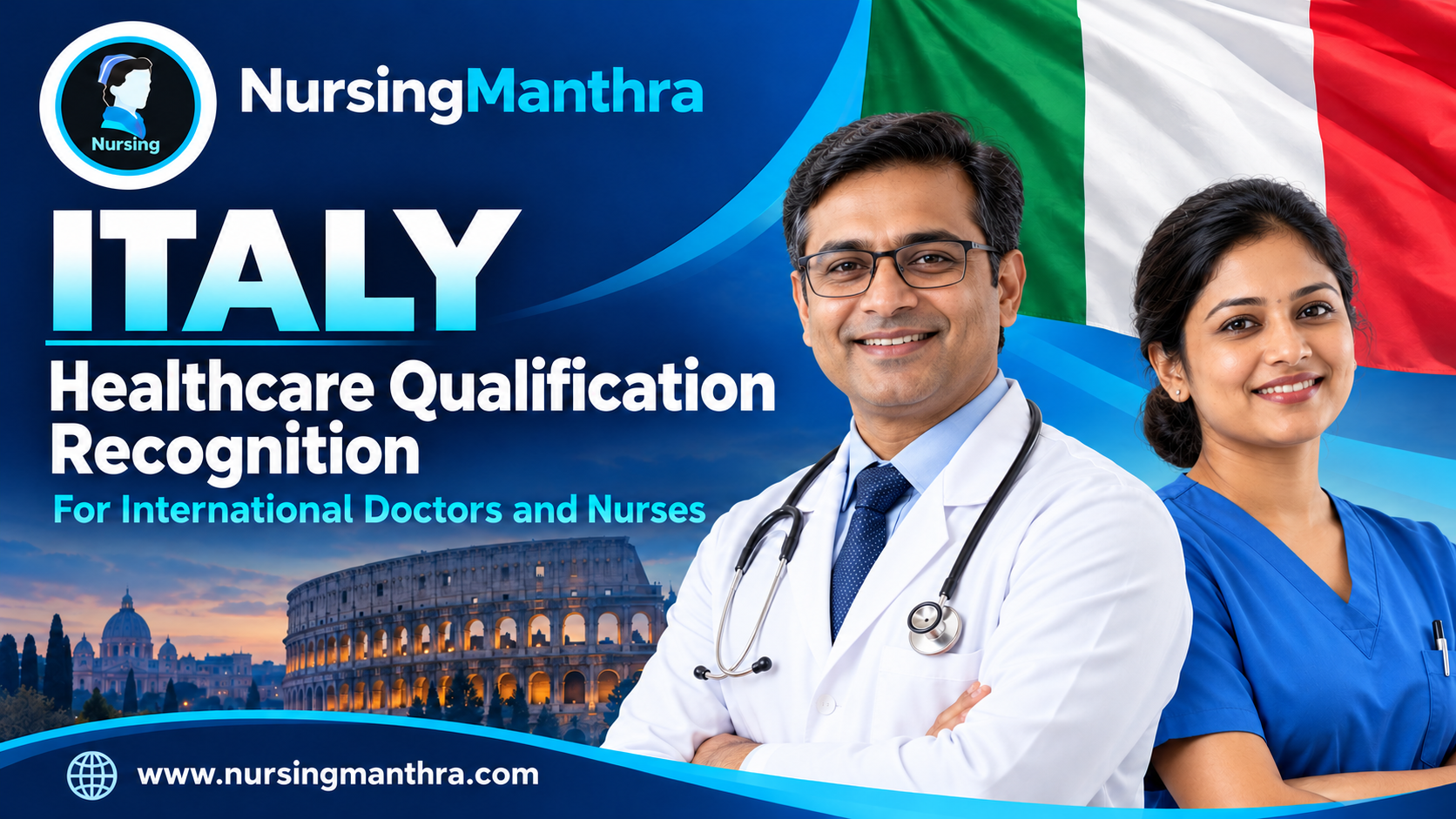
Getting a healthcare qualification recognised in Italy and joining the professional register are connected steps, but they are not the same application. A recognition decree establishes the result of the qualification assessment. Registration with the relevant professional Order is another important step before practising.
For an internationally educated doctor or nurse, a good application begins with choosing the correct Ministry form. The form can depend on the profession, the country where the qualification was obtained, citizenship and whether it has already been recognised elsewhere in Europe.
This guide focuses on the usual route for qualifications obtained outside the EU. It does not describe temporary emergency recruitment arrangements as if they were permanent nationwide recognition.
Which authorities are involved:
The Ministero della Salute, Italy’s Ministry of Health, handles the relevant healthcare professional qualification recognition procedures. Doctors subsequently deal with the competent territorial Ordine dei Medici Chirurghi e degli Odontoiatri. Nurses register with the appropriate Ordine delle Professioni Infermieristiche, or OPI. Other regulated professions must identify their own recognition procedure and professional register.
A statement about a degree’s academic level should not be confused with a Ministry professional recognition decision.
Step 1: Select the right recognition category
For a medical qualification obtained in a non-EU country, the Ministry identifies D1 Medico as the relevant standard application category described on its service page. For non-EU nursing qualifications, the corresponding nursing service identifies D2-1 INF. These are different files with different annexes.
If your qualification was obtained in the EU or has already been formally recognised by another European country, do not automatically reuse either form. Check the Ministry’s category matching your citizenship and recognition history. An overseas qualification does not become an EU-issued qualification simply because you have worked in Europe.
Step 2 : Collect complete education and registration evidence
Use the current annex for your profession as the submission checklist. Collect the actual professional award and the records describing the course, duration and clinical training. Make sure employment certificates identify the role and dates accurately.
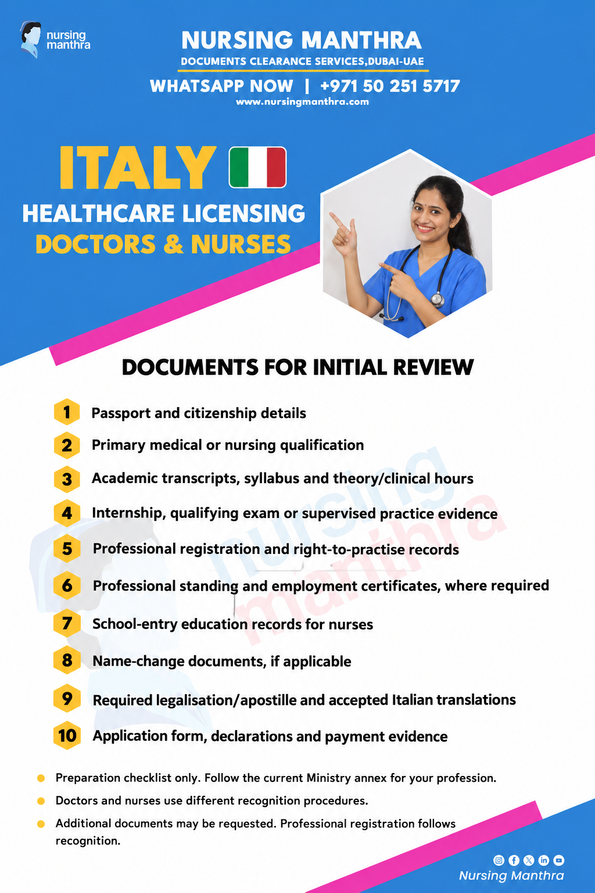
A practical preliminary file may include:
- Passport and identity or citizenship details.
- Primary medical or nursing qualification.
- Transcript, syllabus and evidence of theoretical and clinical hours.
- Internship, professional qualifying examination or supervised practice evidence where relevant.
- Registration and entitlement-to-practise evidence from the qualification country.
- Professional standing and experience evidence where the annex requires it.
- Name-change records.
- Required legalisation or apostille and Italian translations.
- Application form, declarations and payment evidence.
- For nursing, retain school-entry education records as well as the nursing award. The Ministry’s FAQ explains that general school education can be relevant to statutory recognition requirements.
- For medical specialists, the FAQ also states that basic professional recognition is needed before seeking recognition of the specialty.
- This list is a preparation aid, not a declaration that every document is mandatory in identical form for every applicant. Read the actual D1 or D2-1 annex before ordering certificates.
Step 3 :Arrange acceptable authentication and translation
The doctor’s Ministry service page describes Italian diplomatic or consular legalisation or Hague Apostille arrangements, as applicable. It also describes the accepted certification or sworn translation routes for documents in a foreign language.
Do not treat notarisation, apostille, translation and professional verification as interchangeable services. Each answers a different administrative requirement. A clear scanned copy can still be unacceptable if the required authentication or translation is missing.
Before paying a translator, ask which originals or certified copies need to be included, whether the receiving office accepts the proposed translation route and whether a short-validity certificate should be ordered later.
Step 4 : Submit through the stated channel
The Ministry service pages list submission and delivery arrangements. They should not be marketed as a process completed entirely by clicking an online licensing form. The published doctor and nurse procedures include postal or hand-delivery arrangements, while payment can use the Ministry’s online system. Follow the current instructions for the specific file.
Retain the complete submitted file, courier or delivery proof, payment receipt and correspondence. If the Ministry asks for missing documents, respond to the reference number and organise the response so each request has a clear matching document.
Step 5 :Understand the possible decision
The published recognition procedures describe three broad outcomes: a recognition decree, recognition conditional on completing a compensatory measure, or refusal.
If a measure is imposed, read the decree carefully. Confirm the content, organiser, dates and evidence required after completion. Do not assume that passing an unrelated private course satisfies the Ministry’s condition.
An employment offer can be useful for planning, but it should not be treated as a substitute for the professional recognition result.
Step 6 :Complete professional registration and Italian language checks
Doctors should approach the territorial medical Order for the registration requirements applicable to their status. Nurses should approach the relevant OPI. Recognition and register entry are separate milestones.
Italian communication is essential for clinical work. Nursing Order guidance describes language assessment and, for applicable non-EU candidates, assessment of the rules governing professional practice. The exact booking, evidence and charges should be checked with the receiving Order. Do not present a universal B2 certificate as automatically sufficient for every profession and province.
Prepare for patient communication, clinical handover, documentation and understanding professional responsibilities. A language-school attendance certificate is not necessarily the evidence a professional Order requires.
Fees and budgeting:
The Ministry’s published standard non-EU doctor and nurse service pages identify €16 stamp duty per qualification to be recognised. This is not the total cost of becoming licensed or registered in Italy.
Additional expenses can include legalisation or apostille, Italian translations, document delivery, any compensatory measure, language assessment, professional Order registration and subscriptions, travel and living costs. Obtain a separate written quotation for NursingManthra’s administrative assistance.
When someone quotes a complete package, ask whether the amount includes official charges, examinations, repeat attempts, training and professional registration. A low government stamp duty does not make the overall pathway cost-free.
How long does recognition take:
The Ministry service pages describe a four-month period from complete documentation for the standard doctor and nurse files. That is not a guaranteed end-to-end employment timeline. Missing documents, clarification, compensatory measures, language assessment and register entry can add time.
Plan your next step around the decision actually received, rather than an agent’s assumed completion date.
Other healthcare professions and specialist qualifications
Select the Ministry recognition service for the exact profession. A physician’s D1 file is not the correct template for a physiotherapist, radiographer or nurse. Professional register structures can also differ. Specialist recognition should be planned separately from the basic right to practise
Questions to clarify before paying:
Will my Indian or Gulf registration be enough? It is useful evidence of your professional history, but does not replace Italian recognition.
Can a job offer remove the Ministry assessment? Do not assume so. Check any claimed exception against the specific legal arrangement and employer role.
Do I need to travel immediately? Establish the submission, language, compensatory measure and registration requirements first. Some administrative preparation can begin abroad, while later stages may require attendance.
Nursing Manthra support:
Nursing Manthra can help organise a profession-specific document review and agreed application assistance. Send your qualification country, profession, citizenship, CV, current registration, Italian level and previous recognition decisions for an initial discussion.
Any training, placement, employment or immigration service must be confirmed separately. The Ministry and professional Orders make the recognition and registration decisions. Visit www.nursingmanthra.com (https://www.nursingmanthra.com/) or WhatsApp +971 50 251 5717.
Official sources:
1. Ministry of Health non-EU doctor qualification recognition (https://www.salute.gov.it/new/it/servizi-online/profs-rtenc-xd1m/riconoscimento-di-titolo-abilitante-allesercizio-della-professione/)
2. Ministry of Health non-EU nursing qualification recognition (https://www.salute.gov.it/new/it/servizi-online/profs-rtenc-d21/infermiere-riconoscimento-titolo-professionale-sanitario-conseguito/)
3. OPI Brescia foreign qualification and language examination guidance (https://www.opibrescia.it/pagina21502_riconoscimento-titolo-esame-infermieri-stranieri.html/)
4. Ministry of Health healthcare recognition FAQ (https://www.salute.gov.it/new/it/faq/riconoscimento-qualifiche-professioni-sanitarie/)
5. Florence medical Order guidance for foreign doctors and qualifications (https://www.ordine-medici-firenze.it/professione/strumenti-operativi/faq-domande-frequenti/faq/166-medici-stranieri-e-o-titoli-stranieri-doctors-from-abroad-and-or-medica-degrees-from-abroad)
Independent application guidance. Use the current Ministry annex and territorial Order instructions. Recognition does not itself grant immigration permission or a guaranteed job.
About the Author
Shincy George, RN, MSN (Cardiothoracic Nursing), SCFHS-RN, DHA RN, MOH UAE RN, NCLEX-RN (USA), is the Founder of Nursing Manthra Academy.
With extensive international clinical and academic experience, she is dedicated to guiding healthcare professionals through global licensing pathways. Through Nursing Manthra, she supports internationally educated healthcare professionals in achieving their career goals across Canada, USA, UAE, Middle East, UK, Ireland, Australia, New Zealand, and other countries.
Her mission is to simplify complex licensing processes and empower healthcare professionals with the right knowledge, guidance, and support to succeed globally.