By NursingManthra | Updated 23 October 2026
Before planning a healthcare career in France, ask one question: does France offer a recognition route for your exact profession, qualification and personal status?
For a doctor with a non-EU qualification, the answer may involve a competitive examination and supervised professional consolidation. For a nurse with a non-EU diploma, the answer is often further French nursing education rather than a straightforward overseas registration application. Both need French, but the legal routes are different.
This guide focuses on applicants educated outside the EU and EEA. It should not be used as a substitute for the separate rules governing EU-qualified professionals, protected statuses or specific recognition agreements.
Who handles the process:
For non-EU-qualified doctors, the Centre national de gestion, or CNG, administers important parts of the authorisation pathway, including the EVC examinations and authorisation procedures. Final professional registration involves the relevant medical Order. Nurses deal with the nursing qualification framework and, once eligible, the Ordre national des infirmiers. France does not operate one universal registration desk for all healthcare professions.
An academic comparability statement alone should not be presented as permission to practise a regulated clinical profession.
The doctor pathway explained:
The common authorisation framework is known as the procédure d’autorisation d’exercice, or PAE. Doctors with non-EU qualifications are often described as PADHUE. The usual examination-based journey includes EVC, an applicable parcours de consolidation des compétences, or PCC, and an authorisation decision.
Step 1 Identify your eligible route
Review the current CNG session notice and the profession or specialty open for applications. Route categories and eligibility conditions can differ. A doctor already working under a qualifying French status may not be in the same position as a new overseas applicant. Do not choose an internal route simply because you have clinical experience abroad.
Step 2 Prepare the qualification and language file
Collect identity, diploma, right-to-practise evidence and any route-specific professional records. Check the prescribed French-language documents and exemptions. The CNG identifies accepted B2-level evidence, including specified language tests and diplomas; the exact evidence matters.
Step 3 Apply during the published EVC window
Follow the official registration notice and retain a complete copy of the submission. Examination applications are not continuously open. The 2026 registration period is already closed as of this article’s update, so a new applicant must consult the next announced session rather than assume the old registration link remains usable.
Step 4 Complete the applicable professional consolidation
Passing EVC is not the same as obtaining unrestricted practice rights. The required PCC, supervised role and assessments must be completed under the rules applying to your route. Do not assume that ordinary work experience outside France automatically replaces this stage.
Step 5 Apply for authorisation and professional registration
Submit the required authorisation dossier, including the relevant training and assessment evidence, through the current CNG procedure. Following the appropriate authorisation, complete registration with the competent medical Order. The Order’s guidance distinguishes ministerial authorisation from subsequent registration.
The nurse pathway requires particular care:
An Indian BSc Nursing or GNM qualification does not normally become a French nursing licence through a simple application to the nursing Order. The official public-service guidance describes limited recognition categories and agreements; applicants who do not meet an applicable route must obtain a recognised qualification through nursing education.
For many non-EU-qualified nurses, the practical starting point is an IFSI, an Institut de formation en soins infirmiers. Ask the institution to confirm the current admission route, any permitted individual exemptions and the qualification that will result. France’s 2026 nursing education reforms make it especially important to check the rules for the actual intake. Older descriptions of shortened training should not be treated as a guaranteed place or guaranteed course length.
A sensible nursing sequence is:
1. Establish whether a special recognition category genuinely applies.
2. If not, obtain written IFSI or university admission guidance.
3. Meet the relevant French-language and educational entry requirements.
4. Complete the education and clinical requirements applicable to your admission.
5. Obtain the qualifying award and complete professional registration.
Do not pay for a supposed direct nurse licence solely on the strength of an overseas good-standing certificate. Good standing is evidence about professional status; it does not replace a recognised qualification.
French language expectations:
For the doctor EVC process, B2 is an important documented threshold under the CNG evidence rules, with specific alternatives or exemptions. Safe clinical work still requires strong listening, explanation and documentation skills.
For IFSI nursing education, official guidance identifies B2 French as a minimum. The institution may have its own admission assessment. An English test does not establish French clinical communication ability.
When budgeting, distinguish a language-school completion certificate from an examination result accepted by the authority or university. Ask for the precise test and score requirement in writing.
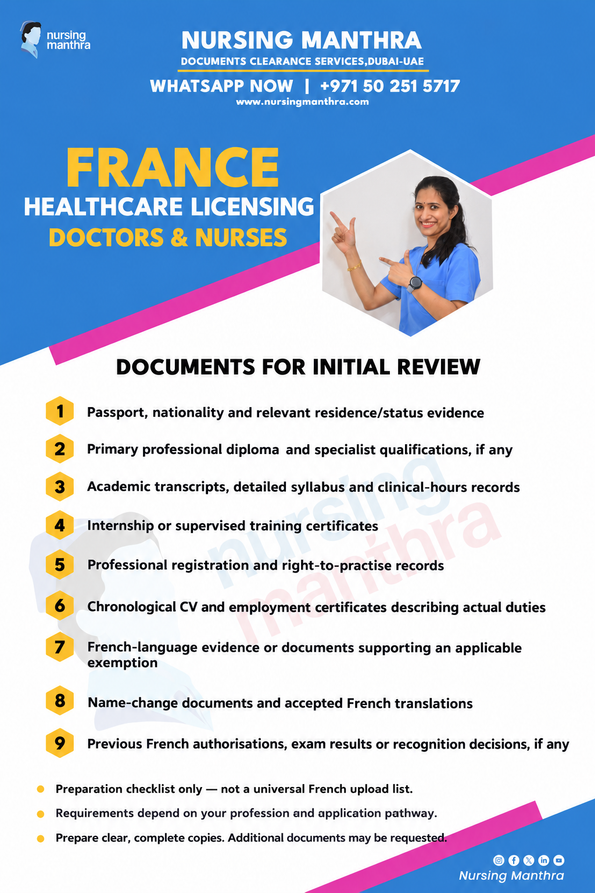
Documents to prepare for an initial review:
The following is a preparation checklist, not a universal French upload list:
Passport, nationality and relevant residence or status evidence.
Primary professional diploma and any specialist qualification.
Academic transcripts, detailed syllabus and clinical-hours records.
Internship or supervised training evidence.
Registration and right-to-practise records from the relevant country.
Chronological CV and certificates describing actual employment duties.
French-language evidence or evidence supporting an applicable exemption.
Name-change documents and accepted French translations.
Prior French authorisations, examination results or recognition decisions, if any.
For a nurse seeking education, also prepare the information the IFSI asks for about academic entry qualifications, motivation and previous study. For a doctor already in a French supervised pathway, keep all assessment records and employment documents organised by stage.
Costs and timescales:
There is no single France healthcare licensing price covering every doctor and nurse. Ask for a route-specific budget covering language examinations, translations, certification, any application or registration charges, travel and living costs. Nurses who need education must budget for the institution’s actual tuition and placement-related requirements. Check funding eligibility rather than assuming tuition is covered.
A doctor’s examination, consolidation and authorisation journey is different from the processing time for the final dossier. Nursing education can also make the journey substantially longer than a document-only recognition process. Avoid committing to an employment start date until the required qualification and authorisation milestones are clear.
Other healthcare professions:
Dentists, pharmacists, midwives and allied health professionals have their own rules. The fact that EVC includes certain other professions does not make it a universal examination for every healthcare worker. Identify the protected profession and eligible qualification route before submitting a file.
Questions applicants often ask:
Can work experience alone give me a full licence? Do not assume so. The qualification, route and required assessments remain central.
Does speaking French make my overseas nursing diploma directly registrable? Language competence and qualification eligibility are separate requirements.
Can NursingManthra secure a supervised post or IFSI place? Any such service would need separate confirmation. Application guidance should not be mistaken for a guaranteed university place, examination result or employer contract.
NursingManthra support:
Begin by sharing your profession, exact qualification, awarding country, nationality, current registration, French level and any prior French applications. NursingManthra can help organise an initial route and document review and assist with agreed administrative application tasks. Examinations, education, placements and immigration decisions remain with the responsible organisations.
For enquiries visit www.nursingmanthra.com (https://www.nursingmanthra.com/) or WhatsApp +971 50 251 5717. Service charges must be quoted separately from official and institution fees.
Official sources:
1. CNG EVC 2026 session and application rules (https://www.cng.sante.fr/session-evc-2026)
2. CNG Commission d’autorisation d’exercice (https://www.cng.sante.fr/procedures-dautorisation-dexercice/obtenir-autorisation-dexercice/commission-dautorisation-dexercice-cae)
3. French medical Order registration guidance (https://www.conseil-national.medecin.fr/medecin/carriere/sinscrire-tableau-lordre)
4. Official public-service guidance for nursing practice in France (https://entreprendre.service-public.gouv.fr/vosdroits/F39604)
5. French nursing diploma order of 20 February 2026 (https://www.legifrance.gouv.fr/jorf/id/JORFTEXT000053568913)
6. CNG EVC general examination and French evidence guidance (https://www.cng.sante.fr/candidats/concours/internats/concours-medicaux/concours-medicaux-cnph-evc/epreuves-verification-connaissances-evc)
Independent application guidance. Individual eligibility, nationality or residence provisions, intake rules and authorisations require confirmation with the competent French organisation.
WhatsApp: +971 50 251 5717
Website: www.nursingmanthra.com
About the Author
Shincy George, RN, MSN (Cardiothoracic Nursing), SCFHS-RN, DHA RN, MOH UAE RN, NCLEX-RN (USA), is the Founder of Nursing Manthra Academy.
With extensive international clinical and academic experience, she is dedicated to guiding healthcare professionals through global licensing pathways. Through Nursing Manthra, she supports internationally educated healthcare professionals in achieving their career goals across Canada, USA, UAE, Middle East, UK, Ireland, Australia, New Zealand, and other countries.
Her mission is to simplify complex licensing processes and empower healthcare professionals with the right knowledge, guidance, and support to succeed globally.