By NursingManthra | Updated 23 October 2026
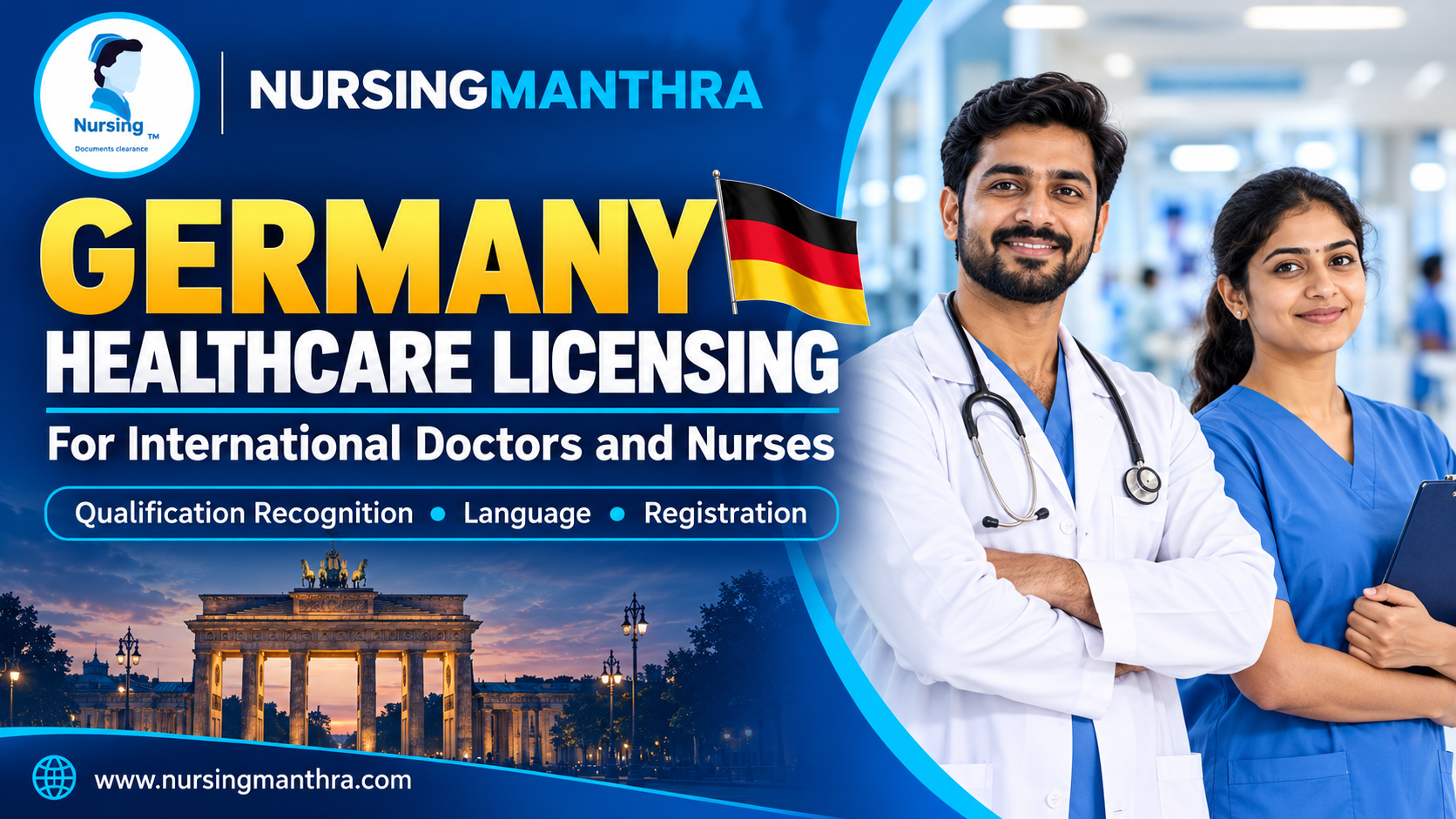
A doctor and a nurse can move to the same German city and still face different recognition procedures. The doctor may need Approbation and a medical language examination. The nurse needs recognition against the German nursing profession and permission to use the protected professional title. Understanding that difference is the first step in building a realistic application plan.
This guide focuses on qualifications obtained outside the EU, EEA and Switzerland, including Indian qualifications. EU qualifications and certain previously recognised qualifications need a separate route assessment. Your degree title, training content, registration history and target German state all matter.
Who handles recognition in Germany:
Germany has no single national application office for every healthcare licence. The responsible state authority assesses recognition and issues the relevant professional permission. Medical chambers can organise language examinations and handle professional chamber matters; they should not all be described as the authorities issuing Approbation. Use the federal Recognition Finder to identify the correct office for your profession and intended location.
For doctors, Approbation is the unrestricted professional licence. For nurses, the outcome is recognition and permission to use the relevant nursing title. A restricted medical permission, where available, is different from full Approbation and comes with conditions.
The route for doctors:
Step 1 Choose a state and identify the correct authority:
Decide where you genuinely intend to work. Start from that state’s official checklist and application instructions. Record any previous German applications accurately, rather than opening multiple inconsistent files.
Step 2 Prepare the qualification assessment file:
Collect evidence of medical education, training duration and clinical experience. The authority examines whether your qualification is equivalent and whether the remaining licensing conditions are satisfied. If substantial educational differences remain, a Kenntnisprüfung, or knowledge examination, may be required. It is not the same as the medical language examination.
Step 3 Build the necessary German language skills:
The general expectation for doctors is B2 German, with a specialist medical language examination generally based on C1. Accepted certificates, exemptions and examination arrangements must be confirmed with the state authority. Passing a general language course does not automatically satisfy the medical communication requirement.
Step 4 Complete any examination and outstanding evidence:
Respond to the authority’s actual decision. Do not book an expensive knowledge-test package merely because another applicant needed that examination. Your own assessment determines the next requirement. Check where health, conduct and language evidence must be submitted and whether documents have short validity periods.
Step 5 Obtain permission and complete professional formalities:
Once all requirements are met, obtain Approbation and confirm the applicable chamber, employment and immigration formalities before starting unrestricted clinical work. Specialist recognition is a further professional matter; a foreign specialist award should not be treated as automatically recognised through basic licensing.
The route for nurses:
The nursing authority assesses the qualification against the German reference profession. B2 German, health suitability and personal trustworthiness are among the core requirements. Where significant differences cannot be resolved through the assessment, an adaptation period or knowledge test can be used to demonstrate the necessary competence.
A nurse’s practical sequence is:
1. Identify the state nursing recognition authority.
2. Assemble education and clinical-hours evidence.
3. Submit the correct application and obtain the assessment or required measure.
4. Complete the language requirement and any adaptation or examination.
5. Obtain professional permission and confirm the authorised scope of work.
Current guidance also describes the option of waiving the detailed equivalence assessment and proceeding to an adaptation measure. This is a choice with consequences: your existing training and experience may not reduce the measure in the same way. Obtain individual advice before signing a waiver.
Employment as a care assistant while recognition is pending is not the same as permission to practise as a recognised nurse. Check the actual job title and duties in the contract.
Documents to start collecting:
Treat this as a preparation list. The state and profession-specific checklist controls the final submission.
Passport and evidence explaining any name changes.
Medical or nursing qualification and final award certificate.
Detailed transcript, syllabus, course duration and theoretical and clinical hours.
Internship and supervised training records, where relevant.
Registration or evidence of the right to practise in the training country.
Employment certificates and an accurate chronological CV.
Language evidence, with any required specialist language result.
Conduct or good-standing evidence and medical fitness evidence when requested.
Required German translations, certified copies and application declarations.
Do not order every short-validity certificate at the beginning of a long language course. First ask when it must be current. Ensure translations are acceptable to the receiving authority; a document translated for a different regulator may not meet German requirements.
Fees and the real budget:
There is no reliable single Germany-wide price for the complete pathway. As a location-specific example, the Berlin medical chamber currently lists €550 for its specialist medical language examination. This is not a national tariff or a complete package price. Approbation and nursing recognition fees must be checked with the responsible state office.
Budget separately for language study, examination attempts, translations, certification, any knowledge test or adaptation, travel and living expenses. Obtain a written NursingManthra service quotation separately from government and examination charges. An employer contribution should be confirmed in the contract, including any repayment clause.
How long can the process take:
A document assessment period is not the same as the time needed to become ready for work. Some official nursing guidance describes a four-month assessment once the documents are complete. Language learning, missing records, adaptation, examinations and immigration can extend the overall journey substantially. Do not treat the administrative target as a guaranteed arrival or employment date.
What about physiotherapists and other healthcare professionals:
Start with the exact protected profession in the Recognition Finder. The nursing adaptation route and the medical Approbation route should not be copied into an allied health application. Check whether the foreign qualification corresponds to the German profession and which authority assesses it.
Practical questions before you proceed:
Can I begin from India or the Gulf? Initial recognition preparation can begin abroad, but examinations, adaptation and identity or employment requirements may require attendance in Germany. Confirm the specific application channel.
Is a German course certificate a medical licence? No. Keep education recognition, language evidence, professional permission and the right to enter or work as separate milestones.
Will a postgraduate nursing degree remove every assessment requirement? Do not assume this. Submit the complete professional education history and let the authority assess the actual qualification.
NursingManthra application guidance
For an initial review, share your profession, country of qualification, current registration, CV, language level and preferred German state. NursingManthra can assist with organising documents and the application steps within an agreed service scope. Language tuition, test preparation, adaptation placements and employment arrangements must be confirmed separately with the relevant providers; they are not automatic inclusions in an administrative service.
Contact NursingManthra through www.nursingmanthra.com (https://www.nursingmanthra.com/) or WhatsApp +971 50 251 5717. Recognition decisions belong to the German authorities. A licence does not itself grant a visa or guarantee employment.
Official sources:
1. Federal Recognition Finder example for doctors in Berlin (https://www.anerkennung-in-deutschland.de/en/interest/finder/result?arrangement=Nein&location=47619&nationality=Drittstaat&profession=412&qualification=Drittstaaten&success=Ja&whereabouts=Ausland&zipSearch=0)
2. German government portal for physicians (https://www.make-it-in-germany.com/en/working-in-germany/professions-in-demand/physicians)
3. German government portal for nursing professionals (https://www.make-it-in-germany.com/en/working-in-germany/professions-in-demand/nursing)
4. Federal portal nursing recognition example for North Rhine Westphalia (https://verwaltung.bund.de/leistungsverzeichnis/EN/leistung/99150018001000/herausgeber/NW-121424685/region/050000000000)
5. Berlin medical chamber current specialist language examination fee (https://www.aekb.de/aerzt-innen/aus-dem-ausland-ins-ausland/fachsprachpruefung)
6. Berlin state authority doctor Approbation application and documents (https://service.berlin.de/dienstleistung/331391/)
Independent educational and application guidance. Requirements, fees and accepted evidence may change. Confirm the rules applicable to your profession, state and application date.
For assistance kindly contact nursing manthra whatsapp number-+971502515717
About the Author
Shincy George, RN, MSN (Cardiothoracic Nursing), SCFHS-RN, DHA RN, MOH UAE RN, NCLEX-RN (USA), is the Founder of Nursing Manthra Academy.
With extensive international clinical and academic experience, she is dedicated to guiding healthcare professionals through global licensing pathways. Through Nursing Manthra, she supports internationally educated healthcare professionals in achieving their career goals across Canada, USA, UAE, Middle East, UK, Ireland, Australia, New Zealand, and other countries.
Her mission is to simplify complex licensing processes and empower healthcare professionals with the right knowledge, guidance, and support to succeed globally.