By NursingManthra | Updated 23 October 2026 | Includes published 2027 examination fees
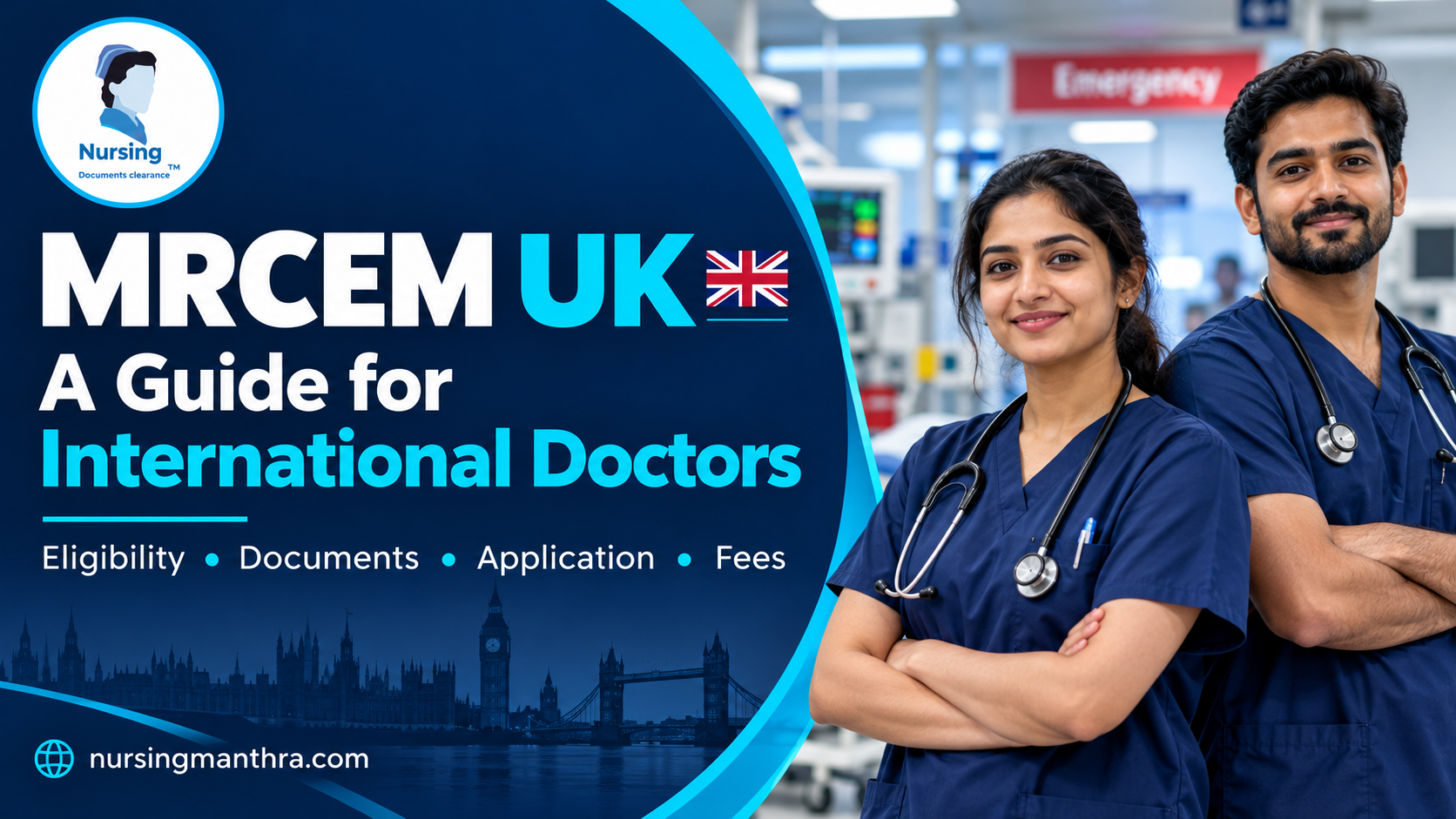
For a doctor working in an emergency department, the decision to pursue MRCEM often begins with a practical question: “Can I apply with my present qualification and experience?”
The answer depends on which examination you are applying for. A doctor may meet the requirements for MRCEM Primary but still need more clinical experience before progressing to SBA or OSCE. Understanding that distinction before paying for an examination can help you plan your time, documents and budget.
This guide explains the pathway for doctors educated outside the UK, including applicants from India and other countries.
What is MRCEM?
MRCEM stands for Membership of the Royal College of Emergency Medicine. It is a postgraduate examination qualification awarded through the UK Royal College of Emergency Medicine.
Candidates normally progress through three examinations in order:
MRCEM Primary → MRCEM SBA → MRCEM OSCE
Completing Primary alone does not mean that you hold the full MRCEM qualification. Membership by examination requires completion of the relevant components.
The three examinations at a glance
| Examination | Format | Main focus |
| MRCEM Primary | 180 single best answer questions in three hours | Basic sciences relevant to emergency medicine |
| MRCEM SBA | 180 questions across two two-hour papers, with a one-hour interval | Clinical assessment and decisions across emergency presentations |
| MRCEM OSCE | 16 assessed stations of eight minutes each, plus reading time and rest stations | Practical clinical and communication skills |
The theory examinations use Surpass Assessment test centres. Listed OSCE locations include London, Kuala Lumpur, Chennai and Hyderabad; check the available sitting before making travel plans.
MRCEM eligibility for internationally educated doctors:
Your primary medical qualification must be acceptable to the GMC. The following requirements apply at the point of application, rather than being requirements you can finish before examination day.
| Stage | Medical registration | Experience | Previous examination passes |
| Primary | Current provisional or full registration | No separate minimum experience listed | None |
| SBA | Current full registration with a licence to practise | Two years after the primary medical qualification | MRCEM Primary |
| OSCE | Current full registration with a licence to practise | Six months full-time-equivalent emergency medicine experience above Foundation training | MRCEM Primary and MRCEM SBA |
RCEM assesses eligibility, including how overseas training and experience meet these requirements.
Does an MBBS degree make me eligible?
An MBBS or other primary medical degree is the starting qualification. It does not, by itself, establish eligibility for every examination stage. Check the acceptability of your qualification, registration status, clinical experience and previous passes together.
For an Indian applicant, a sensible first step is to place the degree certificate, internship completion certificate and current medical registration side by side. Check the dates and make sure the employment history accurately explains what happened after graduation.
Does internship emergency experience count for OSCE?
Do not assume that an emergency department posting during internship satisfies the OSCE requirement. RCEM specifies emergency medicine experience above Foundation training. If your role, training level or part-time hours make the position unclear, obtain RCEM clarification before applying.
A useful employer letter should describe your actual role rather than simply state “hospital experience.” Ask the hospital to include department, designation, exact dates, weekly hours or full-time status, responsibilities, and an authorised signature with contact details. This is a practical preparation recommendation; follow any specific evidence request RCEM sends you.
Do you need GMC registration before applying?
GMC registration is not the only registration accepted for entering the examinations. RCEM regulations also allow registration with the statutory medical regulator where the doctor practises, subject to the relevant stage and any restrictions requiring disclosure.
However, permission to sit an examination and permission to practise medicine in the UK are separate matters. Keep your examination application and any later UK registration application as separate projects with separate checklists.
Is IELTS or OET required?
RCEM examinations are conducted in English. Its examination information identifies IELTS Level 7 as the expected English standard. The regulations specifically state that OSCE candidates must have achieved IELTS Level 7, OET or equivalent and may be asked for evidence. Confirm the evidence accepted for your application rather than assuming that English-medium medical education automatically settles the question.
Any later GMC application has its own English-language requirements. Check those independently when planning UK registration.
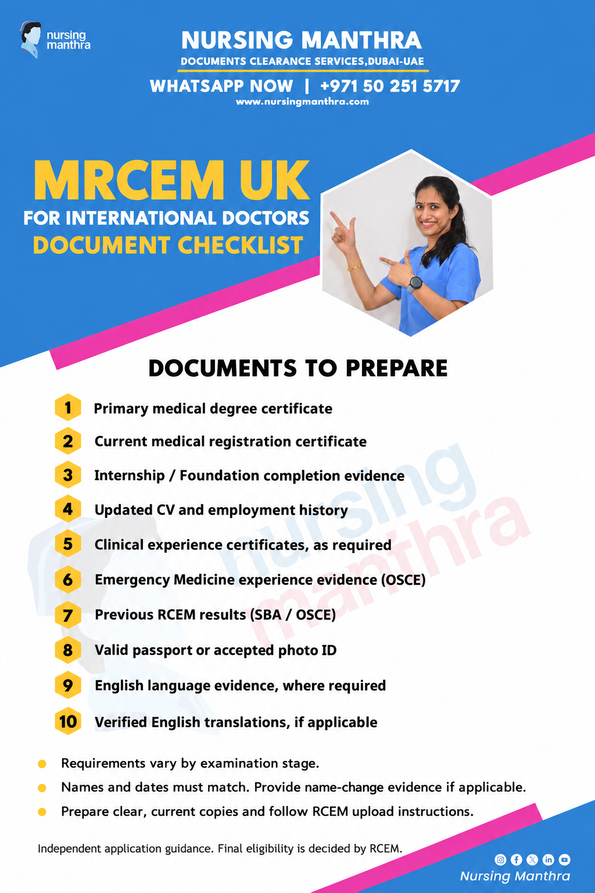
Documents to prepare:
RCEM asks candidates to keep qualification, registration, training and employment information current, with supporting documents in English or verified English translation.
| Document or information | Preparation point |
| Primary medical qualification | Keep a clear degree certificate and accurate qualification details ready |
| Current medical registration | Upload the valid certificate appropriate to the examination stage |
| Internship or Foundation evidence | Prepare the internship completion or UK Foundation certificate |
| Employment history | Update dates, posts and departments in the RCEM account |
| Experience evidence | Keep supporting letters available for eligibility queries |
| Identity document | Ensure the examination booking name matches accepted ID |
| English evidence | Prepare it when applicable, particularly for OSCE |
| Translation or additional evidence | Provide verified translations and any specifically requested clarification |
Valid matching ID is required on examination day. Check the current supplier instructions for the exact ID accepted.
Treat the checklist as a preparation aid, not a promise that every applicant must upload every item in the same format. Resolve name or date differences before the deadline rather than trying to explain them at the test centre.
How to apply for MRCEM:
1. Choose the correct stage. Check eligibility and previous results before selecting a sitting.
2. Create or update your RCEM account. Check personal details, qualifications, registration and employment history.
3. Prepare the evidence. Remove expired documents and upload clear current copies.
4. Apply within the published window. RCEM normally opens applications at 10 am UK time and closes them at 4 pm UK time on the stated dates. Submit before the deadline.
5. Complete the theory booking process. After eligibility review, follow the Surpass email to select a test centre within the separate booking deadline. An application submission is not the final test-centre booking.
6. For OSCE, wait for allocation. Places are limited. Eligible applicants may be prioritised using RCEM’s oversubscription criteria. Pay within the deadline if offered a place.
7. Check the final confirmation. Read the location, reporting time and ID instructions carefully. For overseas travel, arrange the required visa and leave time for entry formalities.
Use the official RCEM application page (https://rcem.ac.uk/apply-for-an-exam/) and exam calendar (https://rcem.ac.uk/exam-calendar-fees/) for the current sitting. Convert UK deadlines carefully: the UK changes between GMT and British Summer Time, while India does not.
MRCEM examination fees:
The following are RCEM’s published 2027 fees, checked on 23 October 2026. Each theory fee applies separately to Primary and SBA.
| Examination and location | Member | Non-member |
| Primary or SBA — UK | £444 | £543 |
| Primary or SBA — international | £502 | £630 |
| OSCE — UK | £606 | £702 |
| OSCE — international | £1,161 | £1,392 |
For one attempt at each component, all at international venues using these fees, the calculated examination-only total is £2,165 for a member or £2,652 for a non-member.
These totals exclude membership subscriptions, applicable taxes, repeat attempts, preparation, travel and accommodation. Confirm the amount for your actual sitting. Taxes depend on country of residence, not examination venue. RCEM requires membership payment at least 24 hours before the application window opens to qualify for the reduced fee.
Other costs to plan for:
Build your personal budget around the journey you will actually take. A local theory sitting and an overseas OSCE can have very different travel costs.
Allow for, where applicable:
English-language testing and document translation.
Membership subscriptions and study resources.
Bank conversion or international transaction charges.
Visa, flights, accommodation and local travel.
Repeat examinations and additional preparation time.
A later GMC application and its separate verification requirements.
If using an application assistance service, obtain a written quotation showing the service charge separately from official examination fees.
Attempts and the seven-year completion rule:
RCEM normally allows six attempts at each MRCEM component. An additional attempt requires approval and is not automatic.
The standard completion period runs for seven years from passing Primary. SBA and OSCE must be completed within that currency period, subject to RCEM’s extension provisions. Doctors with older passes or an interrupted examination journey should check their individual position.
Can MRCEM help with GMC registration?
The GMC lists MCEM/MRCEM among its acceptable postgraduate qualifications. A completed acceptable qualification can support the relevant application route for full registration with a licence to practise. Primary or SBA alone should not be presented as the completed award.
The GMC still assesses its other requirements. Passing MRCEM does not automatically issue a medical licence, employment offer, visa or specialist registration. The GMC also applies a recency rule: a qualification older than three years at approval requires additional evidence of recent medical experience.
Preparing alongside clinical work
Plan each stage around what it assesses. Primary needs structured basic science preparation. SBA needs clinical reasoning across emergency presentations. OSCE needs practical rehearsal, communication and feedback.
For SBA practice, look beyond whether you chose the correct diagnosis. Ask why one action comes first, what makes a competing option unsafe and which new finding would change your decision. Keep an error notebook organised by reasoning problem, such as missed instability, delayed source control or failure to reassess.
Planning your next step with NursingManthra
Before requesting application guidance from NursingManthra, prepare your qualification, internship and registration details, current CV, emergency department experience and previous RCEM results. This makes it easier to identify the stage you intend to apply for and the questions that need clarification.
Ask about the current scope and charges for document review or online application assistance before proceeding. Eligibility approval, examination allocation and results remain RCEM decisions.
Visit NursingManthra (https://nursingmanthra.com/) for enquiries.Whatsapp-+971502515717
*NursingManthra is an independent consultancy and educational resource provider. It is not affiliated with or endorsed by RCEM or the GMC. Requirements and fees can change; use the official guidance applicable to your sitting.*
Official references:
1. RCEM MRCEM examinations (https://rcem.ac.uk/mrcem-exams/)
2. RCEM examination eligibility and currency (https://rcem.ac.uk/exam-eligibility-and-adjustments/)
3. RCEM MRCEM examination regulations (https://rcem.ac.uk/wp-content/uploads/2024/11/MRCEM_Exam_Regulations_2025_V1.pdf)
4. RCEM examination applications (https://rcem.ac.uk/apply-for-an-exam/)
5. RCEM theory examination guidance (https://rcem.ac.uk/theory-exams-faqs/)
6. RCEM calendar and fees (https://rcem.ac.uk/exam-calendar-fees/)
7. GMC acceptable postgraduate qualifications (https://www.gmc-uk.org/registration-and-licensing/join-our-registers/before-you-apply-guide-for-doctors/acceptable-postgraduate-qualifications)
8. GMC registration route for international graduates with a postgraduate qualification (https://www.gmc-uk.org/registration-and-licensing/join-our-registers/registration-applications/application-guides/full-registration-for-international-medical-graduates-with-a-postgraduate-qualification)
For Study materials—https://nursingmanthra.com/product/mrcem-uk-exam-review-2000-mcqs/
About the Author
Shincy George, RN, MSN (Cardiothoracic Nursing), SCFHS-RN, DHA RN, MOH UAE RN, NCLEX-RN (USA), is the Founder of Nursing Manthra Academy.
With extensive international clinical and academic experience, she is dedicated to guiding healthcare professionals through global licensing pathways. Through Nursing Manthra, she supports internationally educated healthcare professionals in achieving their career goals across Canada, USA, UAE, Middle East, UK, Ireland, Australia, New Zealand, and other countries.
Her mission is to simplify complex licensing processes and empower healthcare professionals with the right knowledge, guidance, and support to succeed globally.