Updated: August 2026
How Can an International Nurse Work as a Registered Nurse in the Netherlands?
The Netherlands offers career opportunities for internationally educated nurses, but overseas nurses cannot simply use their foreign nursing registration to begin working as a Dutch registered nurse.
Nursing is a BIG-register profession in the Netherlands. An internationally educated nurse must first have the foreign nursing qualification officially recognised and then obtain registration in the BIG-register before being allowed to work under the regulated nursing profession in the Netherlands.
For nurses educated outside Europe, such as nurses trained in India, the Philippines, Nepal or other non-EU countries, the usual recognition route is the Certificate of Competence – Verklaring van Vakbekwaamheid procedure. Nurses who qualified in the EU or Switzerland may qualify for a different recognition route, including automatic recognition for certain European qualifications.
This guide explains the complete pathway, including qualification recognition, Dutch and English language requirements, the nursing BI test, document preparation, BIG registration, costs, work-experience requirements and immigration.
First Understand the BIG Register
The BIG-register is the official Dutch healthcare professionals register. For nurses, registration is mandatory before practising as a registered nurse in the Netherlands. BIG registration also confirms that the healthcare professional meets the applicable professional requirements and allows the person to use the legally protected professional title.
For an internationally educated nurse, there are therefore two major stages:
Stage 1: Recognition of the foreign nursing qualification
followed by
Stage 2: Registration in the BIG-register
Receiving diploma recognition alone is not enough for a nurse; BIG registration is still required before working as a nurse.
Which Registration Route Applies to You?
The route depends primarily on where your professional nursing diploma was obtained, while immigration requirements depend separately on your nationality.
The BIG Register currently has three foreign-diploma recognition pathways. Certain nursing qualifications obtained in an EU Member State or Switzerland may qualify for automatic recognition with direct BIG registration. Other EU/Swiss qualifications generally use the Recognition of Professional Qualifications procedure. A nursing diploma obtained outside the EU or Switzerland generally follows the Certificate of Competence procedure.
Because most Nursing Manthra readers from countries such as India and other non-EU countries will fall under the third category, the remainder of this article focuses mainly on the Certificate of Competence pathway for non-EU internationally educated nurses.
Basic Requirements for a Non-EU Internationally Educated Nurse
A foreign nurse applying through the Certificate of Competence route must demonstrate an appropriate professional nursing qualification, sufficient Dutch language ability, English reading ability, legal eligibility to practise the profession in the country of qualification, and sufficient professional competence when compared with Dutch nursing standards. Nurses in this route must also complete the Dutch BI professional competence test.
The Dutch authority does not simply approve a qualification because the certificate says BSc Nursing, Diploma Nursing or GNM. The content and level of the applicant’s nursing education are assessed against the corresponding Dutch professional education. The assessment can also consider relevant additional education and professional experience.
Dutch Language Requirement for Nurses
This is one of the most important requirements.
For the foreign-diploma recognition procedure, the BIG Register currently places nursing under the MBO professional level for language purposes, for which the minimum Dutch-language requirement is:
Dutch Language Level: B1
The nurse must be able to demonstrate:
Reading + Writing + Speaking + Listening
A certificate showing only attendance at a Dutch-language course is not enough. It must show successful completion of an accepted examination or assessment. The applicable language certificate generally must not be older than two years.
Pathway 1: State Examination NT2 – Program I, B1
The main Dutch-language pathway is the Staatsexamen Nederlands als Tweede Taal – NT2.
For B1, the relevant examination is:
NT2 Programma I – B1
The official NT2 examination consists of four components:
Reading, Listening, Speaking and Writing.
DUO administers the State Examination NT2 on behalf of the Dutch College for Tests and Examinations. Program I corresponds to B1, while Program II corresponds to B2.
The current examination fee is:
€50 per component
or
€200 for all four components
as of August 2026.
The NT2 examination is currently offered at examination centres in Amsterdam, Eindhoven, Rijswijk, Rotterdam, Utrecht and Zwolle.
Pathway 2: Dutch Language Examination from Abroad – CNaVT
An applicant who is living outside the Netherlands but already has sufficient Dutch may also be able to use an accepted CNaVT – Certificate of Dutch as a Foreign Language examination administered under the Dutch Language Union.
The BIG Register states that an appropriate CNaVT test can be used for applicants taking Dutch as a foreign language abroad. The CNaVT examination is normally held once a year in May. Applicants should ensure that the examination corresponds to the required professional language level before registering.
This can be particularly useful for candidates who want to complete their language requirement before travelling to the Netherlands.
Pathway 3: Previous Education in Dutch
A separate Dutch-language test may not always be necessary if the candidate already has accepted evidence of Dutch-language education.
BIG accepts certain evidence such as Dutch-language primary and secondary education or a diploma supplement confirming that the professional education was completed in Dutch, provided it satisfies the applicable requirements.
For most nurses educated in India, the Philippines or other non-Dutch-speaking countries, however, NT2 B1 will generally be the more relevant pathway.
Is IELTS Required to Become a Nurse in the Netherlands?
Not necessarily.
The Certificate of Competence procedure requires internationally educated nurses to demonstrate English reading ability in addition to Dutch proficiency. For language-requirement purposes, BIG currently lists nurses under the MBO professional category, for which the required English reading level is:
English Reading: A2
However, a separate English examination may not be necessary if acceptable evidence shows that the candidate completed professional nursing education in English. BIG specifically accepts a diploma supplement confirming that vocational/professional education was completed in English as one possible form of proof.
If a separate examination is needed, BIG’s current A2 table specifically lists Cambridge 120–139 and EnglishScore from the British Council among the options for the MBO level. BIG also provides general provisions for recognised English-test evidence. English language certificates used as test evidence generally must not be more than two years old.
Therefore:
IELTS is not automatically mandatory for every internationally educated nurse applying to the Netherlands.
A nurse whose nursing education was conducted in English may be able to use acceptable educational evidence instead.
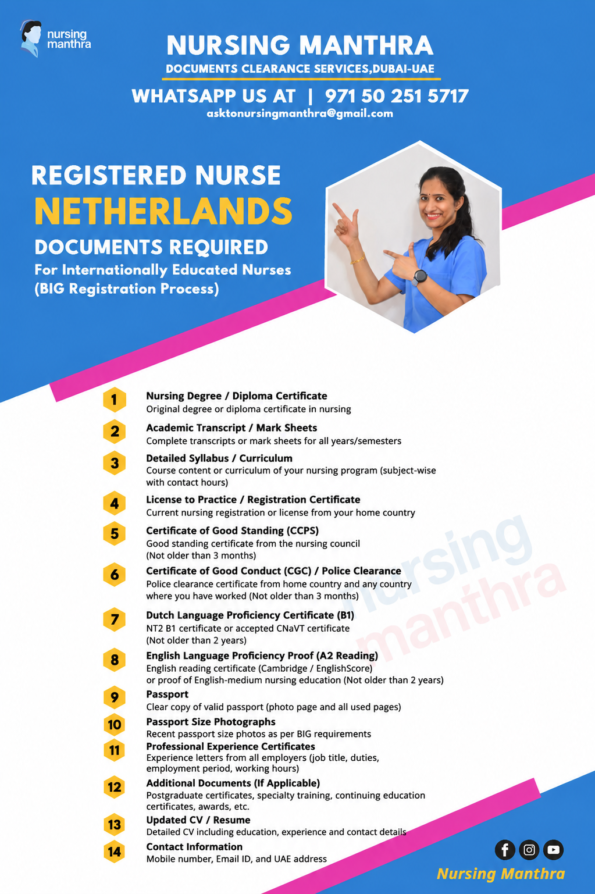
Documents Required for Dutch Nursing Qualification Recognition
Document preparation is one of the most important stages because an incomplete file can significantly delay the application.
BIG’s Certificate of Competence guidance requires applicants to provide their professional nursing diploma, an overview of the nursing course/subjects, the training programme or detailed syllabus/curriculum, a certified copy of the passport or European ID, evidence showing authorisation to practise the profession in the country of qualification, Dutch-language evidence and English-reading evidence.
The detailed syllabus or curriculum is particularly important. BIG states that it should relate to the years in which the applicant actually completed the programme, contain the applicant’s name and describe the content of the courses studied.
Applicants are also encouraged to provide a detailed CV, specialist or postgraduate qualifications, additional professional training certificates and evidence of nursing work experience. Employer evidence should clearly show the position held, duties performed and period of employment.
Documents in languages other than Dutch or English generally require translation by a sworn translator, together with the required original-language document. BIG also warns that an apostille by itself does not replace the required certification of a copy because an apostille verifies a signature rather than the content of the document.
Step-by-Step Application Process for a Non-EU Nurse
The practical Certificate of Competence pathway can be understood in the following order.
- Learn Dutch and complete the required language evidence. For nurses this is normally Dutch B1, together with the required English-reading evidence. BIG recommends waiting until the appropriate language evidence and major documents are ready before submitting the recognition application.
- Collect your nursing documents. Prepare the diploma, course/subject overview, detailed curriculum or syllabus, evidence of professional authorisation, identity documents, language certificates, CV and supporting professional experience documents.
- Create access to My BIG Register. Candidates with a Dutch BSN can use DigiD. Applicants who do not yet have a BSN, for example because they are living abroad, can obtain a BIG login.
- Complete the Certificate of Competence application online. The system generates a personalised overview of the documents required for the individual application. A profession-specific appendix may also be required.
- Submit the evidence requested by BIG. Some documents can be uploaded digitally, while others may have to be submitted in the required certified form or by post. The application is processed once all required evidence has been received.
- Qualification assessment takes place. BIG can arrange assessment of the foreign qualification and subject overview through Nuffic or SBB where necessary; the applicant does not need to independently commission this assessment.
- Take the Nursing BI Test. Nurses applying under the Certificate of Competence route must complete the professional competence examination.
- CBGV assesses the complete case. The Commission for Foreign Healthcare Graduates considers the foreign education, BI-test results and other relevant professional evidence. Additional education or a work placement can be required if substantial differences remain.
- Receive the decision and Certificate of Competence. BIG first communicates an intended decision. Applicants can respond to that intended decision before the definitive decision is issued. A positive outcome results in recognition through the Certificate of Competence.
- Complete BIG registration. Nurses cannot yet work as registered nurses merely because the foreign qualification has been recognised. Final BIG registration must be completed and the required professional-status and conduct documents supplied.
Dutch Language Training Centres in India
| Institute | Location / Mode | Levels / Useful Features |
|---|---|---|
| Langma School of Languages | New Delhi + Online | Dutch A1–C2, all four skills; offers NT2 and CNaVT preparation. Langma states that it is an official CNaVT examination centre. |
| The Dutch Door | Online; current batches also shown for Pune and Hyderabad | Offers structured Dutch courses including A1, A2 and B1; its current schedule shows online B1 training as well as courses connected with Pune and Hyderabad. |
| ODEPC Training Division | Kerala centres: Thiruvananthapuram, Pathanamthitta, Palarivattom, Angamaly, Kozhikode; also New Delhi | Provides Dutch-language training, including online/offline options. However, Dutch training is currently limited to candidates selected through ODEPC’s corresponding recruitment programmes, rather than being open general-public training. |
Particularly useful option for Indian nurses
For someone starting from India specifically for the Netherlands nursing pathway, Langma is worth checking first because it offers Dutch training through the required CEFR levels and specifically advertises CNaVT/NT2 examination preparation, rather than only conversational Dutch.
The Dutch Door can also be useful for candidates who prefer a structured online B1 pathway.
Dutch Language Training Centres in UAE
| Institute | Location / Mode | Levels / Useful Features |
|---|---|---|
| Eton Institute | Dubai Knowledge Park + Abu Dhabi Yas Creative Hub + Online | Dutch courses from beginner through advanced levels, aligned to CEFR; group, private and online options. Their current course information includes training through B1 and beyond. |
| Berlitz UAE | Dubai – JLT and Jumeirah + Online | In-person Dutch courses, private/group/intensive options and online classes; focuses on speaking, listening and practical language development. |
| Al Manal Training Center | Abu Dhabi | Dutch beginner/intermediate courses are currently listed by UAE course directories; current listings show approximately 30-hour beginner and intermediate modules. I would confirm the active Dutch batch directly with the institute before payment because its own current site does not prominently list Dutch on the pages I could verify. |
Strongest UAE option to check first
For an internationally educated nurse in Dubai or Abu Dhabi, Eton Institute is currently the clearest directly verified option because it offers Dutch at multiple CEFR levels, including progression to B1, with both UAE classroom and online delivery.
Berlitz Dubai is another established option, particularly for candidates preferring private or intensive learning.
Very Important for Nurses: Training Course vs BIG Language Certificate
A nurse should not ask only:
“Does this institute give a B1 certificate?”
Instead, ask:
“Does this programme prepare me for the Dutch language certificate accepted by BIG for foreign-trained nurses?”
BIG currently requires nurses to demonstrate B1 Dutch, with assessment of:
- Reading
- Writing
- Speaking
- Listening
For B1/B2, BIG identifies the Staatsexamen Nederlands als Tweede Taal (NT2) route. For candidates living abroad, BIG also allows an appropriate CNaVT test from the Nederlandse Taalunie. A simple attendance or course-completion certificate is not sufficient.
Therefore, before joining any centre, ask these 5 questions:
- Do you teach from A1 up to B1 Dutch?
- Does the course cover reading, writing, speaking and listening?
- Do you specifically prepare candidates for NT2 Program I/B1 or an accepted CNaVT examination?
- Do you have experience training healthcare professionals/nurses?
- Where will I take the final recognised examination?
Practical pathway for nurses in India/UAE
A beginner can usually plan the language journey as:
A1 → A2 → B1 → dedicated NT2/CNaVT exam preparation → recognised B1 examination → BIG recognition application.
For a nurse living permanently in India, I would first enquire with Langma and The Dutch Door. For a nurse living in the UAE, I would first enquire with Eton Institute, followed by Berlitz Dubai.
Before paying, candidates should tell the institute clearly:
“I need Dutch B1 for the Netherlands BIG Register nursing recognition process, not only a general Dutch-language course.”
What Is the Nursing BI Test?
The BI-toets is the professional competence examination required for nurses, doctors and dentists using the Certificate of Competence procedure.
For nurses, the current BI assessment consists of:
a written nursing knowledge test, a practical skills test, and a clinical-reasoning interview.
The examination assesses whether the applicant’s knowledge and professional skills correspond sufficiently with the Dutch professional standard.
Current Nursing BI Test Fee: €400
The BI test is offered at a number of scheduled times during the year. After the test, BIG says results are normally available within approximately 3–6 weeks.
What Happens If Your Nursing Education Is Not Fully Equivalent?
Not every internationally educated nurse receives immediate recognition.
The CBGV – Commission for Foreign Healthcare Graduates assesses the applicant’s education, competence and BI-test result. If there are significant differences between the foreign education and Dutch nursing requirements, the commission can require further education or an additional work placement before recognising the qualification.
According to BIG’s current guidance, additional education may range from approximately three months to two years, depending on the deficiencies identified in the individual assessment.
Therefore, international applicants should submit detailed evidence of relevant:
- nursing experience,
- postgraduate qualifications,
- continuing education,
- specialty courses, and
- professional duties.
These documents can help the CBGV obtain a more complete picture of the applicant’s professional competence.
Final BIG Registration After Diploma Recognition
Once the Certificate of Competence has been granted, the nurse must complete registration in the BIG-register.
The key conditions are a recognised professional qualification, adequate Dutch-language proficiency, and evidence that the nurse does not have professional-practice restrictions or relevant criminal convictions.
Two important documents at this stage are:
CCPS – Certificate of Current Professional Status. This demonstrates that there are no applicable restrictions on the nurse’s authority to practise.
CGC – Certificate of Good Conduct. This provides evidence regarding criminal convictions.
BIG requires these documents from relevant foreign jurisdictions based on the applicant’s education, residence, professional work and placements. The CCPS and CGC used for BIG registration generally must not be older than three months.
Applicants with work or residence in several countries should therefore review their personalised BIG requirements carefully rather than assuming that documents are needed only from their home country.
BIG Registration Fee
The current BIG registration fee is:
€85
Registration is issued for five years.
What If Your Nursing Diploma Is More Than Five Years Old?
This is extremely important for experienced internationally educated nurses.
If the nursing qualification was obtained five years ago or longer, additional requirements apply when registering in the BIG-register.
For nurses, the current work-experience standard is:
2,080 hours of nursing work within a five-year period
If this work-experience requirement cannot be met, a training route may be available instead.
Foreign nursing experience can count, but BIG requires it to meet the applicable nursing evaluation criteria. Where the nurse practised abroad, legal professional registration may need to be demonstrated through a Certificate of Current Professional Status or equivalent evidence.
This makes recent, properly documented nursing experience particularly important for nurses whose original qualification is more than five years old.
How Long Does the Netherlands Nursing Registration Process Take?
For the Certificate of Competence procedure, BIG currently estimates an average of approximately:
6 months to 1.5 years after the application is submitted
This does not necessarily include the time required beforehand to learn Dutch, sit the language examination or collect documents from foreign institutions and regulators.
If additional training is ordered, the process can take substantially longer; BIG states that such training may last approximately three months to two years depending on the case.
Incomplete applications, missing syllabi, document-verification problems and waiting for BI-test availability can also lengthen the overall timeline.
A realistic candidate should therefore begin Dutch-language preparation and document collection as early as possible.
How Much Does the Complete Netherlands RN Process Cost?
There is no single universal total because Dutch-language courses, translations, certification, professional-status certificates, travel, English testing and any additional training vary considerably between applicants.
However, the major fixed official fees for a typical non-EU nurse using the NT2 pathway are currently:
| Process | Current Official Fee |
|---|---|
| Certificate of Competence application/CBGV assessment | €0 |
| NT2 Program I B1 – 4 components | €200 |
| Nursing BI Test | €400 |
| BIG Registration | €85 |
| Core official licensing fees | €685 |
| GVVA work/residence permit, if this route applies | €423 |
| Licensing + GVVA official fees, where applicable | €1,108 |
The €685 figure should not be interpreted as the entire real-world cost. Candidates may additionally have to pay for Dutch-language classes, English-language testing when separate proof is required, certified copies, sworn translations, CCPS/Good Standing certificates, CGC/police certificates, courier charges, travel and accommodation for examinations, retests, and any bridging education required by CBGV. BIG explicitly states that these additional costs vary by individual situation and country.
The immigration fee is also a separate matter from professional registration.
Visa and Work Permit for Nurses
BIG registration and immigration permission are completely separate processes.
An EU/EEA or Swiss citizen can work in the Netherlands without a Dutch work permit and does not require a Dutch residence permit under the ordinary EU free-movement rules.
A nurse who is a citizen of a non-EEA country, such as India, normally requires appropriate permission to live and work in the Netherlands. For employment lasting more than three months, one commonly applicable route is the GVVA – combined residence and work permit, although the exact immigration route depends on the employment and personal circumstances.
The IND currently charges €423 for the GVVA application. The IND recommends that the employer submit the application in the Netherlands. If an employer pays this application fee, the IND states that the employer is not permitted to pass that fee on to the employee.
Candidates should therefore avoid assuming that completing BIG registration automatically provides a Dutch visa or guarantees employment.
Can You Apply for BIG Recognition While Living Outside the Netherlands?
Yes. Candidates who do not yet have a Dutch Citizen Service Number (BSN) and therefore cannot use DigiD can obtain a BIG login to access My BIG Register from abroad.
The main difficulty is language examination planning. The regular NT2 B1 State Examination is held at examination locations in the Netherlands, while BIG also recognises an appropriate CNaVT route for candidates taking Dutch as a foreign language abroad.
Is Nursing Experience Mandatory?
Recent work experience is not described as a universal prerequisite for every Certificate of Competence applicant, but relevant professional experience can be important during the competence assessment and should be documented properly. BIG specifically encourages evidence of practical and professional experience as supporting material for the CBGV assessment.
If the qualification is five years old or more, the issue becomes much more important because the nurse must satisfy the re-registration-style work or training requirement, currently 2,080 qualifying hours over five years for nurses.
Can a GNM Nurse Apply for Registration in the Netherlands?
A foreign diploma is assessed on its content, professional level and comparability rather than solely on its title. Therefore, a GNM, Diploma in Nursing or BSc Nursing candidate should not assume approval or rejection merely from the name of the qualification.
For non-EU applicants, the CBGV assesses whether the applicant’s education and competence are sufficiently comparable with Dutch nursing requirements and may prescribe additional education if significant differences are found.
A detailed syllabus, transcript, clinical-training information and work-experience evidence are therefore particularly valuable.
Is the NCLEX Required for the Netherlands?
The Dutch nurse-registration pathway is not based on NCLEX.
For a non-EU internationally educated nurse, the relevant Dutch professional examination is the BI-toets, along with foreign-diploma recognition, Dutch-language requirements and BIG registration.
Passing NCLEX in another country does not replace these Dutch requirements.
Is IELTS Mandatory?
No. A nurse may be able to satisfy the English-reading requirement using acceptable evidence that the professional nursing programme was conducted in English. If separate test evidence is needed, it must satisfy BIG’s current English-reading rules for the applicable professional level.
The much more important language hurdle for most international nurses is therefore:
Dutch B1
Important Mistakes International Nurses Should Avoid
Candidates should not apply before collecting the major documents and language evidence, should not submit an ordinary uncertified photocopy when a certified copy is required, and should not assume an apostille alone satisfies BIG’s certification rules. A detailed nursing syllabus should also not be overlooked.
Another common problem is obtaining CCPS and CGC documents too early. Since these documents used for final BIG registration generally must be no older than three months, candidates need to plan their timing carefully.
Candidates whose diploma is more than five years old should also check the 2,080-hour nursing work requirement early rather than discovering it only after completing recognition.
Frequently Asked Questions
What Dutch level does a nurse need in the Netherlands?
For foreign-diploma recognition, the BIG Register currently lists B1 Dutch for nursing, covering reading, writing, speaking and listening.
What is the English requirement?
For language purposes, nursing is listed under the MBO category, where A2 English reading is required. English-medium professional education can be accepted as one form of evidence when properly documented.
Does an international nurse have to take an exam?
A nurse following the non-EU Certificate of Competence route must take the BI professional test, consisting of nursing knowledge, skills and clinical reasoning.
How much is the BI nursing exam?
The current fee is €400.
How much is BIG registration?
€85 for five years.
How much does the Dutch B1 examination cost?
The full NT2 State Examination costs €200, based on four components at €50 each.
How long does recognition take?
BIG currently estimates approximately 6 months to 1.5 years after submission for the Certificate of Competence process, excluding potentially lengthy language preparation and document collection.
Can foreign nursing experience count if the diploma is older than five years?
Yes, qualifying foreign nursing experience may count, provided it satisfies BIG’s requirements and the nurse can provide the required evidence of lawful professional practice. The current standard is 2,080 hours in five years.
Conclusion
Becoming a registered nurse in the Netherlands as an internationally educated nurse is achievable, but it is a multi-stage professional-recognition process rather than a simple licensing examination.
For most non-EU nurses, the major milestones are Dutch B1 proficiency, preparation of a detailed foreign-qualification file, the Certificate of Competence application, successful completion of the Nursing BI assessment, CBGV approval and final BIG registration. Non-EU citizens must then separately satisfy Dutch immigration and employment requirements.
Starting Dutch-language preparation early and collecting the detailed nursing syllabus, transcript, registration documents and work-experience evidence before filing the application can significantly reduce avoidable delays. BIG itself recommends completing these preparations before applying.
Nursing Manthra can assist internationally educated nurses with understanding the Netherlands nursing-registration pathway, document preparation and licensing guidance.
Disclaimer: Licensing, language, examination, immigration and government fees can change. This article reflects official information available in August 2026. Candidates should always verify the latest requirements applicable to their individual case before making payments or submitting documents.
👩⚕️ About the Author:
Shincy George, RN, MSN (Cardiothoracic Nursing), SCFHS-RN, DHA RN, MOH UAE RN, NCLEX-RN (USA), is the Founder of Nursing Manthra Academy.
With extensive international clinical and academic experience, she is dedicated to guiding healthcare professionals through global licensing pathways. Through Nursing Manthra, she supports internationally educated healthcare professionals in achieving their career goals across Canada, USA, UAE, Middle East, UK, Ireland, Australia, New Zealand, and other countries.
Her mission is to simplify complex licensing processes and empower healthcare professionals with the right knowledge, guidance, and support to succeed globally. 🌍