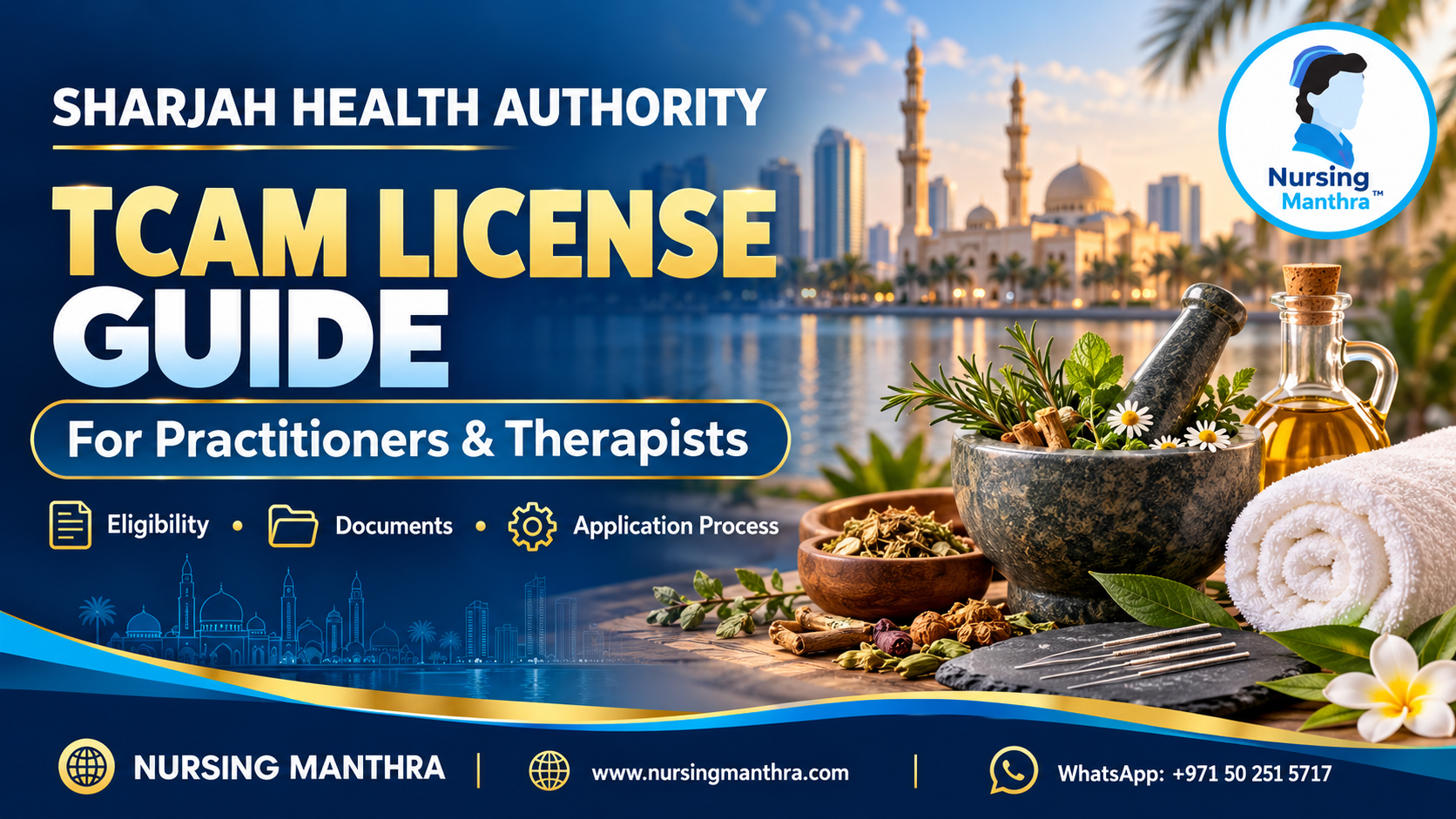
Planning to work in Sharjah as an Ayurveda practitioner, homeopath, acupuncturist, Hijama therapist or complementary medicine professional? Start by checking which authority licenses your intended facility and which professional title matches your training.
For an SHA TCAM license, the main stages are professional assessment and healthcare-facility licensing. Your education, clinical training, registration and experience support the assessment. The employing facility then completes the relevant license application.
This guide explains the Sharjah Health Authority application process, including documents, DataFlow, assessments, fees and preparation resources for practitioners and therapists.
What Is an SHA TCAM License?
SHA means Sharjah Health Authority. TCAM commonly refers to Traditional, Complementary and Alternative Medicine. Current qualification documents and SHA fee categories also use TCIM: Traditional Complementary and Integrative Medicine.
A practitioner license and a therapist license are different. An Ayurveda Massage Therapist, for example, does not have the same qualification requirements or independent scope as an Ayurveda Practitioner.
The SHA route applies to work under the relevant SHA-licensed facility. Do not assume that a workplace’s Sharjah address alone establishes its regulator, or that a license from another UAE authority automatically authorizes practice there.
Which Practitioners and Therapists Are Covered?
The Unified PQR’s TCIM framework includes:
- Acupuncture Practitioner
- Ayurveda Practitioner
- Ayurveda Massage Therapist
- Chiropractor Practitioner
- Herbal / Oriental Medicine Practitioner
- Homeopathy Practitioner
- Naturopathy Practitioner
- Osteopathy Practitioner
- Traditional Chinese Medicine Practitioner
- Chinese Massage Therapist
- Unani Practitioner
- Hijama Therapist
- Traditional Japanese Medicine Practitioner
- Traditional Korean Medicine Practitioner
These are qualification-framework titles. SHA assesses the requested title against your own credentials and the applicable rules. Confirm availability and the correct classification before paying.
General Eligibility Requirements
Before opening a paid application, organize evidence of:
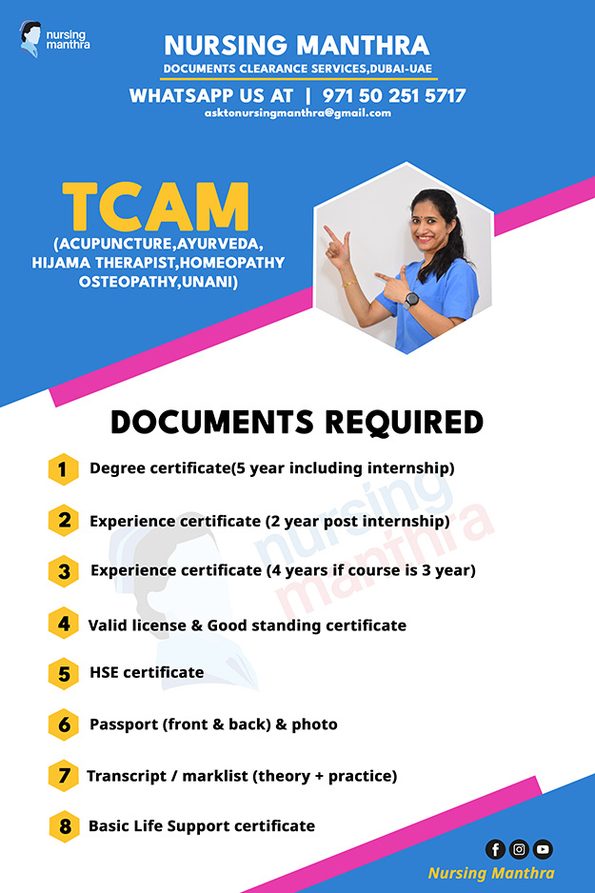
- Recognized education relevant to your intended title.
- Required course duration and theory/clinical hours.
- Internship or supervised clinical training.
- Relevant professional registration, where applicable.
- The experience required for the qualification route.
- Professional good standing.
- Current Basic Life Support certification.
- Recency of practice and any additional requirements.
The PQR includes physician privilege routes: an existing physician license is not automatic permission to practise another discipline.
Certain provisions differ for eligible UAE graduates, UAE nationals and children of Emirati women. Overseas applicants should not assume these exceptions apply without assessment.
Qualification and Experience Requirements
This table summarizes common routes in the current Unified PQR. Use the full qualification row and footnotes when checking a course.
| Professional title | Main qualification route | Experience |
|---|---|---|
| Acupuncture Practitioner | Five-year full-time acupuncture degree including internship; or an accredited minimum two-year/part-time equivalent route with 2,500 teaching hours or the specified NCCAOM/equivalent certification route | 2 years for the degree route; 3 years for the shorter route |
| Ayurveda Practitioner | BAMS/equivalent, minimum five years including internship, with 4,500 theory/practical hours and 1,000 internship hours; or a recognized 3–4-year programme with 2,500 hours plus 500 supervised internship hours | 2 years for the degree route; 4 years for the shorter route |
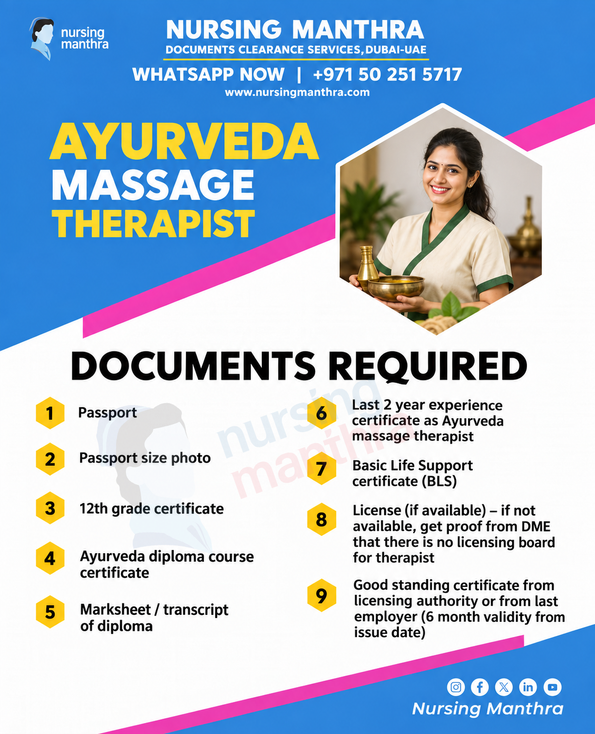
| Ayurveda Massage Therapist | At least 500 classroom hours or a one-year Ayurveda massage course | 2 years; supervised practice required |
| Chiropractor Practitioner | Recognized chiropractic qualification, minimum four years full-time and 4,200 contact hours | 2 years |
| Herbal / Oriental Medicine Practitioner | Relevant professional bachelor’s degree, minimum four years including internship | 2 years |
| Homeopathy Practitioner | BHMS/licentiate, minimum five years including internship; or accredited minimum three-year homeopathy programme | 2 years for the longer route; 4 years for the three-year route |
| Naturopathy Practitioner | ND/BNYS/BSc/equivalent, minimum four years including supervised clinical training | 2 years |
| Osteopathy Practitioner | Recognized osteopathy qualification, minimum four years and 1,000 supervised clinical training hours | 2 years |
| Traditional Chinese Medicine Practitioner | Recognized five-year qualification including a one-year internship; or a 3–4-year programme with 2,400 total hours, including 900 clinical practicum hours | 2 years for the degree route; 4 years for the shorter route |
| Chinese Massage Therapist | Relevant three-year TCM college/vocational route plus one-year supervised internship; or a 500-hour Chinese massage course plus one-year supervised internship | 2 years; supervised practice required |
| Unani Practitioner | BUMS/BEMS or the specified equivalent four-year qualification including supervised clinical practicum | 2 years |
| Hijama Therapist | Specific qualification/training routes and existing-license conditions; see the dedicated section below | 2 years |
| Traditional Japanese Medicine Practitioner | Physician route with accredited fellowship training and the relevant national examination | 2 years |
| Traditional Korean Medicine Practitioner | Accredited four-year training, comprising one year general practice and three years specialization, after passing the national examination | 2 years |
The experience listed is relevant post-qualification experience. Internship hours and later employment are not automatically interchangeable.
A similarly named online course, short workshop or spa certificate should not be assumed equivalent to a regulated healthcare qualification.
Ayurveda Massage Therapist: Qualification and Supervision
The PQR lists 500 hours of classes or a one-year Ayurveda massage course, together with two years of related post-qualification experience.
The therapist must work under an Ayurveda Practitioner’s supervision. This title does not authorize independent Ayurveda practitioner work.
Before accepting a role, ask the facility which title it will apply for, who will supervise the therapist and whether the service is included in its licensed activities.
Chinese Massage Therapists similarly require supervision under a Traditional Chinese Medicine Practitioner.
Hijama Therapist Requirements
The current PQR describes routes based on:
- High-school education plus a qualifying two-year Hijama programme.
- Healthcare bachelor’s education plus a qualifying one-year Hijama programme.
- An eligible current UAE healthcare license and minimum BSc qualification, plus an Authority-approved programme of at least 25 CME hours.
The specified training includes 20 treatment cases, and the experience column states two years of related post-qualification experience.
The footnotes restrict Hijama practice to a healthcare facility and require the title to be added to an existing valid Authority license, except for the stated UAE-national/children-of-Emirati-women provisions.
Keep the programme curriculum, approval, hours and case records available. A short course alone does not establish eligibility. Do not replace the current route-specific wording with an older universal 50-hour rule.
Official SHA Application Websites
| Website | Purpose |
|---|---|
| SHA website | Official authority information and support |
| SHA services directory | Locate assessment, licensing, renewal and amendment services |
| SHA professional portal | Follow the current account and application route |
| DataFlow verification | Select the Sharjah Health Authority route |
| Nursing Manthra study materials | Profession-specific preparation support |
The SHA website currently displays more than one portal link across its service cards. Start from the official services directory and use the relevant Start Service button if a saved link does not open the expected application.
Documents to Prepare
SHA’s assessment checklist includes qualifications, professional history, identity and applicable exemption evidence. Its general FAQ also lists BLS/CPR and a recent photograph.
Prepare:
| Document | Preparation point |
|---|---|
| Valid passport | Match names and dates across applications |
| Emirates ID | Follow SHA’s instructions; overseas applicants should confirm how to proceed if not yet issued |
| Recent photograph | Keep a clear, suitable image ready |
| Degree/diploma and additional qualifications | Support the exact title requested |
| Transcript/mark sheets | Show subjects, duration and clinical hours |
| Internship certificate | Particularly relevant to TCIM practitioner routes |
| Registration/license | Include relevant current records |
| Experience certificates | Use consistent dates and a clear professional title |
| Good Standing Certificate | Obtain the appropriate regulator-issued record |
| BLS certificate | Keep certification current |
| Previous PSV reports | Include available reports and case references |
| Exemption/other UAE evaluation evidence | Submit where relevant for review |
| Course curriculum and case records | Important for additional training and Hijama |
| Name-change evidence | Resolve different names in supporting records |
Do not treat surgical logbooks or residency documents as mandatory for every TCAM applicant merely because they appear on a general healthcare checklist. Supply them when relevant or requested.
SHA Application Process: Step by Step
Step 1: Check the Title and Facility Route
Compare your credentials with the current PQR and confirm that the prospective employer uses SHA licensing.
Prepare a simple timeline of your qualification, internship, registration and employment. This makes inconsistencies easier to resolve before submission.
Step 2: Open the Healthcare Professional Assessment Service
Use SHA’s services directory and select Request for Healthcare Professional Assessment.
Follow the current registration/sign-in prompts. Keep your own email, login and application references. Do not enter inaccurate identification information to bypass a required field.
Step 3: Submit the Application
Choose the appropriate practitioner or therapist category, complete the professional history and upload the requested evidence.
Include relevant previous verification and exemption records. The portal asks applicants to declare previous UAE examination attempts.
Step 4: Complete Verification and Credentialing
Follow SHA’s instructed PSV route and respond to any missing-information requests. Do not purchase a verification package for another regulator on the assumption it will automatically meet SHA’s requirements.
Step 5: Complete Any Required Examination
Use the assessment instructions SHA issues for your title. Submit exemption evidence where applicable, but wait for the authority’s decision.
Keep messages, approvals and deadlines with your application records.
Step 6: Obtain the Assessment Certificate
Once the requirements are satisfied, SHA issues the professional assessment certificate. It confirms the assessed professional title; it does not authorize you to start treating patients.
Step 7: Coordinate the Facility License Application
The hiring facility’s representative applies for the professional license. Prepare the offer letter and malpractice insurance; additional documents depend on the license type and applicant.
For example, part-time applications may need an NOC, and visiting/temporary applications have facility undertaking requirements.
Step 8: Check the Issued License
Before beginning clinical work, verify the professional title, facility, license type and any restrictions. A therapist must also have the required supervision arrangement.
Keep copies of the license and renewal requirements.
DataFlow Verification for SHA TCAM Applicants
Primary source verification checks credentials with the organizations that issued them. DataFlow lists Sharjah Health Authority among its regulator routes.
The usual preparation sequence is:
- Select the correct SHA route.
- Confirm the documents and package requested.
- Enter identity, education, registration and employment details accurately.
- Upload readable, complete records.
- Sign the authorization.
- Pay the displayed verification charges.
- Respond to further requests and keep the case reference.
Verification establishes the outcome of document checks. SHA still decides whether the credentials support the requested professional title.
Can You Use a Previous DataFlow Report?
Supply the report when the application requests it. The regulator/provider decides whether it can be reused, transferred or supplemented.
Updated employment, a new qualification or changed registration may need additional checks. Do not assume a positive report from another regulator automatically grants SHA eligibility.
Verification and Attestation Are Different
DataFlow says its own PSV process does not require attestation/apostille. SHA or an employer may separately request documents in an approved form.
Follow each instruction rather than paying for every possible stamp before the checklist is clear.
SHA TCAM Exams: Oral, Written or Prometric?
SHA’s services directory includes oral/written examination and repeat-attempt services. However, I could not verify an official current table assigning a Prometric provider, duration, question count and pass mark to every TCAM title.
Follow the examination mode assigned to your SHA application. Do not use DHA exam codes or DOH booking instructions for an SHA assessment.
SHA’s general FAQ describes exemption for qualifying applicants with valid UAE evaluation/license evidence or another applicable exemption. Submit the evidence for SHA review; do not assume exemption also removes verification, experience or licensing requirements.
Suggested Preparation Topics
These are study themes, not a published SHA examination blueprint:
- Professional assessment and clinical reasoning.
- Contraindications and treatment precautions.
- Infection prevention and equipment safety.
- Recognition of urgent symptoms and referral.
- Consent, communication and recordkeeping.
- Limits of the intended professional scope.
- Supervision and escalation for therapist titles.
Practise explaining what you would do when a treatment is unsuitable, when you would defer care and when you would refer the patient.
Attempts and Reassessment
SHA’s title-amendment service FAQ describes a three-attempt limit with payment before reattempts. Applicants are asked to disclose prior attempts with other UAE authorities.
Confirm how the current rule applies to the specific title and previous history. Opening another account should not be treated as resetting examination attempts.
SHA TCAM Fees: Practitioner Versus Therapist
SHA explicitly distinguishes the categories:
| Service | TCIM practitioner | TCIM therapist |
|---|---|---|
| Professional assessment | AED 500 | AED 300 |
| Full-time professional license | AED 3,000 | AED 1,000 |
| Arithmetic subtotal of these two listed fees | AED 3,500 | AED 1,300 |
The subtotal is not an all-inclusive quote. PSV, examination, retake, additional review and other costs may apply. Confirm the exact title category and checkout amount.
A practitioner qualification should not automatically be charged as a therapist application, or vice versa.
Budget separately for training, good standing, translations, BLS, insurance, study materials and travel when applicable.
Processing Time, Career Gaps and Validity
SHA lists eight working days for assessment review and separately for professional licensing. These are service-stage estimates, not a guaranteed end-to-end timeline.
Verification responses, missing records, examination availability and employer readiness can add time.
The main assessment/licensing pages refer to a three-year practice-gap threshold; the licensing FAQ describes required PQR training for longer gaps. Do not assume a long gap is automatically acceptable: have SHA assess the complete practice history.
The license FAQ lists one-year full-time and part-time validity, two months for visiting and three months for temporary licenses. Always follow the dates on the license actually issued.
Renewal and Changes to Professional Title
The facility handles renewal. SHA’s renewal card asks for CME evidence, identity, the relevant life-support certification and malpractice cover, with additional records where applicable.
The published service allows full-time/part-time renewal up to three months before expiry. Keep certificates ready early; late fees can apply.
If you obtain a new qualification, use the appropriate title-amendment/privilege process. Updating the assessment record is separate from updating the professional license. It does not automatically extend the existing license expiry.
SHA TCAM Study Materials from Nursing Manthra
Nursing Manthra provides profession-specific preparation support for TCAM/TCIM practitioners and therapists, including:
- Acupuncture and Ayurveda.
- Ayurveda Massage Therapy.
- Homeopathy and Unani.
- Hijama.
- Chiropractic, Naturopathy and Osteopathy.
- Herbal/Oriental Medicine.
- Traditional Chinese Medicine and Chinese Massage Therapy.
- Traditional Japanese and Korean Medicine.
Materials may support written/computer-based preparation or oral assessment, according to the route assigned. The availability of a study resource does not establish which exam SHA will require.
Visit Nursing Manthra Study Materials and open the Prometric/Pearson VUE Study Materials section. Search your profession.
For purchasing study materials, WhatsApp +971 50 251 5717:
https://wa.me/971502515717
Share your professional title, regulator and assessment notice so the team can confirm the appropriate material. If your title is not visible, contact Nursing Manthra for assistance.
These are independent preparation resources, not SHA-approved exam questions or a guarantee of success.
Common Application Mistakes
- Assuming all Sharjah workplaces use the same regulator.
- Applying as a practitioner with therapist-level credentials.
- Omitting course hours or internship evidence.
- Using another authority’s examination specifications.
- Treating PSV or an assessment letter as permission to practise.
- Assuming a short Hijama course is enough on its own.
- Overlooking supervision arrangements.
- Failing to disclose previous assessment attempts.
- Waiting until expiry to organize renewal evidence.
Frequently Asked Questions
Can BAMS graduates apply for an SHA Ayurveda license?
A qualifying BAMS/equivalent is a listed PQR route. SHA assesses education, internship, registration, experience and other applicable conditions.
Can BHMS and BUMS graduates apply?
Qualifying Homeopathy and Unani routes are listed. Applicants must still meet the requested title’s requirements.
Is Ayurveda Massage Therapist a separate title?
Yes. It has its own qualification, experience and supervision conditions.
Is an SHA assessment certificate enough to start work?
No. The official professional license must be issued for the appropriate facility.
Does every SHA applicant take Prometric?
No universal TCAM Prometric rule was verified. Follow SHA’s current assessment notice.
Can a DHA, DOH or MOHAP record support an exemption?
SHA’s FAQ recognizes qualifying UAE evaluation/license evidence for exemption review. SHA decides acceptance and any remaining requirements.
Can I apply from overseas without an Emirates ID?
The service card lists Emirates ID, while the general FAQ qualifies it as “if any.” Ask SHA how an overseas applicant should complete the current portal; do not enter substitute information.
Is the fee the same for practitioners and therapists?
No. The published assessment fees are AED 500 and AED 300 respectively; full-time license fees are AED 3,000 and AED 1,000 respectively.
Does Nursing Manthra provide job placement?
Nursing Manthra provides licensing/documentation support and study materials. Recruitment and placement are not part of these services.
Contact Nursing Manthra
For document preparation, verification support, licensing guidance and examination study materials:
UAE / WhatsApp: +971 502 515 717
India: +91 6828756689
WhatsApp: https://wa.me/971502515717
Study materials: https://nursingmanthra.com/study-materials/
About the Author
Shincy George, RN, MSN (Cardiothoracic Nursing), SCFHS-RN, DHA RN, MOH UAE RN, NCLEX-RN (USA), is the Founder of Nursing Manthra Academy.
With extensive international clinical and academic experience, she is dedicated to guiding healthcare professionals through global licensing pathways. Through Nursing Manthra, she supports internationally educated healthcare professionals in achieving their career goals across Canada, USA, UAE, Middle East, UK, Ireland, Australia, New Zealand, and other countries.
Her mission is to simplify complex licensing processes and empower healthcare professionals with the right knowledge, guidance, and support to succeed globally.