By Shincy George | Nursing Manthra
Last reviewed: 30 October 2026
Moving to Oman as a doctor involves more than passing an examination. Before you start, you need to understand the professional title you can apply for, which credentials require verification and where your employer must become involved.
A doctor applying with an MBBS qualification follows a different eligibility assessment from a doctor presenting specialist training or a consultant-level portfolio. Even two doctors with the same number of years in practice may receive different decisions because their qualifications and clinical histories differ.
This guide explains the main application stages for internationally qualified medical doctors. The experience table below comes from the Ministry of Health’s private-sector doctors’ procedure. Government hospitals and other institutions may have different appointment arrangements.
1. Who Handles Doctor Licensing in Oman?
| Organisation | Main role |
|---|---|
| Ministry of Health (MOH) | Practitioner registration and relevant medical licensing services |
| Directorate General of Private Health Establishments (DGPHE) | Private healthcare professional assessment and licensing |
| Oman Medical Specialty Board (OMSB) | Occupational classification testing and qualification verification/equivalency functions |
| DataFlow | Primary source verification |
| Pearson VUE | Delivery and booking of OMSB computer-based examinations |
| Employing institution | Employer-side submissions and coordination of employment and licensing |
Keep registration, verification, qualification equivalency, examinations and the final licence as separate milestones in your application plan.
2. GP, Specialist and Consultant: Understand Your Intended Title
For planning purposes, separate your file into three possible routes:
- GP: your basic medical qualification, internship and relevant clinical employment history.
- Specialist: your basic medical education plus the full record of specialist training and qualifications.
- Consultant: your specialist credentials plus the evidence supporting your proposed senior clinical role.
These are practical ways to organise your records, not a substitute for Oman’s classification decision.
A designation on an employment certificate from another country does not, by itself, establish the title Oman will approve. Ask for confirmation of the intended classification before committing to an examination or accepting a contract based on that title.
3. Published Private-Sector Experience Requirements
The MOH doctors’ SOP lists the following:
| Category as written in the SOP | Listed experience requirement |
|---|---|
| GP doctor | Four years’ work experience; internship is listed separately |
| Specialist Level 3 | Three years after specialty qualification |
| Specialist Level 2 | Zero years after specialty qualification |
| Consultant Level 3 | Twelve years after specialty qualification |
| Consultant Level 2 | Six years after specialty qualification |
These are category-specific entries. The “zero years” provision is not permission for every new postgraduate to work as a specialist. First obtain confirmation of which qualification level applies.
Important interpretation: Read the qualification level and experience requirement together. Do not assume that experience alone moves an applicant from one row to another.
For GP applications, the SOP’s brief wording does not fully explain which periods count. Obtain confirmation about internship, residency, part-time work, overlapping appointments and the clinical departments represented in your experience.
Indian MBBS, MD, MS, DNB and super-specialty applicants
Prepare the complete educational sequence, including internship and specialist training records. For MD, MS, DNB, DM, MCh or fellowship holders, ask how the exact programme will be evaluated.
Do not select a Level 2 or Level 3 category merely from an online comparison of qualification names. The awarding body, programme structure and complete credential history need to be considered in the relevant assessment.
A doctor who has worked under the title “consultant” should still request confirmation that the proposed Oman consultant application is appropriate.
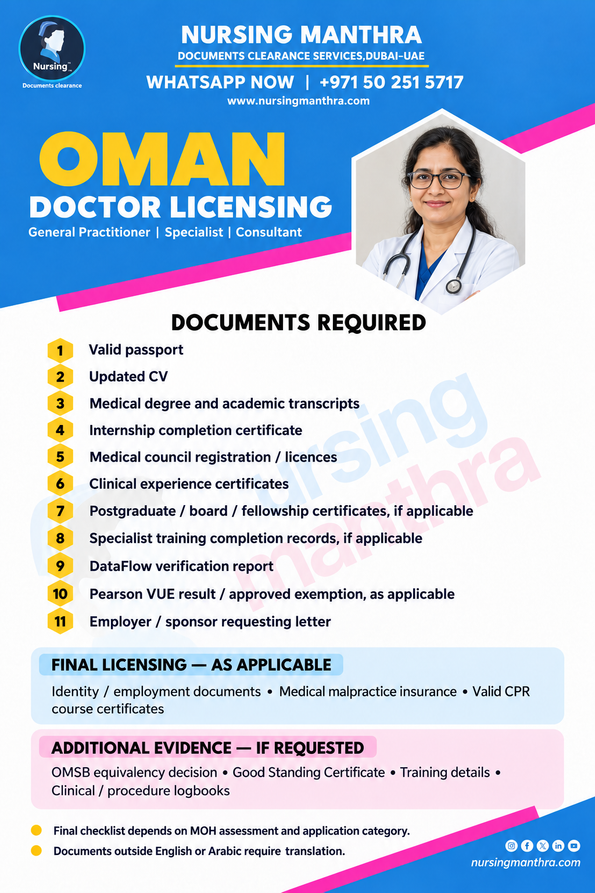
4. Documents to Prepare
The private-sector doctors’ SOP lists a CV, medical degree, internship evidence, Pearson VUE test record, experience, sponsor letter, DataFlow and passport.
MOH practitioner registration also requests basic and specialist qualifications, transcripts, experience certificates and previous professional registration/licensing. Documents outside Arabic or English require translation.
Use this preparation checklist:
| File section | Records to organise |
|---|---|
| Identity | Passport; evidence linking different names where relevant |
| Medical education | Basic degree, academic records and internship certificate |
| Specialist education | Specialty/subspecialty certificates and supporting training records |
| Registration | Current and previous medical registrations or licences |
| Employment | Dated certificates showing clinical position and employer |
| Application records | Verification report, examination result and employer correspondence |
| Final licensing | Insurance and required course certificates |
The medical staff licence service specifically lists malpractice insurance from an accredited insurer and valid CPR course certificates. Confirm the accepted cover and course requirements for your case.
Additional evidence worth keeping ready
Depending on questions raised during assessment, it may help to have residency completion records, training dates, rotations, programme descriptions, operative logs or a clinical portfolio.
Treat these as supporting preparation, not a claim that every applicant must upload every item.
If asked for a Good Standing Certificate or other additional document, confirm the correct issuing body, recipient and validity requirements before ordering it.
5. Start With an Eligibility and Document Review
Before paying, prepare a one-page chronology showing:
- Medical graduation.
- Internship.
- First professional registration.
- Each clinical appointment.
- Specialist training and qualification dates.
- Subsequent specialist practice.
- Any employment or practice gaps.
This makes it easier to identify a missing certificate, an unexplained overlap or a proposed title that needs clarification.
For specialists, distinguish training from independent post-qualification employment. For consultants, make sure your evidence describes the clinical responsibilities you actually performed.
Ask your prospective employer which title they intend to request and which authority-side stages they will arrange.
6. MOH Health Practitioner Registration
The Health Practitioners Registration e-Service covers applicants inside and outside Oman seeking work in government and private healthcare.
The published process involves creating an account, completing the application, uploading records and submitting them for review. A registration number is issued following the relevant assessment.
The service currently lists no fee and five business days from completion of the application. This is the registration service period, not the total time needed to obtain a job and licence.
Monitor returned applications carefully. Respond to the actual query and keep copies of both the request and your response. A registration number should not be treated as permission to begin clinical practice.
7. DataFlow Primary Source Verification
Primary source verification checks credentials directly with their issuing organisations. OMSB states that verification is mandatory for those who obtained qualifications outside Oman and directs applicants to DataFlow.
The checks concern the authenticity of educational, experience and licensing records.
Before submission, check the correct Oman package, the credentials it includes and whether extra documents will attract additional charges. Provide accurate university, council and employer contact details.
If verification is delayed, identify which issuing organisation has not responded. If a discrepancy appears, review the exact finding and submit genuine supporting evidence.
An existing report from another country should be reviewed for possible transfer and any extra requirements. Do not assume it automatically completes your Oman verification.
A positive verification outcome addresses authenticity; it should not be read as a decision on the professional title you will receive.
8. OMSB Qualification Equivalency
Verification and equivalency answer different questions: whether a credential is authentic, and how it is evaluated for the intended professional pathway.
OMSB’s guidance states that credentials should be verified before equivalency assessment. Employer submissions go through its electronic equivalency system.
Its listed supporting records include the verification report, qualifications, available transcripts, experience, professional licence and CV. The page gives an indicative equivalency period of one to three months.
Ask your employer whether your case requires this submission, which certificates will be assessed and what further training evidence is needed.
For postgraduate doctors, this is a stage to clarify early. An employment offer should not be mistaken for confirmation that a particular specialist or consultant classification has been approved.
9. Oman Doctor Examinations: Pearson VUE and OMSB
Although “Oman Prometric” remains a common search phrase, the current official OMSB occupational classification testing route directs candidates to Pearson VUE.
OMSB lists the Omani Examination for General Practitioners, or OEGP, and specialty examinations including internal medicine, general surgery, paediatrics, anaesthesia, obstetrics and gynaecology, and other fields.
Examinations are available through the OMSB test centre and Pearson VUE centres internationally.
Which examination should you choose?
Confirm the examination attached to your intended category and specialty. Do not book a GP examination simply because it is available if you are pursuing a specialist application.
Likewise, do not assume that every consultant must follow an identical examination route, or that a foreign board certificate automatically provides an exemption. Obtain an individual decision where relevant.
Booking essentials
Pearson’s published process is to create an account, select the examination and schedule an appointment. Use details matching your identification.
Non-Omani candidates must bring a valid original passport. Check the current candidate instructions, booking confirmation and cancellation terms. Pearson states that score reports are emailed within 24 hours.
No single question count, examination duration or pass mark should be advertised as applying to every medical specialty.
10. Employer-Led MOH Interview or Assessment
The doctors’ private-sector SOP includes an interview/viva stage.
MOH’s interview and examination booking service is accessed through the healthcare establishment owner’s authenticated account. It includes document submission, payment, the relevant visa letter following approval, and result and Ministry of Labour documentation after passing.
Discuss these arrangements with the employer before travelling. Ask who submits the file, how appointments are communicated and which approvals must be received before joining.
For preparation, practise explaining your clinical reasoning: initial assessment, differential diagnosis, emergency management, safe prescribing, referral and escalation. Specialists should also be ready to discuss the limits of their practice and examples from their own clinical work.
These are preparation suggestions, not a published list of viva questions.
11. Final Licensing and Employment Approvals
The private-sector new practitioner licence service is employer-facing. Its process includes completing the application, attaching evidence, obtaining approval, paying and downloading the certificate.
The page cites compliance with the executive regulations under Ministerial Resolution 231/2024.
Coordinate the remaining employment and immigration requirements with your institution. Confirm that the professional licence has been issued before beginning clinical duties.
Also ask what scope of practice and clinical privileges apply to the role. MOH publishes category-specific scope and privilege forms, including GP and specialist/consultant surgical forms.
A senior title should never be treated as permission to undertake every procedure without checking the applicable privileges.
12. Oman Doctor Licensing Fees
| Item | Published fee or budgeting guidance |
|---|---|
| MOH practitioner registration | Free |
| MOH interview/exam booking service—doctors | OMR 100 |
| New private-sector licence—non-Omani doctor | OMR 100 |
| Licence fee—Omani doctor | OMR 20 |
| Pearson VUE examination | Confirm the live price for your examination |
| DataFlow | Depends on the package and additional checks |
| Equivalency, if applicable | Confirm any charge through the relevant service |
| Other expenses | Allow for required translation, certificates, courses, insurance and travel |
The MOH assessment charge and Pearson VUE examination fee are separate. The two OMR 100 entries above are not an all-inclusive cost.
Request an itemised estimate. Keep authority fees separate from optional assistance charges and confirm which costs the employer will pay.
13. Processing Time, Renewal and Old Registrations
There is no single guaranteed end-to-end timeline. Verification responses, equivalency review, examination availability, employer action and returned applications can all affect progress.
The new private-sector practitioner licensing service lists seven days for that service stage. It does not promise completion of the whole pathway in a week.
For renewal, keep your expiry date, insurance and required course records under review. Ask the employer for the current renewal checklist.
Doctors returning after a long absence should obtain specific guidance. Gov.om’s medical staff service includes a retesting condition linked to six years from first registration, but uses the older “Prometric” wording. Clarify how that condition applies to your case and the current examination route; do not infer universal six-year result validity.
14. Frequently Asked Questions
Can an MBBS doctor apply without postgraduate qualifications?
The GP route is the relevant starting point to investigate. Eligibility still needs to be confirmed against the basic qualification, internship, registration and accepted experience.
Does an MD, MS or DNB automatically qualify me as a specialist?
Do not assume automatic approval from the qualification name. Request assessment of the complete specialist training record and intended category.
Can years of experience alone make me a consultant?
Use both your credentials and clinical history when requesting classification. Ask for confirmation before accepting a consultant contract.
Does a UAE or Saudi licence automatically transfer?
Do not assume automatic transfer or exemption. Present your existing licensing history for consideration and obtain a decision.
Can I start preparing before an offer?
Yes. Organise your records, identify the appropriate category and plan your study. Confirm the relevant package and examination before payment. Employer-facing assessment and final licensing stages still require institutional involvement.
What if I fail an assessment?
Identify whether the result concerns a Pearson examination or the MOH assessment. Check that stage’s current retake rules before rebooking; do not apply one service’s rules to another.
15. Profession-Specific Study Materials
Preparing for your Oman licensing examination? Visit the Nursing Manthra Study Materials page to check the resources available for your profession and examination.
Before choosing materials, confirm your examination category and specialty. Contact our team if you need help identifying the relevant resources, and use the official examination content outline to guide your preparation.
Contact Nursing Manthra
For document preparation, verification support, licensing guidance and examination study materials:
UAE / WhatsApp: +971 502 515 717
India: +91 6828756689
WhatsApp: https://wa.me/971502515717
Study materials: https://nursingmanthra.com/study-materials/
About the Author:
Shincy George, RN, MSN (Cardiothoracic Nursing), SCFHS-RN, DHA RN, MOH UAE RN, NCLEX-RN (USA), is the Founder of Nursing Manthra Academy.
With extensive international clinical and academic experience, she is dedicated to guiding healthcare professionals through global licensing pathways. Through Nursing Manthra, she supports internationally educated healthcare professionals in achieving their career goals across Canada, USA, UAE, Middle East, UK, Ireland, Australia, New Zealand, and other countries.
Her mission is to simplify complex licensing processes and empower healthcare professionals with the right knowledge, guidance, and support to succeed globally.