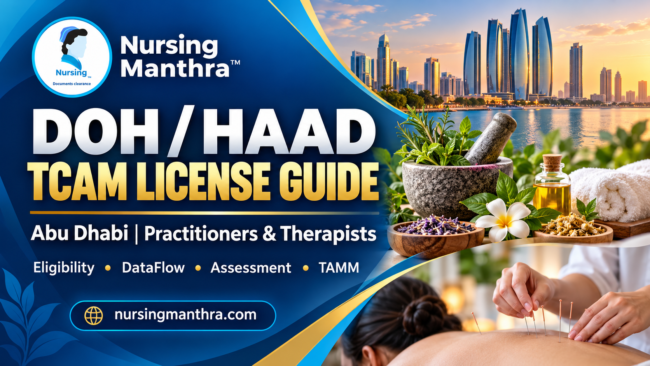
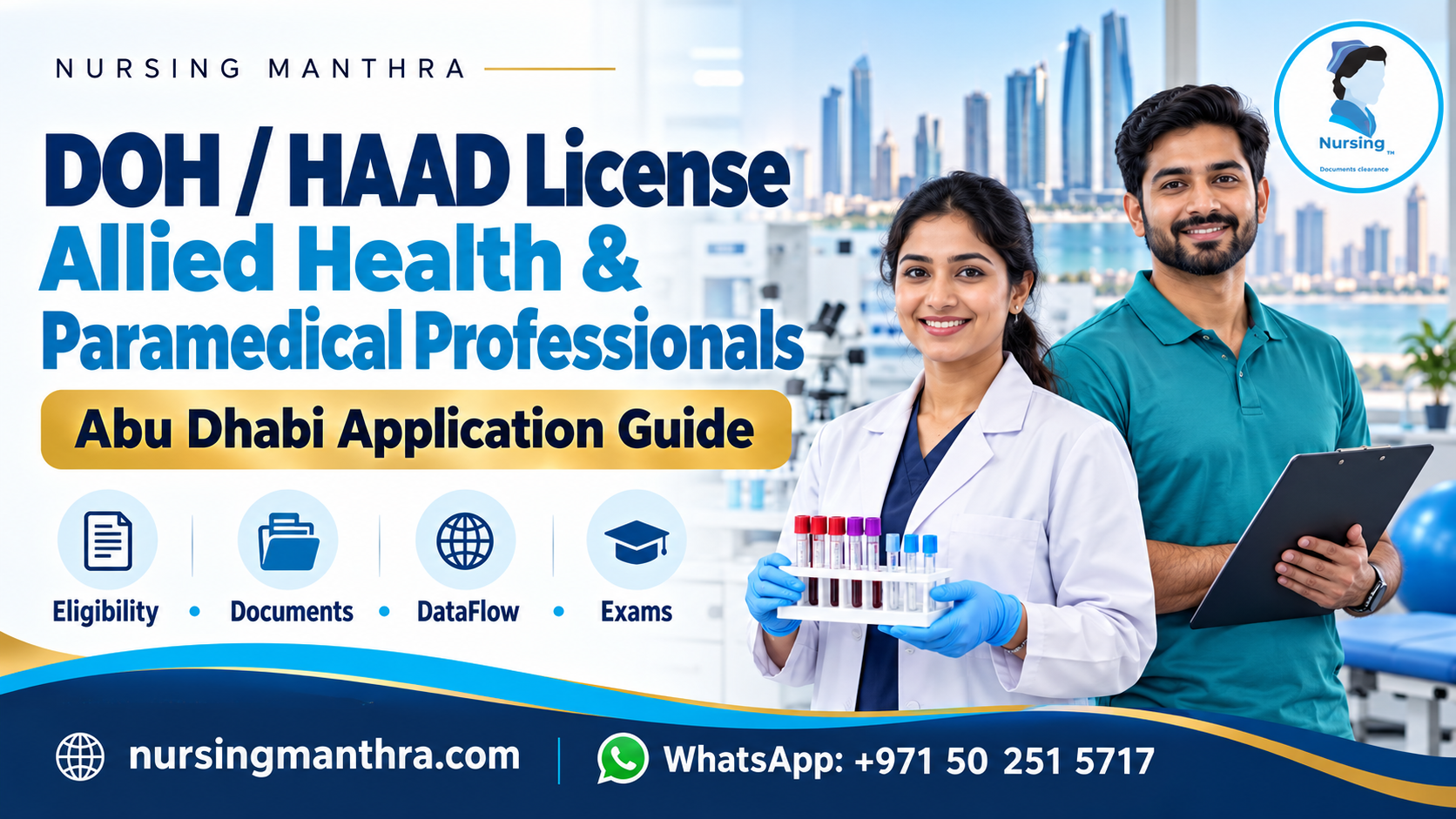
Planning to work in Abu Dhabi as a physiotherapist, laboratory professional, radiographer or another allied healthcare professional? Your first step is to confirm the professional title you qualify for and understand the Department of Health licensing pathway.
Many applicants still search for the HAAD licence or HAAD examination. The current authority is the Department of Health–Abu Dhabi (DOH), and its healthcare professional licensing services are available through TAMM.
This guide explains eligibility, documents, DataFlow verification, assessment booking and the final steps before starting clinical practice.
Who Should Apply for a DOH Licence?
This route is for professionals seeking to practise in healthcare facilities regulated by DOH in Abu Dhabi emirate, including Al Ain and Al Dhafra.
Allied healthcare covers a wide range of clinical and technical disciplines, such as:
- Medical laboratory sciences.
- Radiography and medical imaging.
- Physiotherapy and occupational therapy.
- Respiratory therapy.
- Anaesthesia technology.
- Audiology and speech therapy.
- Optometry.
- Dietetics and nutrition.
- Dental laboratory technology.
- Other recognised healthcare technical professions.
“Paramedical” is a broad term. Your application must use the specific professional title supported by your qualifications and clinical background.
DOH Eligibility Requirements
DOH uses the Unified Healthcare Professional Qualification Requirements (PQR) to assess education, experience and professional registration. Requirements vary by title; there is no single eligibility rule covering all paramedical professionals.
Recognised educational qualification
Your degree or diploma must meet the requirements for the selected title. Course duration, programme recognition, subjects studied and practical training can affect eligibility.
Relevant professional background
Check the experience requirement for your exact category. A technician, technologist, therapist and assistant may have different requirements.
Registration and academic records
Prepare your professional registration or licence, where applicable, and complete academic transcripts. The PQR requires transcripts for credential assessment and states that assistant allied healthcare professionals cannot practise independently. It also excludes qualifications obtained through correspondence or distance learning from meeting its qualification requirements.
Practical advice: do not choose a title simply because it matches your current job designation. Match it against your education and the relevant PQR category.
Can Fresh Graduate Paramedical Professionals Apply?
Some titles have pathways without previous work experience. Others require relevant experience or training.
Graduation date and time away from practice can also affect assessment. Before applying as a fresh graduate, confirm:
- Whether your selected title requires experience.
- Whether your qualification meets the required duration and content.
- Whether clinical training is necessary.
- Which professional registration documents apply.
- Whether additional conditions apply to your circumstances.
An experience exemption announced for one profession should not be assumed to cover every allied healthcare category.
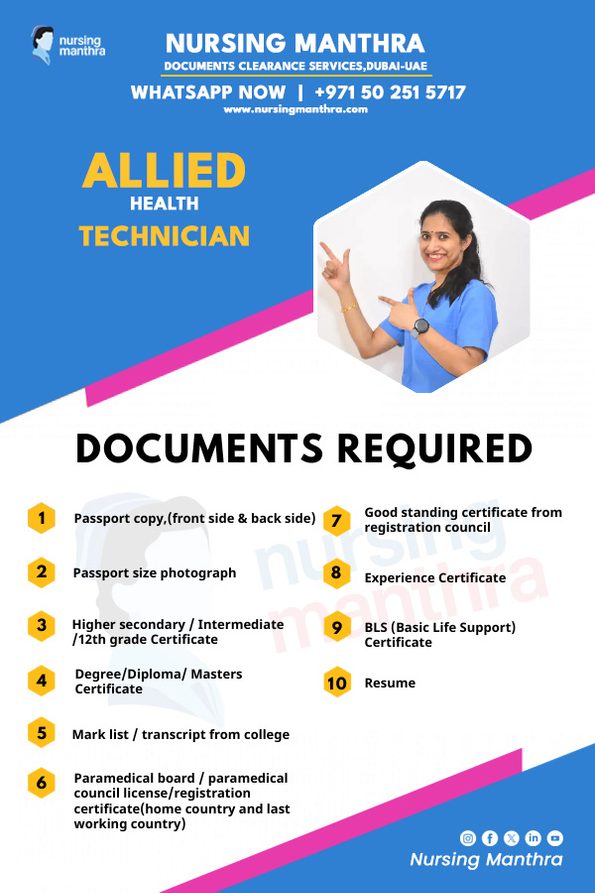
Documents to Prepare
Use the checklist issued through your DOH application as the final guide.
| Document | What to check |
|---|---|
| Valid passport | Personal details should match the application |
| Recent photograph | Keep a clear professional photograph ready |
| Degree or diploma | Submit the qualification supporting your intended title |
| Academic transcript | Include the complete academic record |
| Higher secondary certificate | May be required for qualifications below bachelor’s level |
| Experience certificates | Prepare relevant employment records where required |
| Professional registration or licence | Provide applicable registration covering the required practice period |
| Good Standing Certificate | Obtain from the relevant professional regulator |
| Previous DataFlow report | Keep the report and reference details, if available |
| Additional supporting documents | Provide training records, translations or other evidence when requested |
DOH’s published allied healthcare checklist identifies qualifications, transcripts, applicable experience, professional registration and Good Standing Certificates. It specifies that a Good Standing Certificate should be no older than six months. Requirements may differ where experience is not required.
Make sure names, qualification titles and employment dates are consistent. Explain genuine differences with supporting documents.
DOH/HAAD Allied Health Licence Process: Step by Step
Step 1: Confirm Your Professional Title
Review the PQR before paying for verification or examination preparation.
For example, laboratory technician and laboratory technologist are distinct titles. Your education must support the category selected.
Step 2: Access TAMM
Visit TAMM Abu Dhabi and complete the required identity sign-in.
Open the DOH healthcare professional licensing service. The service may appear under healthcare professional licence registration or management.
Step 3: Enter Your Details and Submit Documents
Complete your personal, education, registration and employment details accurately. Upload the documents requested for your category.
Step 4: Complete DataFlow Verification
Follow the application instructions to submit credentials for Primary Source Verification.
Step 5: Complete DOH Credential Review
After verification, DOH reviews the application. Respond to requests for missing documents or clarification.
Eligible applicants are then approved for the examination stage where an assessment is required. This sequence—TAMM application, verification, licensing review and examination approval—is described in DOH’s official guidance.
Step 6: Complete the Required Assessment
Follow the assessment instructions issued for your approved title. An exemption must be accepted by DOH; do not assume one applies automatically.
Step 7: Complete the Remaining Licensing Stages
Work with your hiring facility to complete the remaining requirements. DOH’s published pathway includes assessment, security clearance and licence issuance.
An examination pass alone does not authorise clinical practice. Ensure the professional licence has been issued and the required facility association is complete before starting work.
DataFlow Verification: What Applicants Should Know
DataFlow verification and DOH eligibility assessment serve different purposes.
Verification checks credentials with their issuing organisations. DOH decides whether those credentials satisfy the licensing requirements for the requested title.
To help avoid delays:
- Submit complete, readable records.
- Provide accurate university, employer and regulator contact details.
- Keep your application and verification references.
- Disclose previous DataFlow reports.
- Check transfer requirements before purchasing a new package.
- Respond promptly to verification enquiries.
A previous positive report does not automatically mean every document required for a new DOH application has already been verified.
DOH Examination and Pearson VUE Booking
For computer-based examinations delivered through Pearson VUE, the official booking sequence is:
- Receive DOH examination approval.
- Pay the required pre-booking charge through TAMM.
- Open the Pearson VUE link activated in your TAMM account.
- Select an available examination location, date and time.
- Complete the booking and retain the confirmation.
Pearson VUE advises candidates to print their confirmation and check spam folders for examination correspondence.
Assessment formats differ by professional title. Follow your approval notice rather than relying on a generic “HAAD exam pattern” found online.
What Should You Bring on Examination Day?
Pearson VUE’s DOH identification policy requires:
- Your original valid passport.
- A second valid government or official identification document.
- At least one identification document bearing your signature.
- A printed booking confirmation.
Photocopies are not accepted. Pearson recommends arriving 30 minutes before the appointment.
What If You Have a Gap in Clinical Practice?
A practice gap may lead to additional training and continuing education requirements.
DOH’s Return Back to Practice programme addresses professionals who have discontinued practice for more than two years. The licensing department reviews the application and determines the applicable training and CME requirements.
Where directed, training must be completed through an approved practice setting. Obtain DOH’s instructions before paying for a placement or course.
Fresh graduation and a prolonged interruption after professional practice are different situations and should be reviewed accordingly.
How Much Does a DOH Allied Healthcare Licence Cost?
Budget for separate stages:
- DataFlow verification or report transfer.
- Application and credential review.
- Examination booking and scheduling.
- Additional assessments, where required.
- Licence issuance.
- Translation or additional document verification.
The total depends on your title, verification needs and assessment route. Check the current amount displayed in TAMM, DataFlow and the examination booking system before payment.
If you use application assistance, request a clear breakdown of authority fees, third-party charges and service fees.
How Long Does the Process Take?
There is no reliable single timeline for every applicant.
The overall duration depends on document readiness, responses from issuing organisations, credential review, assessment availability and completion of the final licensing stages.
Keep track of deadlines in your application and examination approval. Delays in providing additional information can extend the process.
Preparing for the DOH Allied Health Assessment
Prepare for your specific profession rather than using a general paramedical question bank.
Your revision should reflect the knowledge and clinical decisions expected in your role. Depending on the discipline, this may include:
- Core professional knowledge.
- Clinical procedures and equipment.
- Patient safety.
- Infection prevention.
- Quality assurance.
- Professional ethics.
- Recognition of complications and appropriate escalation.
Use practice questions with explanations. For an oral or practical assessment, practise explaining your decisions clearly through clinical scenarios.
Common Application Mistakes
- Selecting a title unsupported by your qualification.
- Assuming all allied health professions require the same experience.
- Leaving name or date differences unexplained.
- Uploading incomplete academic records.
- Booking an examination before receiving the correct authorisation.
- Assuming a previous UAE licence automatically transfers to DOH.
- Treating examination approval or a pass result as an active licence.
- Paying for training without confirming its acceptance.
Nursing Manthra Application Support and Study Materials
Need help understanding your starting point?
Contact Nursing Manthra to enquire about DOH/HAAD documentation support, DataFlow assistance, application guidance and study-material availability for your profession.
WhatsApp: +971 50 251 5717
Study materials: Explore Nursing Manthra Study Materials
When messaging, include:
- Your profession and qualification.
- Country and year of graduation.
- Professional registration status.
- Relevant clinical experience.
- Any gap in practice.
- Previous UAE examination or DataFlow history.
Nursing Manthra supports documentation and licensing applications. Recruitment and job placement are not included. Final eligibility, assessment exemptions and licensing decisions remain with DOH.
Frequently Asked Questions
Are DOH and HAAD different application routes?
HAAD is the former authority name still commonly used by applicants. The current licensing route is through DOH and TAMM.
Can diploma holders apply?
Some titles accept specified diplomas. Eligibility depends on the discipline, programme duration, recognition and other requirements for the title.
Is two years of experience compulsory?
Do not apply a single experience rule to every paramedical profession. Check the current PQR category and DOH’s assessment of your circumstances.
Can I use an existing DataFlow report?
It may support your application, but report transfer or additional verification may be required.
Does passing the examination guarantee a job?
No. Employers make separate recruitment decisions and may require interviews, experience or competency assessments.
Can I work with only an examination pass?
No. Complete the remaining licensing requirements and confirm that your professional licence has been issued before clinical practice.
Start with the right professional title, prepare complete records and follow the instructions in your TAMM application.
For documentation guidance and study-material enquiries, contact Nursing Manthra on WhatsApp: +971 50 251 5717.
Requirements and fees may change. Check the current DOH qualification requirements and TAMM service instructions before applying or paying.
Contact Nursing Manthra
For document preparation, verification support, licensing guidance and examination study materials:
UAE / WhatsApp: +971 502 515 717
India: +91 6828756689
WhatsApp: https://wa.me/971502515717
Study materials: https://nursingmanthra.com/study-materials/
About the Author:
Shincy George, RN, MSN (Cardiothoracic Nursing), SCFHS-RN, DHA RN, MOH UAE RN, NCLEX-RN (USA), is the Founder of Nursing Manthra Academy.
With extensive international clinical and academic experience, she is dedicated to guiding healthcare professionals through global licensing pathways. Through Nursing Manthra, she supports internationally educated healthcare professionals in achieving their career goals across Canada, USA, UAE, Middle East, UK, Ireland, Australia, New Zealand, and other countries.
Her mission is to simplify complex licensing processes and empower healthcare professionals with the right knowledge, guidance, and support to succeed globally.