
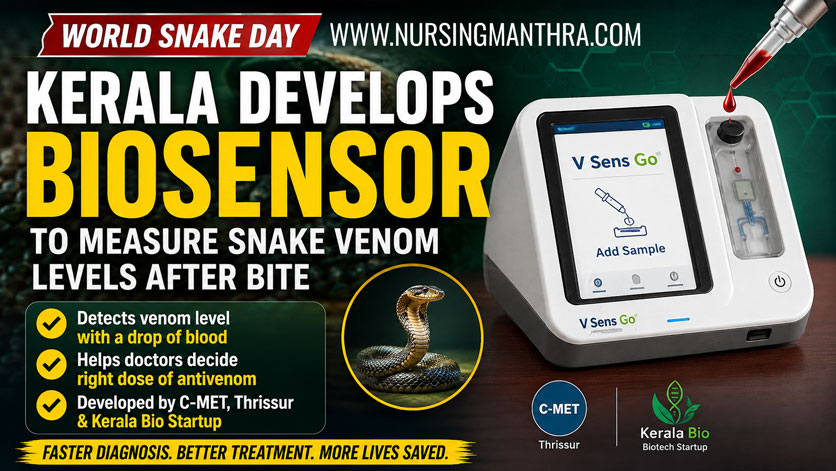
New sensor could help doctors identify the type and quantity of venom and determine the appropriate antivenom treatment
Marking World Snake Day, researchers in Kerala have developed a biosensor designed to rapidly detect and measure snake venom in the body of a bite victim. The technology could help doctors make faster treatment decisions and administer antivenom more precisely.
The sensor was reportedly developed through a collaboration involving the Centre for Materials for Electronics Technology—C-MET—in Thrissur and a Kerala-based biotechnology startup team led by Dr. R. Dileep Kumar.
Venom detection using a single drop of sample
According to the developers, the sensor can analyse a small biological sample—such as a drop of blood, urine or fluid collected from the bite wound—to determine whether venom has entered the body and estimate its concentration.
The sample is placed on a specially designed sensor chip coated with antibodies that recognise selected proteins found in snake venom. When venom molecules bind to these antibodies, the interaction produces a measurable change that can be converted into a diagnostic result.
The technology reportedly uses a surface-plasmon-based sensing system. Surface plasmons are electromagnetic waves generated along a metal surface. Changes occurring when venom proteins attach to the antibody-coated surface can be detected and measured, allowing the device to identify even small quantities of venom.
Designed to detect venom from India’s major snake species
The researchers focused on medically important Indian snakes, particularly the four species responsible for a large proportion of serious snakebite cases:
- Indian cobra
- Common krait
- Russell’s viper
- Saw-scaled viper
The sensor reportedly uses antibodies prepared to recognise characteristic proteins present in the venom of these snakes. According to the development team, the system may help determine the type of venom involved and the amount circulating in the patient’s body.
An earlier report on the Kerala-based project said that Indriyam Biologics Pvt. Ltd. was developing a species-specific diagnostic device capable of distinguishing venomous from non-venomous bites, identifying the responsible snake species and estimating venom concentration from a blood sample.
Why measuring venom levels matters
Snakebite treatment is often based on the patient’s symptoms, clinical examination, laboratory findings and information about the snake. In many cases, the snake is not identified, and symptoms may take time to develop.
The World Health Organization notes that tests such as the 20-minute whole-blood clotting test can help identify venom-induced clotting abnormalities. However, rapid point-of-care tests that directly identify the snake species and measure circulating venom are still not widely available.
A clinically validated biosensor could potentially help doctors:
- confirm whether significant envenoming has occurred;
- identify the likely type of snake venom;
- monitor the amount of venom in the bloodstream;
- support decisions on whether antivenom is required;
- assess the patient’s response after treatment; and
- reduce unnecessary exposure to antivenom.
Antivenom remains the only specific treatment capable of neutralising snake venom. However, it must be administered in a hospital where the patient can be monitored, as antivenom may occasionally cause severe allergic reactions or serum sickness. Research on other venom-detection biosensors has also highlighted the potential value of measuring venom concentrations while stressing that extensive human clinical validation is essential before routine use.
Potential for more targeted treatment
Dr. Dileep Kumar, who led the research, said that determining the amount and type of venom could eventually support the use of an appropriate quantity of species-specific or monovalent antivenom.
Most antivenom commonly used in India is polyvalent and is produced to neutralise venom from the four major snake species. A reliable species-specific diagnostic system could help avoid unnecessary treatment components and support more targeted clinical management.
However, the sensor should not be considered a replacement for emergency medical assessment. Antivenom dosing cannot be decided solely from a device reading until the technology has undergone appropriate clinical trials, accuracy testing and regulatory approval.
India carries a major snakebite burden
Snakebite envenoming remains a serious but neglected public-health problem, particularly in rural and agricultural communities.
The WHO estimates that approximately 5.4 million people are bitten by snakes worldwide every year, with between 1.8 million and 2.7 million cases of envenoming. Snakebites cause an estimated 81,410 to 137,880 deaths annually, along with hundreds of thousands of amputations and permanent disabilities.
A major study estimated that India recorded approximately 1.2 million snakebite deaths between 2000 and 2019, averaging around 58,000 deaths per year. Nearly half of the victims were between 30 and 69 years of age, while more than one-fourth were children below the age of 15.
Production and clinical validation awaited
The developers are reportedly preparing to move towards industrial-scale production. The technology may also have future applications in detecting toxins associated with spider bites and scorpion stings.
Before the device can be introduced into hospitals, it will require validation using samples from actual snakebite patients, assessment of its sensitivity and specificity, testing against venom variations from different geographical regions and approval from the relevant regulatory authorities.
If these stages are completed successfully, the biosensor could become an important point-of-care tool—particularly in rural hospitals where rapid laboratory facilities and specialist snakebite expertise may be limited.
Important factual correction
The statement that five lakh people die from snakebite every year in India is incorrect. The figure of approximately five million refers broadly to the estimated number of snakebites worldwide each year. The best-known estimate for India is approximately 58,000 snakebite deaths annually, based on data covering 2000–2019.