By Shincy George | NursingManthra
Prepared: 1 October 2026
Moving your occupational therapy career to New Zealand begins with professional registration. Your degree and experience provide the foundation, but you need to establish that you meet the requirements for practice in Aotearoa New Zealand.
This guide explains how to organise your application, what to prepare and which questions to resolve before spending money.
Who regulates occupational therapists in New Zealand?
The Occupational Therapy Board of New Zealand (OTBNZ) is the registration authority for occupational therapists. To practise, you need registration with the Board and a current Annual Practising Certificate (APC). Registration, employment and immigration permission are separate parts of the move.
Step 1: Identify your registration pathway
For an internationally educated applicant, first review the Board’s overseas-qualified practitioner pathway. The Ministry of Health’s 2024 Allied Health Report describes the general international pathway as a Board-set assessment, including an online course on Te Tiriti o Waitangi.
The same report identifies a Trans-Tasman mutual recognition pathway for occupational therapists registered in Australia. If you already hold Australian registration, ask the Board which application applies to you.
Use these descriptions as an orientation. Obtain the Board’s current instructions before choosing a route or paying a fee. Holding an overseas qualification or a master’s degree should not be treated as advance confirmation of eligibility.
Step 2: Prepare your education and practice records
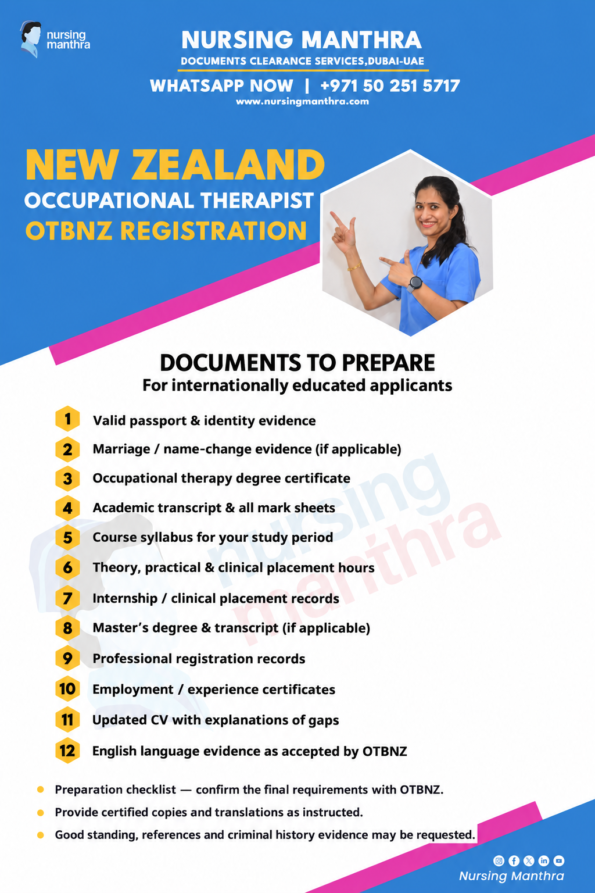
The following is a practical preparation list, not a verified reproduction of the Board’s current mandatory checklist. Submit documents according to the Board’s actual instructions.
| Document to prepare | Details to organise |
|---|---|
| Passport and identity evidence | Current identity documents and consistent personal details |
| Marriage or name-change evidence | Documents connecting different names, where applicable |
| Occupational therapy degree certificate | Exact qualification, university and awarding institution |
| Academic transcript and mark sheets | Subjects and results for the complete programme |
| Course syllabus | Curriculum applicable to your actual study years |
| Course-hour breakdown | Separate theory, practical and clinical placement hours |
| Internship or placement evidence | Dates, settings, supervision and completion |
| Postgraduate qualifications | Master’s degree and transcript, where applicable |
| Professional registration records | Registration bodies, numbers, status and dates |
| Employment evidence | Dates, role, duties, clinical setting and working hours |
| Current CV | Clear education and employment timeline, including gaps |
Ask your university early for detailed records. A generic syllabus downloaded from its current website may not describe the programme you completed.
For placement records, organise the setting, patient groups, duration and supervision details. For employment letters, ask the employer to explain your occupational therapy duties rather than provide only a job title.
Prepare any further evidence—such as regulator-issued good standing, references, criminal history information or translations—when required by the Board. Confirm whether documents must be sent directly by an institution and how copies must be certified.
Step 3: Resolve English evidence before submitting
Clear communication matters in occupational therapy: explaining treatment, discussing goals, documenting assessments and working with patients, families and colleagues.
Before booking a test or relying on an existing result, confirm the Board’s current English language policy. Ask:
- Which tests are accepted for occupational therapist registration?
- What minimum scores apply to each component?
- Is there an overall-score requirement?
- How long are results valid?
- Can results from separate sittings be combined?
- Are there alternative evidence routes, and what documents support them?
Do not assume that English-medium education automatically provides an exemption. Also, do not apply New Zealand nursing requirements or Australian AHPRA requirements to an OTBNZ application.
Is PTE accepted?
This guide does not state a PTE acceptance rule or score because the Board’s current policy could not be verified during preparation. Obtain written confirmation before relying on PTE for registration.
If you already have a score report, provide the complete report and test date. An overall score alone cannot establish whether every required component is met.
Can preparation begin before the English test?
You can begin organising your degree, transcripts, syllabus, placement records and CV. Whether the Board will accept a formal application with English evidence outstanding must be confirmed directly.
Document preparation and acceptance of an incomplete application are different questions.
Step 4: Follow the Board’s application instructions
Once your pathway is confirmed:
- Use the application method linked from the official Board website.
- Read the current guide and checklist before uploading documents.
- Enter your education, registration and employment history accurately.
- Complete the required declarations.
- Provide evidence in the requested format.
- Pay the applicable fee after checking the amount and refund terms.
- Keep copies of your submission, payment and correspondence.
Use an email address you monitor regularly. If someone assists with your application, retain access to your account and copies of the submitted documents.
Step 5: Complete the assessment and any requested learning
The Ministry of Health’s published description of the international pathway includes a Board-set assessment and an online Te Tiriti o Waitangi course.
Follow the Board’s current directions on what to complete and when. Do not assume that this is a standard Prometric examination or that every overseas applicant receives an identical assessment.
Prepare to explain your education and clinical work clearly. Useful preparation includes reviewing anonymised examples of assessment, goal setting, intervention planning and evaluation. Never include identifiable patient records.
Learning about Māori health, cultural safety and the New Zealand practice environment also helps you prepare for work with patients and whānau.
Step 6: Read the registration decision carefully
When the Board issues its decision, check your registration details and any conditions or further requirements.
If additional evidence is requested, respond to each point separately. A clear response with labelled attachments is easier to review than a large collection of unrelated documents.
Share the relevant outcome with a prospective employer so that the planned role and start date match your registration status.
Step 7: Obtain a current Annual Practising Certificate
Registration alone does not complete the requirements for practice. New Zealand’s Ministry of Health states that practitioners in regulated professions must also hold a current APC.
Before starting occupational therapy work, confirm that your certificate is issued and valid, and that any conditions are understood. Continue following the Board’s renewal and competence requirements.
Step 8: Coordinate employment and immigration
Discuss registration progress honestly with employers. Clarify whether an offer depends on registration, an APC or other checks.
Immigration New Zealand advises that applicants for work in occupations requiring registration need evidence of that registration for the relevant visa application. Check the current visa requirements for your circumstances.
A job offer does not replace professional registration, and professional registration does not itself grant a visa.
What costs should you budget for?
Obtain the current Board fee schedule before making a financial commitment. This guide does not quote an unverified registration fee or total package price.
Your budget may need to cover:
| Cost category | What to confirm |
|---|---|
| Registration application or assessment | Applicable pathway and current fee |
| Board-directed learning | Whether a separate charge applies |
| APC | Current certificate fee and renewal arrangements |
| English evidence | Test fee and possible repeat sittings |
| University records | Transcript, syllabus and placement-document charges |
| Certification and translation | Required format and authorised providers |
| Other requested checks | Regulator documents, criminal history checks or courier costs |
| Immigration and relocation | Visa, medical checks, travel and accommodation as applicable |
Request a written breakdown distinguishing authority fees, third-party expenses and any consultancy service charge.
How long does the process take?
There is no processing-time promise in this guide. Ask the Board for its current estimate and whether that estimate starts only when an application is complete.
Reduce avoidable delays by requesting university records early, checking name differences and confirming English evidence before submission. Keep your employer informed if further assessment or documents are needed.
Common questions
Does a master’s degree guarantee registration?
Do not treat an additional degree as confirmation of approval. Include it as supporting evidence and obtain the Board’s decision on your complete application.
Should I arrange an NZQA assessment first?
Ask whether an NZQA assessment is needed for your specific registration or immigration purpose before ordering one. Do not assume it replaces the Board’s professional assessment.
Can I work immediately after receiving a job offer?
To practise, you need the required professional registration, a current APC and appropriate permission to work.
Can I use New Zealand registration to move to Australia later?
Treat any later Australian application as a separate regulatory step. Obtain current Australian Board guidance before relying on mutual recognition, particularly if your New Zealand registration has conditions.
NursingManthra application support
A well-organised application starts with knowing what your documents show and what information is missing.
Contact NursingManthra to discuss assistance with organising education and employment records, understanding the application instructions and preparing responses to document requests.
Website: https://www.nursingmanthra.com
WhatsApp: +971 50 251 5717
Registration decisions remain with OTBNZ.
Official references
- OTBNZ overseas-qualified practitioners: https://www.otboard.org.nz/site/rp/overseas?nav=sidebar
- Ministry of Health — responsible authorities: https://www.health.govt.nz/regulation-legislation/health-practitioners/responsible-authorities
- Ministry of Health — 2024 Allied Health Report, occupational therapy section: https://www.health.govt.nz/system/files/2024-06/allied-health-report-2024.pdf
- Immigration New Zealand — occupational registration: https://www.immigration.govt.nz/work/requirements-for-work-visas/green-list-occupations-qualifications-and-skills/check-if-you-need-occupational-registration-for-your-job/?page=1