By Shincy George | NursingManthra
Updated: October 2026
Completing an occupational therapy degree in India and gaining clinical experience is an important foundation for an international career. However, before working as an occupational therapist in Australia, you must obtain registration with the Occupational Therapy Board of Australia through Ahpra.
For many applicants, the confusing part is knowing where to begin. Should you complete an English test first? Does a master’s degree allow direct registration? Is supervised practice necessary even if you have several years of experience?
This guide explains the current pathway for applicants who completed their occupational therapy qualifications in India.
Can an Indian-qualified occupational therapist apply for Ahpra registration?
Yes. Occupational therapists educated in India can apply to have their qualifications assessed for Australian registration.
However, holding a bachelor’s degree, a master’s degree and clinical experience does not automatically establish eligibility for general registration. Ahpra must assess the qualifications and determine the appropriate pathway.
For an applicant whose education and registration history are based in India, the Individual Qualification Assessment Pathway is generally the route to investigate. The applicant’s circumstances and Ahpra’s assessment determine the final pathway.
Under the current system, Ahpra manages overseas qualification assessment for registration on behalf of the Occupational Therapy Board. Some applicants must subsequently complete an Assessment of Competence through the Occupational Therapy Council of Australia, known as OTC.
Can you start before passing the English test?
Yes. You can begin the separate qualification assessment while preparing to meet the English language requirement.
This is useful for applicants who already have their academic documents but need more time to obtain the required English scores.
Ahpra’s occupational therapy qualification portfolio allows applicants to declare that they meet—or will meet when submitting their registration application—the relevant registration standards, including English.
The distinction between qualification assessment and registration is important:
| Stage | English requirement |
|---|---|
| Collecting documents and preparing the portfolio | A qualifying English result is not needed to begin preparation |
| Separate qualification assessment | Can begin while the applicant works towards the English requirement |
| Applying for limited registration for supervised practice | Must meet the English language standard |
| Starting supervised occupational therapy practice | Must first obtain limited registration |
| Applying for general registration | Must meet all applicable registration requirements |
Starting a qualification assessment does not authorise you to practise in Australia.
Step 1: Prepare your qualification documents
A complete academic file helps Ahpra understand what you studied, how the programme was delivered and what clinical training you completed.
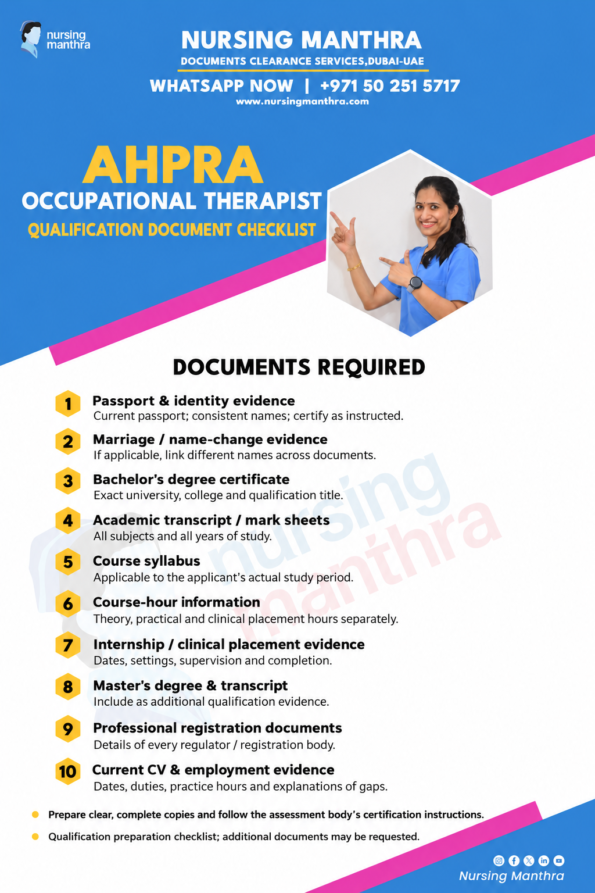
Prepare the following documents, then check them against the current application instructions:
| Document | Details to check |
|---|---|
| Valid passport and identity evidence | Name, date of birth and required certification |
| Marriage or name-change evidence | Links any different names across documents |
| Bachelor’s degree certificate | Exact qualification, university and college details |
| Academic transcript and mark sheets | All subjects and academic years |
| Course syllabus | Relevant to your actual study period |
| Course-hour information | Theory, practical and clinical placement hours |
| Internship or clinical placement records | Dates, settings, supervision and completion |
| Master’s degree and transcript | Additional qualification evidence |
| Professional registration certificates | Details of the issuing body and registration status |
| Current CV | Education, employment, practice hours and gaps |
| Employment certificates | Dates, role, duties, hours and employer contact information |
Ahpra publishes the Portfolio for the assessment of non-approved qualifications—PNAQ-96 for occupational therapy. Its instructions require certified colour copies and explain that further curriculum information may be requested after an initial review.
Before arranging certification or courier delivery, check the current submission instructions. The requirements on the application form should guide how the documents are prepared.
Does a master’s degree remove the need for assessment?
A master’s degree should be included as supporting academic evidence. However, applicants should not assume that postgraduate study removes the need to assess their entry-level occupational therapy education or complete a competence assessment.
The decision rests with Ahpra and the Board.
Step 2: Submit the qualification assessment application
Begin with the Occupational Therapy Board’s internationally qualified practitioner guidance.
Follow the current instructions to:
- Complete the qualification assessment application or portfolio.
- Attach the required identity and academic documents.
- Pay the applicable assessment fee.
- Submit using the method advertised by Ahpra.
- Respond to requests for additional information.
Keep copies of the submitted documents, payment receipt and correspondence. If Ahpra requests more information, provide documents that directly address the request.
An OTC migration skills assessment is a separate process. It does not replace Ahpra’s assessment for registration.
Step 3: Complete the English language requirement
Applicants must demonstrate that they meet the Board’s English language skills standard.
For applicants educated in India, studying in English should not be treated as an automatic exemption. Eligibility for an education-based English pathway depends on the exact conditions in the registration standard.
Current PTE Academic requirements
For PTE Academic tests taken on or after 23 April 2026, the published minimum scores are:
| Component | Minimum score |
|---|---|
| Overall | 63 |
| Listening | 58 |
| Reading | 59 |
| Writing | 60 |
| Speaking | 76 |
These thresholds apply according to the test date. Earlier tests are assessed against the requirements applicable to them.
Can two PTE results be combined?
Yes, subject to Ahpra’s conditions.
Applicants may combine results from a maximum of two sittings within a 12-month period. All four skills must be tested in each sitting, and each sitting must have an overall score of at least 63.
Across the two sittings, the applicant must achieve the required scores. Neither sitting may have a score below:
| Component | Minimum allowed in either sitting |
|---|---|
| Listening | 53 |
| Reading | 54 |
| Writing | 60 |
| Speaking | 66 |
These lower figures are the floors for combining results; they are not the final required component scores. For example, Speaking must still reach 76 in at least one qualifying sitting.
English results are generally required to be within two years before lodging the registration application, unless an applicable exception is met.
Step 4: Receive the qualification assessment outcome
Ahpra’s outcome determines the next steps.
If the qualification is assessed as relevant to occupational therapy and the applicant is required to demonstrate competence, the pathway involves limited registration and a competence assessment.
Do not book travel or promise an employment start date based only on submitting the qualification portfolio. Wait for the outcome and understand the conditions attached to it.
Step 5: Arrange suitable Australian employment and supervision
If a competence assessment is required, the applicant needs a suitable Australian occupational therapy position and approved supervision arrangements.
An employer’s willingness to offer a job is helpful, but the workplace and supervisors must also meet the requirements for the assessment pathway.
Employment, registration and immigration are connected, but separate:
- The employer provides the position and workplace arrangements.
- Ahpra determines registration.
- OTC assesses competence where required.
- The applicant must separately hold suitable Australian work rights.
Step 6: Apply for limited registration
Limited registration allows the applicant to practise within the approved supervised arrangements.
Depending on the current application requirements, prepare:
- Qualification assessment outcome.
- Evidence of meeting the English standard.
- Current CV and employment history.
- Practice-hour evidence.
- Professional registration and good-standing/status evidence.
- International criminal history check reference.
- Employment and supervisor documents.
- Required supervised practice plan.
- Professional indemnity insurance arrangements and other declarations.
Recent practice evidence
The occupational therapy recency standard requires at least one of the following:
- 750 hours of practice in the previous five years;
- 450 hours in the previous three years; or
- 150 hours in the previous 12 months.
Employment dates alone may not demonstrate these hours. Ask employers to confirm hours worked and the nature of the occupational therapy role.
Criminal history checks
Relevant applicants must arrange an international criminal history check through an Ahpra-approved supplier. Do not assume that a standard Indian Police Clearance Certificate replaces Ahpra’s approved check. Police certificates may also be needed separately for immigration or employment.
Step 7: Complete the OTC Assessment of Competence
For applicants referred to this stage, competence is assessed through supervised occupational therapy practice in Australia. Before starting, the applicant must secure employment, nominate primary and secondary supervisors, obtain approval of the arrangements and receive limited registration. After limited registration is granted, the applicant completes OTC’s application and provides the required CVs, position description and fee receipt.
The Supervised Practice Implementation Plan must be submitted within the first two weeks of employment. The assessment includes supervision records, direct observation and progress and final reporting. The usual period is based on approximately six months of full-time equivalent practice, although the approved plan and progress determine the duration. Part-time arrangements take longer.
Successful applicants receive an Assessment of Competence Certificate. They must continue under limited registration and approved supervision until Ahpra grants general registration.
Step 8: Apply for general registration
After successfully completing the required competence assessment:
- Submit the general registration application.
- Provide the competence certificate and other required evidence.
- Pay the applicable fees.
- Respond to any outstanding requests.
- Await Ahpra’s registration decision.
Once the appropriate general registration is granted, the applicant can practise within its terms and must maintain the ongoing professional requirements.
How much should you budget?
There is no single all-inclusive cost. The amount depends on the assessment outcome, English test attempts, registration stages and arrangements for working in Australia.
The following figures provide a provisional budget for an applicant required to complete supervised competence assessment:
| Item | Estimated amount in AUD |
|---|---|
| Ahpra qualification portfolio assessment | 660 |
| Limited registration application and registration | Approximately 264; confirm current fees |
| OTC competence assessment | 1,500 |
| General registration application and registration | Approximately 264; confirm current fees |
| Provisional core total | 2,688 |
The qualification portfolio publishes a fee of AUD 660. OTC publishes AUD 1,500 for the new-applicant competence assessment, and the retrieved general-registration application lists application and registration fees of AUD 132 each. The limited-registration allowance above must be checked against the current fee schedule before payment.
AUD 2,688 is a planning estimate, not a confirmed total quotation. Fees may change, and the final amount depends on the stages required.
Additional expenses
Budget separately for:
- English examinations and retests.
- International criminal history checks.
- University transcripts and supporting letters.
- Certification, translation and courier services.
- Any employer or supervision charges.
- Visa and immigration expenses.
- Flights, accommodation and living expenses.
- Registration renewals, where necessary.
- Consultancy services.
Is a migration skills assessment included?
No. If the selected visa requires an OTC migration skills assessment, that is a separate application.
The published migration assessment fee is AUD 800. Adding this to the provisional core budget gives AUD 3,488, before other expenses. A migration assessment does not itself permit occupational therapy practice.
Frequently asked questions
Can I start while preparing for PTE?
Yes. You can prepare and begin the separate qualification assessment while working towards qualifying English scores. You must meet English when applying for registration.
Is experience in India useful?
Yes. It helps document your professional history and may support recency of practice. However, experience does not automatically remove a competence assessment required by Ahpra.
Can I complete the whole process from India?
Academic document preparation, qualification assessment and English testing can be undertaken from India. If you are required to complete supervised competence assessment, that stage involves practice in an approved Australian workplace.
Does a positive qualification assessment guarantee registration?
No. You must also meet the applicable registration standards and complete any additional assessment required.
Does registration guarantee a job or visa?
No. Registration, employment and permission to work in Australia require separate arrangements.
NursingManthra assistance
Preparing an overseas registration application is easier when each document has a clear purpose. NursingManthra can assist with reviewing the academic and professional file, identifying missing evidence, organising application documents and explaining authority requests.
The service scope and NursingManthra charge should be agreed before work begins. Authority fees, English tests, verification checks and other third-party expenses are charged separately.
For occupational therapists ready to begin, a practical first step is to prepare the qualification portfolio and plan the English requirement alongside it. Applicants who need supervised competence assessment should also prepare for the employment and relocation stage.
Official guidance:
- Occupational Therapy Board—Internationally qualified occupational therapists
- Occupational Therapy Board—Competence assessment
- Ahpra—Accepted English language tests
- OTC—Assessment of competence
- OTC—Competence assessment fees
This guide describes the pathway for new applicants using guidance checked in October 2026. The applicant’s assessment outcome and the authorities’ current instructions determine the requirements for each case.
NursingManthra documentation guidance
For assistance understanding the checklist and organising your application documents, contact NursingManthra through the website’s WhatsApp link. Share your qualification, registration and recent experience details so the discussion can focus on your profile.
Final qualification acceptance, examination eligibility, registration and licensing decisions belong to MNMC. Employer recruitment and immigration approvals follow their respective processes.
Website: https://nursingmanthra.com/
WhatsApp UAE: https://wa.me/971502515717
👩⚕️ About the Author
Shincy George, RN, MSN (Cardiothoracic Nursing), SCFHS-RN, DHA RN, MOH UAE RN, NCLEX-RN (USA), is the Founder of Nursing Manthra Academy.
With extensive international clinical and academic experience, she is dedicated to guiding healthcare professionals through global licensing pathways. Through Nursing Manthra, she supports internationally educated healthcare professionals in achieving their career goals across Canada, USA, UAE, Middle East, UK, Ireland, Australia, New Zealand, and other countries.
Her mission is to simplify complex licensing processes and empower healthcare professionals with the right knowledge, guidance, and support to succeed globally. 🌍