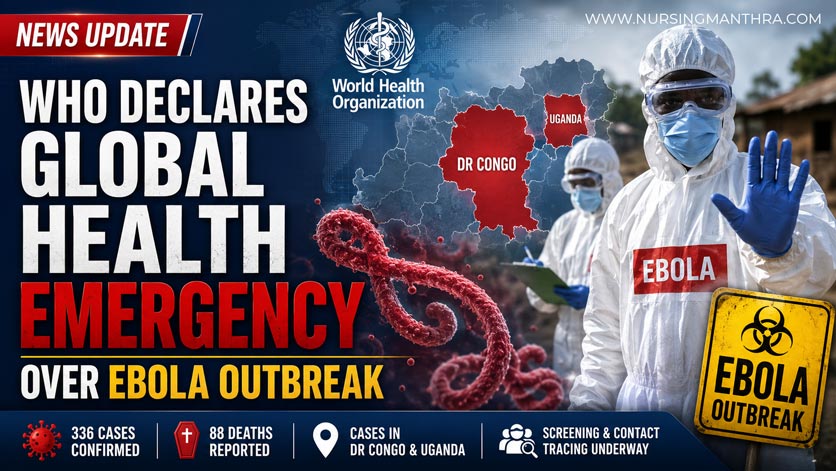
The World Health Organization has declared a global health emergency in the wake of an Ebola outbreak spreading in the African countries of Congo and Uganda.
However, WHO Director-General Tedros Adhanom Ghebreyesus said the Ebola outbreak caused by the Bundibugyo virus is not a global pandemic. Ebola has been confirmed in Congo’s Ituri province. So far, 336 cases have been confirmed and 88 people have died.
Two people who travelled from Congo to Uganda have also tested positive for the disease. Of the deaths, 87 were reported in Congo and one in Uganda. A case has also been confirmed in Kinshasa, the capital of Congo.
Kinshasa is about 1,000 kilometres away from Ituri, the epicentre of the outbreak. Health workers have intensified screening and contact tracing to bring the disease under control. However, ongoing internal conflict in many parts of Congo has posed a major challenge to health workers.
Ebola is a highly contagious disease. It spreads through bodily fluids such as vomit, blood and semen. The virus can be transmitted through the blood, excreta or other fluids of infected people or those who have died from the disease.
The disease is also found in animals such as monkeys, antelopes, porcupines and pigs. Humans can contract the virus through contact with the excreta of infected animals or by eating their meat.
Although Ebola outbreaks are rare, the disease is deadly and often fatal. Ebola has broken out more than 20 times in Congo and Uganda, while the Bundibugyo virus has been reported three times.
The Bundibugyo virus was first identified in Uganda’s Bundibugyo district in 2007–2008, which is how it got its name. At that time, 149 people were infected and 37 died. The second Bundibugyo virus outbreak occurred in Congo in 2012, when 57 people were infected and 29 died.
Ebola was first detected in Congo in 1976.