
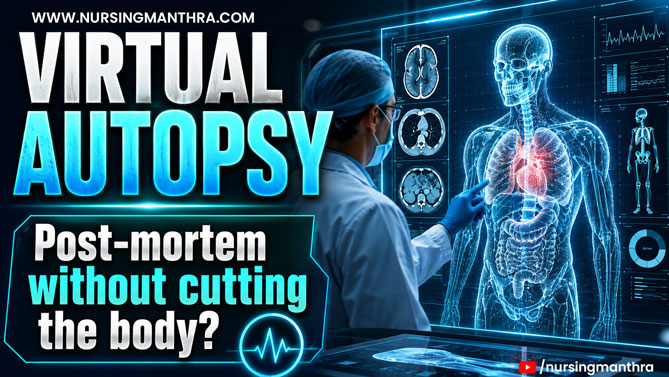
Autopsy has always been one of the most important tools in forensic medicine. When a person dies in an accident, suspicious circumstance, suicide, homicide, hospital complication, or unexplained condition, doctors may need to examine the body to understand the exact cause of death. Traditionally, this is done through a conventional post-mortem examination, where the body is surgically opened and the organs are examined.
Today, forensic medicine is moving into a new era with the development of virtual autopsy, also known as virtopsy or post-mortem imaging. This method uses advanced medical imaging technologies such as CT scan, MRI scan, 3D surface scanning, digital X-ray, and computer-based reconstruction to examine the body after death. Instead of cutting open the body, doctors can study internal injuries, fractures, bleeding, air embolism, bullet tracks, foreign bodies, and organ damage through detailed digital images.
Virtual autopsy does not mean that death is “decided in advance.” It means that the cause and manner of death can be investigated using scientific imaging methods. The main aim is to make forensic examination more accurate, respectful, faster, and digitally recordable.
One of the biggest advantages of virtual autopsy is that it is non-invasive or minimally invasive. In many cultures and religions, cutting the body after death is emotionally difficult for the family. Virtual autopsy can reduce that distress because the external appearance of the body is preserved. It can also help families receive the body more quickly in suitable cases.
Another important benefit is documentation. A conventional autopsy report is mainly written by the doctor at the time of examination. But in virtual autopsy, CT and MRI images can be stored permanently as digital evidence. These images can be reviewed later by other forensic experts, courts, medical boards, or investigators. This is especially useful in medico-legal cases, road traffic accidents, gunshot injuries, mass disasters, and cases where a second opinion may be required.
CT scan is particularly useful in detecting bone fractures, internal bleeding, gas collections, foreign bodies, bullets, and trauma-related injuries. MRI is more useful for soft-tissue examination, brain injuries, spinal cord injuries, and some organ-related findings. 3D scanning can document external wounds, injury patterns, and body surface findings with accurate measurements.
Virtual autopsy is already being used in several countries as part of forensic investigation. India has also started moving in this direction. AIIMS New Delhi has established a Centre for Advanced Research and Excellence in Virtual Autopsy, which is described as a major development in forensic medicine in India and South-East Asia. This shows that India is also adopting modern scientific methods in medico-legal death investigation.
However, virtual autopsy cannot completely replace conventional autopsy in every case. Some deaths require tissue sampling, toxicology testing, histopathology, microbiology, or detailed organ examination. For example, poisoning, infection, some natural diseases, drug-related deaths, and microscopic disease changes may not be fully confirmed by imaging alone. In such cases, a traditional autopsy or a combined approach may still be necessary.
The best use of virtual autopsy is not as a total replacement, but as a powerful additional tool. In many trauma cases, it can guide the forensic doctor before opening the body. In selected cases, it may reduce the need for a full dissection. In complex cases, it can improve accuracy by combining imaging findings with medical history, police records, external examination, laboratory testing, and conventional post-mortem findings.
Virtual autopsy also has value in medical education and legal transparency. Students and forensic trainees can study real post-mortem imaging without depending only on dissection. Courts can also understand injuries better through 3D reconstructions and digital images, especially in cases involving accidents, assault, or firearm injuries.
At the same time, there are challenges. Virtual autopsy requires expensive machines, trained forensic radiologists, proper medico-legal protocols, and secure storage of digital data. Not every hospital or mortuary has these facilities. There must also be clear legal acceptance and standard guidelines for using virtual autopsy findings in court.
In conclusion, virtual autopsy is a major advancement in forensic medicine. It offers a more respectful, scientific, and digitally documented way to investigate death. It is especially useful in trauma, accident, firearm, disaster, and suspicious-death cases. But it should be understood correctly: virtual autopsy is not a shortcut and not a guess. It is a scientific method that uses modern imaging to support forensic truth. In the future, the strongest medico-legal death investigations may use a combination of virtual autopsy, laboratory testing, and conventional post-mortem examination whenever required.