
Nursing manthra 25/03/2026.
Are you an internationally educated nurse looking for a high-paying career in a world-class healthcare system? Hong Kong has recently opened a “Golden Opportunity” for non-locally trained nurses.
Below is the complete roadmap—from the official NCHK registration steps to the practical reality of moving to Hong Kong—curated for the Nursing Manthra community.
1. Who Can Apply? (Eligibility)
According to the NCHK, to be eligible for full registration or enrolment, you must:
- Character: Be of good character and professional conduct.
- Training: * Registered Nurse (RN): Minimum 3 years of nursing training.
- Enrolled Nurse (EN): Minimum 2 years of nursing training.
- Experience: At least one year of post-registration clinical experience is typically required for the recruitment drive.
- Current License: You must possess a valid certificate to practice nursing (e.g., from KNMC or your home country’s council) at the time of application.
2. The Two Main Pathways
Currently, most international nurses are entering via the Hospital Authority (HA) recruitment drive under:
- Limited/Special Registration: This allows you to work in public hospitals (Hospital Authority) without the immediate need for the licensing exam.
- Full Registration: This requires passing the NCHK Licensing Examination.
3. Step-by-Step Application Process
Phase 1: Online Job Application (Direct Recruitment)
The process is 100% direct. There are no agencies.
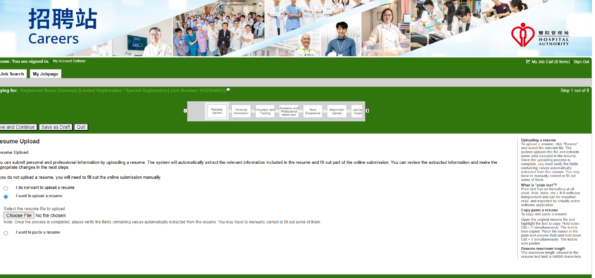
- Visit the Hospital Authority (HA) website and apply under “Opportunities for Non-locally Trained Nurses.”
- Submit your resume, graduation certificates, and proof of experience.
- Interview: If shortlisted, you will have a trial interview (for document/ID check) followed by a formal interview. Results are usually out within 2 months.
Phase 2: NCHK Registration (The Paperwork)
Once the HA selects you, you must complete the NCHK registration forms:
- Form 1 (Personal): Your details and notarized copies of your ID/Passport.
- Form 2 (Training): Must be completed by your Nursing College/University and sent directly to the NCHK in a sealed envelope. It must include a transcript and a detailed breakdown of theoretical and clinical hours.
- Form 3 (Registration): Must be completed by your Home Nursing Council (e.g., Kerala Nursing Council) and sent directly to the NCHK in a sealed envelope.
Note: If your name differs between documents (e.g., maiden name vs. married name), you must provide a Statutory Declaration verifying you are the same person.
4. Documents Required
- Nursing Graduation Certificate.
- Passport/Hong Kong ID.
- Valid Practicing Certificate (E-certificates must be printed and notarized).
- Official Transcripts (sent directly from the college).
- Employment proof/Service certificates.
5. Cost and Timeline
- Total Official Cost: Very affordable. Registration and visa fees generally total less than ₹25,000 INR ($230 HKD for the practicing certificate + $230 HKD for the visa).
- Processing Time: It takes an average of 3 to 4 months for colleges/councils to verify documents. The total process from application to landing takes about 6 months.
- Deadline: While processed year-round, files must be completed by October 31st each year to be assessed for the following year’s licensing exam eligibility.
6. Salary and Benefits
Hong Kong offers some of the highest nursing salaries in the world:
- Monthly Salary: HKD 35,000 – 55,000 (Approx. ₹4 to ₹6 Lakhs per month).
- Allowances: Includes a monthly allowance, a 5% housing subsidy, and a relocation grant.
- Medical: Comprehensive medical benefits (excluding most dental).
- Leave: 25 days of annual leave.
- Travel: Initial flight tickets are initially paid by the nurse but later reimbursed by the Hospital Authority.
7. Life in Hong Kong: What to Expect
- Language: While English is used for medical documentation and by doctors, Cantonese is the local language. You don’t need to pass a Cantonese exam to start, but learning basic phrases is essential for patient care.
- Work Culture: High-tech environment, 5-day work weeks (44 hours/week), and excellent career development courses.
- Accommodation: This is the biggest expense. Be prepared to pay 2 months’ deposit + 1 month’s rent upfront.
- Food & Transport: Very affordable and efficient. Indian/Malayali food items are widely available.
2. Post-Selection Process & Documentation
Once you receive your selection email, the “Document Drive” phase begins:
- Digital Drive Access: You will receive a link to a secure drive with a unique username and password to upload your documents within 3–4 days of selection.
- Form Filling Rule: All forms MUST be typed in capital letters. Hand-written forms are strictly rejected and sent back, which delays the process.
- Experience Certificate Specifics: Your experience certificate must clearly state your weekly working hours (e.g., 48 hours/week in India or 40–44 hours in other regions). If this is missing, the Hospital Authority will request additional supporting documents, causing delays.
3. Registration Categories & Career Path
- Limited vs. Special Registration: The NCHK decides your category based on your qualifications.
- Special Registration: Generally for those with higher qualifications, such as a Master’s degree or those who completed Post Basic B.Sc. Nursing (which is viewed as a post-qualification training program).
- Path to Full Registration: You initially sign a 3-year renewable contract. Successfully completing this period often opens a direct pathway to Full Registration without the initial high hurdles of the licensing exam.
4. Enhanced Relocation Benefits
- Relocation Allowance: Eligible nurses can receive up to HKD 60,000 (approximately ₹6.5 Lakhs INR).
- Usage: This is a reimbursement-based allowance. You can use it for shipping household goods/furniture from your home country or for purchasing new electrical appliances and furniture in Hong Kong.
5. Accommodation Details
- For Single Nurses: The Hospital Authority provides 2 months of temporary accommodation. A small fee (approx. HKD 2,900) is deducted from your salary for this. This 2-month window allows you to find a permanent flat near your assigned hospital.
- For Families: The HA does not provide quarters for families. Nurses moving with spouses or children should book a hotel for the first few days and then rent a private flat.
6. Family Integration
- Dependents: You can bring your spouse and children with you. Their visa processing can start simultaneously with yours.
- Parents: Please note that you cannot bring parents on a dependent visa initially. They can only come on a Visiting Visa until you achieve Permanent Residency (PR) status.
7. Verification Tips for Faster Processing
- Background Checks: The HA conducts thorough background checks with your college and previous hospitals. Ensure your institutions are responsive to emails to avoid delays.
- Courier vs. Email: While NCHK prefers direct couriers from institutions, some councils (like the Kerala Nursing Council) also use email. Using email where possible can significantly speed up the verification timeline.
Important Warning: Applications sent by fax or email will not be processed by the NCHK. All documents must be submitted in person or by post to: Secretariat of the Nursing Council of Hong Kong, 5/F, High Block, Queensway Government Offices, 66 Queensway, Hong Kong.
The “Visiting Nurses” Scheme (Global Health Care Talent Scheme)
If you are seeing “Visiting Nurses” in your interview invitation, here is what you need to know:
- What it is: A medium-term clinical exchange program (12 to 24 months) for various specialties like ICU, Cardiac Care, Renal, Endoscopy, and Emergency Care.
- Registration Type: Applicants under this scheme are granted Limited Registration.
- Salary: remains high, ranging from ₹4 to ₹6 Lakhs (HKD 40,000 – 60,000) depending on experience.
- Opportunity: This is a “trial” for international nurses to integrate into the Hong Kong system. Success here can lead to long-term employment opportunities.
Comprehensive NCHK Licensing Examination Guide
For those aiming for Full Registration, passing the NCHK Licensing Examination is mandatory.
1. Examination Format & Rules
- Two Parts: The exam consists of a Written Part and a Practical Part. There are no exemptions.
- Prerequisite: You must pass the Written Part before you are allowed to sit for the Practical Part. * Pass Requirement: You must pass both parts to register/enroll.
2. Important Timeframes & Limits
- First Attempt: Must be made within 2 years of receiving NCHK approval.
- Re-sitting: If you fail a part, you only re-sit that specific part. However, you must do so within 1 year of your last attempt.
- Three-Strike Rule: You are allowed a maximum of three attempts. If you fail three times, you cannot re-sit without special permission from the Council (requested within 2 weeks of the result).
- The 3-Year Rule: If you pass the written part but fail to pass the practical part within 3 years, you must start over and re-sit both parts.
3. Examination Schedule (Reference Only)
| Examination Type | Written Part | Practical Part |
| Registration (RN) | March & Sept/Oct | Jan/Feb & June |
| Enrolment (EN) | March | August/September |
4. Examination Fees
- Registration (RN): HK$860 (Approx. ₹9,200 INR)
- Enrolment (EN): HK$920 (Approx. ₹9,800 INR)
- Note: Fees are non-refundable and subject to change.
Pro-Tips for Success
- Check for Errors: Even minor document errors lead to files being returned by the NCHK. Double-check every date and signature before submission to avoid a 2-3 month delay.
- Medical Exam Options: The Hospital Authority may offer to pay for your flight to Hong Kong specifically to complete your medical check-up a week before your official joining date.
Real-World Success Stories (Malayali Nurses in HK)
- The Pioneer Group: Over the last 1.5 years, a “Golden Opportunity” has led to 30 international nurses passing the interview, with 17 Malayali nurses already on the ground and working in Hong Kong as of March 2026.
- Longevity: The first nurse recruited through this pathway has now completed 9 months of service, proving the stability of the program. [
- Savings Potential: Nurses report that even after living expenses, they are able to save over ₹2 Lakhs per month (approximately 40-60% of their total salary).
- Home Visits: It is easy and affordable to travel back to India for short leaves (even 1 week) to visit parents and family.
2. Updated Application Link Info
- Broken Links: Many older links in YouTube descriptions have expired. Applicants must use the newly updated 2026 application link provided by the Hospital Authority.
- Specific Category: When browsing the career portal, you must select the option: “Non-Locally Trained Nurses – Special or Limited Registration.” Applying under general “Registered Nurse” categories meant for locals will lead to automatic rejection.
3. Living & Family Benefits
- Family Work Rights: Not only can you bring your spouse and children immediately, but your spouse is also eligible to work in Hong Kong.
- Education: Children of recruited nurses receive free education in Hong Kong.
- Lifestyle: Hong Kong is ranked as one of the top 3 cities globally for quality of life, offering a blend of high-tech urban living and beautiful nature (beaches and hiking trails).
4. Addressing the Language Myth
- English First: While Cantonese is the local language, doctors and medical staff communicate primarily in English.
- Learning Support: The Hospital Authority provides PDF guides and classes to help international nurses learn basic Cantonese phrases for patient interaction. You are not expected to be fluent before you arrive.
5. Why the Urgency? (The 2027-28 Shortage)
- Mass Retirements: Hong Kong is facing a massive nursing shortage due to a wave of retirements expected in 2027–2028.
- New Policy: The government has recently ended the policy of allowing retired local nurses to continue working, specifically to open doors for younger, internationally trained talent.
Updated Blog Summary Table
| Feature | Detail |
| Salary Range | ₹4 – ₹6 Lakhs INR / Month |
| IELTS / OET | Not Required |
| Processing Time | Approx. 6 Months |
| Family Benefits | Spouse work rights + Free child education |
Frequently Asked Questions (FAQ): Nursing in Hong Kong:
No. One of the biggest advantages of this “Golden Opportunity” is that IELTS and OET are not mandatory for the initial recruitment through the Hospital Authority. You must, however, be able to communicate effectively in English.
A: There is no strict age limit mentioned; however, the recruitment drive is specifically aimed at filling gaps caused by a massive wave of retirements expected in 2027–2028.
A: Both GNM and B.Sc. graduates can apply. GNM graduates typically need a minimum of 2 years of training for “Enrolment,” while B.Sc. graduates need 3 years for “Registration.”
A: Yes. Under the Limited or Special Registration pathways, you can work in public hospitals (Hospital Authority) immediately after your certificates are verified and you pass the interview. You do not need to sit the exam first.
A: You are allowed a maximum of three attempts. If you fail three times, you cannot re-sit without special permission from the Council.
A: You only need to re-sit the failed (practical) part. However, you must pass the practical part within 3 years of passing the written part, or you will have to re-sit both.
A: Salaries range from HKD 35,000 to HKD 55,000 (Approx. ₹4 to ₹6 Lakhs INR per month). After living expenses, most Malayali nurses currently in Hong Kong report saving over ₹2 Lakhs per month.
A: Yes, but it is a reimbursement process. You book your own ticket initially, and the HA reimburses the cost after you join.
A: It is a one-time grant of up to HKD 60,000 (approx. ₹6.5 Lakhs) to help you move. This covers shipping your belongings or buying new furniture and appliances once you arrive.
A: Yes. You can bring your spouse and children on dependent visas. Your spouse is also legally allowed to work in Hong Kong, and your children receive free education in government schools.
A: Not for recruitment. While patients speak Cantonese, doctors and medical staff use English for documentation and professional communication. The Hospital Authority provides basic Cantonese classes and PDF guides to help you learn common patient phrases.
A: For single nurses, the HA provides 2 months of temporary housing (for a small fee) to give you time to find a flat. For families, you must rent a private apartment, but the HA provides a 5% housing subsidy to assist with rent.
A: Many old links from 2024/2025 have expired. Ensure you are using the updated 2026 link and selecting the “Non-Locally Trained Nurses” category.
A: Minor documentation errors. Common issues include:
Not typing the forms in CAPITAL LETTERS.
Forgetting to mention weekly working hours on the experience certificate.
Discrepancies in names (maiden vs. married name) without a Statutory Declaration.
Blog post by: Shincy George For more updates, follow: Nursing Manthra
About the Author:
Shincy George, RN, MSN (Cardiothoracic Nursing), DHA RN, MOH RN, SCFHS RN, NCLEX RN. Currently pursuing PhD in Nursing.
Founder – Nursing Manthra Academy
Nursing Manthra assists internationally educated nurses with professional licensing pathways in: All European and Gulf countries Licensing process for health care professionals.







Inrestesd
Good I belive … process will be hopefully
Good
Hii
This is Mensuba gurung . Nepali registered nurse working in OR department in 150 bedded hospital. I want to move hongkong as nurse please help me find a way
Kindly contact us through whatsapp number-+971502515717