

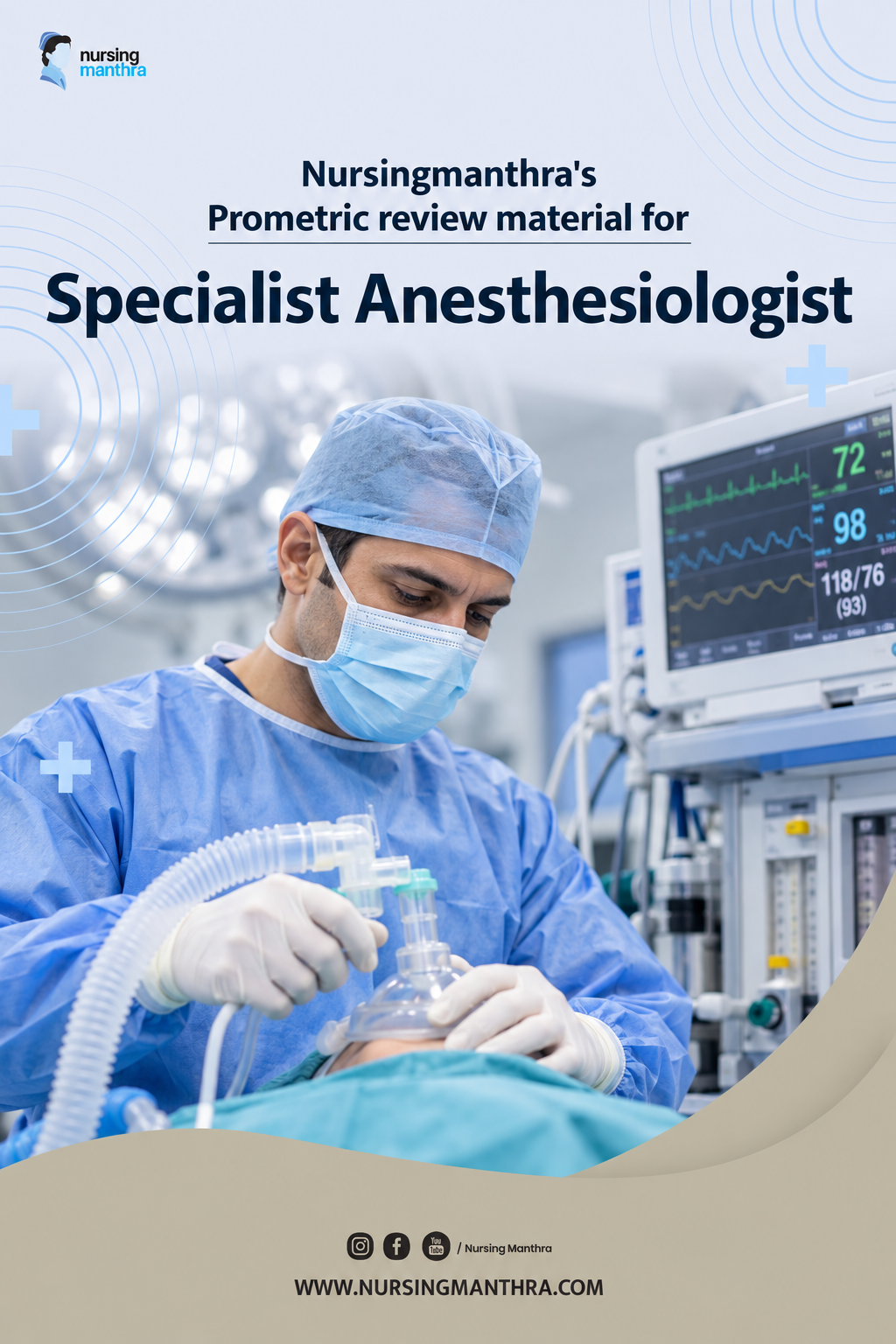
*Nursing Manthra’s Prometric Review Material for Specialist Anesthesiologist*
AED250.00
Study Material Access & Terms
- Nursing Manthra study materials are provided as read-only PDF files and cannot be downloaded, printed, copied, or shared.
- The amount paid for the study material is non-refundable.
- Access is intended exclusively for the registered candidate.
- Candidates should verify that the Gmail address provided at the time of purchase is correct.
- Unauthorized copying, redistribution, resale, screen reproduction, recording, or sharing of the study material is strictly prohibited.
Description
Prepare confidently for the Specialist Anesthesia Prometric Examination with Nursing Manthra’s comprehensive, exam-focused review material. This study resource is designed for anesthesiology professionals preparing for healthcare licensing examinations and focuses on the major clinical areas included in the Specialist Anesthesia examination blueprint.
The material contains 2,000 carefully structured multiple-choice questions covering anesthesia practice, perioperative medicine, critical care, pain management, regional anesthesia, patient safety, and specialty-specific anesthesia.
Study Material Format
Total Questions: 2,000 MCQs
Every question is presented in the following format:
Question
A. Option 1
B. Option 2
C. Option 3
D. Option 4
Correct Answer: One best answer
Rationale: Detailed explanation of why the answer is correct, with relevant clinical reasoning and key exam points.
Questions include a combination of knowledge-based, clinical scenario, decision-making, complication-management, patient-safety, and application-oriented MCQs.
Prometric Exam Coverage Areas
1. Airway
Covers assessment and management of the normal and difficult airway, airway devices, endotracheal intubation, supraglottic airway devices, rapid sequence induction, failed airway management, extubation, aspiration prevention, and airway emergencies.
2. Thoracic, Cardiac & Vascular Anesthesia
Includes anesthesia for cardiac, thoracic, and vascular procedures; cardiovascular physiology; hemodynamic monitoring; cardiopulmonary bypass; valvular disease; ischemic heart disease; one-lung ventilation; major vascular surgery; and perioperative cardiovascular complications.
3. Neurosurgical & Critical Care Medicine
Focuses on neuroanesthesia, intracranial pressure management, cerebral perfusion, traumatic brain injury, intracranial hemorrhage, brain tumors, spinal surgery, neurophysiological monitoring, and critical neurological emergencies.
4. Obstetric & Gynecological Anesthesia
Covers anesthesia for cesarean delivery, labor analgesia, obstetric emergencies, preeclampsia/eclampsia, postpartum hemorrhage, maternal resuscitation, regional anesthesia during pregnancy, and anesthesia for gynecological procedures.
5. Neonatal & Pediatric Anesthesia
Includes pediatric airway management, neonatal physiology, pediatric pharmacology, fluid therapy, congenital abnormalities, pediatric emergencies, perioperative monitoring, pain management, and anesthesia considerations across different pediatric age groups.
6. Organ-Based Anesthesia
Covers anesthesia considerations related to cardiovascular, respiratory, renal, hepatic, endocrine, gastrointestinal, neurological, and other major organ-system diseases.
7. Trauma, Burns & Orthopedic Surgery
Includes anesthesia for major trauma, hemorrhagic shock, massive transfusion, burns, fractures, orthopedic procedures, spinal injuries, fat embolism, tourniquet use, and perioperative management of high-risk trauma patients.
8. Regional Anesthesia, Acute & Chronic Pain
Covers regional anesthesia principles, pain pathways, multimodal analgesia, postoperative pain management, chronic pain conditions, pharmacologic pain therapy, patient-controlled analgesia, and complications associated with regional techniques.
9. Perioperative Medicine
Includes preoperative assessment, optimization of comorbidities, risk stratification, perioperative medication management, intraoperative monitoring, fluid and electrolyte management, postoperative care, and prevention of perioperative complications.
10. Peripheral Nerve Blocks, Epidural & Spinal Anesthesia
Covers neuraxial anesthesia, spinal and epidural techniques, peripheral nerve blocks, indications, contraindications, local anesthetic pharmacology, ultrasound-guided procedures, block selection, and management of complications.
11. Critical Care Medicine
Includes respiratory failure, mechanical ventilation, shock, sepsis, hemodynamic support, fluid therapy, vasopressors, acid-base disorders, electrolyte abnormalities, organ failure, ICU monitoring, and resuscitation.
12. Patient Safety
Focuses on safe anesthesia practice, monitoring standards, medication safety, equipment checks, prevention of adverse events, surgical safety, infection prevention, crisis management, human factors, and recognition of perioperative emergencies.
13. Professionalism & Ethics
Covers informed consent, confidentiality, communication, ethical decision-making, professional responsibilities, documentation, patient autonomy, end-of-life issues, teamwork, and appropriate professional conduct.
Additional High-Yield Areas Included
The 2,000-question review also incorporates important anesthesia topics such as:
- General anesthesia
- Intravenous and inhalational anesthetic agents
- Neuromuscular blocking drugs and reversal agents
- Local anesthetics
- Opioids and analgesics
- Anesthesia machine and breathing systems
- Capnography and respiratory monitoring
- ECG and cardiovascular monitoring
- Fluid, blood and blood-product management
- Acid-base and electrolyte disorders
- Difficult airway algorithms
- Malignant hyperthermia
- Anaphylaxis
- Local anesthetic systemic toxicity
- Perioperative cardiac arrest
- Post-anesthesia care
- Postoperative nausea and vomiting
- Temperature management
- Coagulation and anticoagulation
- Anesthesia-related emergencies and complications
Designed for Exam-Oriented Preparation
The material emphasizes:
✓ High-yield concepts
✓ Clinical scenario-based questions
✓ One-best-answer MCQs
✓ Patient-safety questions
✓ Emergency anesthesia situations
✓ Perioperative decision-making
✓ Detailed rationales for every answer
✓ Broad coverage across the Specialist Anesthesia blueprint
The purpose of this review material is not simply to memorize answers, but to strengthen clinical reasoning, anesthesia knowledge, prioritization, complication recognition, and safe decision-making.
Reviews (0)
Related Products

- Total pages – 656
- Total MCQ – 2000
- Cost — 150 AED


Total Theory pages – 510
Total MCQ – 235
- Total questions-2600 MCQ
- Total pages – 1000 pages
- Cost -150 AED


- Total pages – 1000
- Total MCQ –More than 1000
- Cost — 100 AED

- Total pages – 1000
- Total MCQ –More than 2000
- Cost — 100 AED
Category of Questions For Nurses:
- Nursing fundamentals—30
- Adult nursing—61
- Maternal child health nursing—44
- Unit management and Leadership–15

Question bank Contents:
Total questions-2000 MCQ
Total pages- 699 Pages
It contains MCQ(multiple Choice Questions) with all options, correct answer and rational.
-Previously asked MCQ

Total MCQ —-2300 (QUESTION, OPTION, ANSWER AND RATIONAL ) FORMAT
Theory book -Total pages-344 pages
Cost —150 AED

Total pages –
Total MCQ –
Cost — 150


Reviews
There are no reviews yet.