
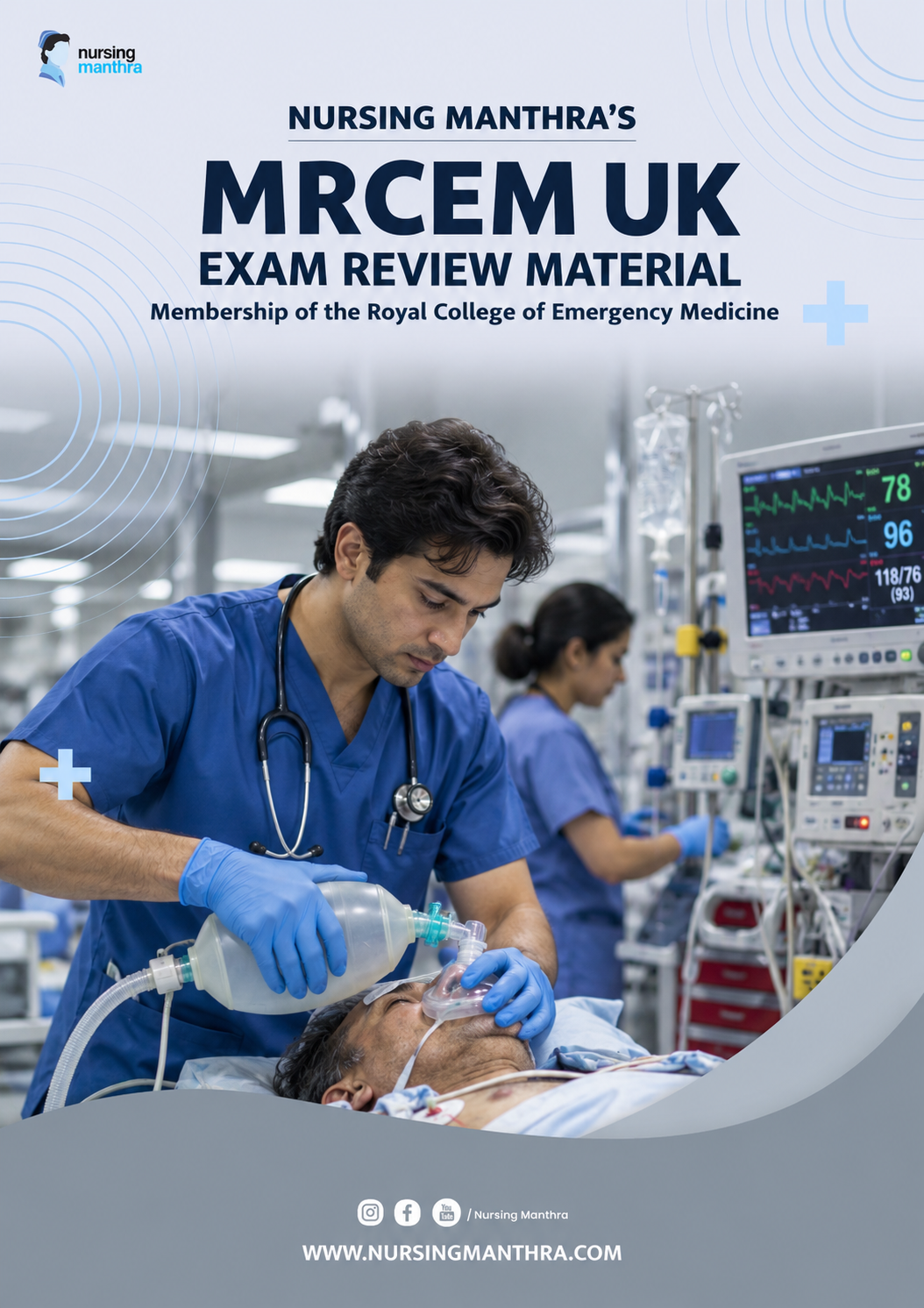
NURSING MANTHRA’S MRCEM UK -EXAM REVIEW MATERIAL – Membership of the Royal College of Emergency Medicine
AED250.00
Total question-2000
Important Access & Usage Terms
Please read the following conditions carefully before purchasing NursingManthra study materials.
- Read-Only PDF: Study materials are provided as read-only PDF files. Downloading, printing, copying and sharing are not permitted.
- Non-Refundable: Payments for digital study materials are non-refundable, subject to applicable consumer law.
- Individual Access: Access is provided exclusively to the registered candidate.
- Correct Gmail Address: Candidates must provide a valid Gmail address at the time of purchase to receive access.
- Copyright Protection: Unauthorised reproduction, recording, redistribution, resale, screen reproduction or sharing of the materials is strictly prohibited.
About the material: NursingManthra provides independent educational review materials for examination preparation.
Description
2,000 Advanced Case-Based MCQs | Questions, Options, Answers and Detailed Rationales
In emergency medicine, recognising the diagnosis is only part of the challenge. A doctor must also decide what to do first, which investigation can wait, and when a patient needs immediate intervention.
NursingManthra’s MRCEM UK Exam Review Material is designed to strengthen these decisions through 2,000 challenging, case-based multiple-choice questions, with particular emphasis on clinical preparation for the MRCEM SBA examination.
The material focuses on complex emergency presentations, critically ill patients and situations where several treatment options appear reasonable—but one is the most appropriate next step. Clinical scenarios encourage candidates to interpret findings, recognise deterioration, prioritise resuscitation and plan safe emergency management.
Question Format
Each MCQ follows a structured learning format:
- Question: A detailed clinical scenario presenting the patient’s history, examination findings and relevant investigation results.
- Options: Five plausible choices requiring selection of the single best answer.
- Answer: The correct option, clearly identified.
- Rationale: An explanation of the clinical reasoning, management priorities and why alternative options are less appropriate.
Contents of the Material
1. Resuscitation and the Critically Ill Patient
Cardiac arrest, peri-arrest deterioration, shock, sepsis, anaphylaxis, post-resuscitation care and prioritisation of treatment in unstable patients.
2. Airway and Respiratory Emergencies
Difficult airway assessment, oxygenation and ventilation, severe asthma, acute respiratory failure, pulmonary embolism, pneumothorax and complications of respiratory support.
3. Cardiovascular Emergencies
Acute coronary syndromes, dangerous arrhythmias, acute heart failure, aortic emergencies, cardiac tamponade and high-risk causes of chest pain or syncope.
4. Trauma and Major Injury
Multisystem trauma, major haemorrhage, head and spinal injuries, chest and abdominal trauma, pelvic injuries, burns and trauma in children, older adults and pregnant patients.
5. Neurological Emergencies
Stroke, intracranial haemorrhage, status epilepticus, meningitis, altered consciousness, acute weakness and time-critical causes of headache.
6. Endocrine, Metabolic and Renal Emergencies
Diabetic ketoacidosis, hyperosmolar hyperglycaemic state, hypoglycaemia, adrenal crisis, thyroid emergencies, acute kidney injury, electrolyte disturbances and complex acid–base disorders.
7. Gastrointestinal and Surgical Emergencies
Gastrointestinal bleeding, acute abdominal pain, bowel obstruction, perforation, mesenteric ischaemia, pancreatitis and hepatobiliary emergencies.
8. Toxicology and Environmental Emergencies
Overdose, poisoning, toxidromes, antidote selection, envenomation, drowning, electrical injuries, heat illness and hypothermia.
9. Paediatric Emergencies
Assessment of the seriously ill child, respiratory distress, shock, seizures, dehydration, neonatal presentations, paediatric trauma and safeguarding concerns.
10. Obstetric and Gynaecological Emergencies
Ectopic pregnancy, early pregnancy bleeding, eclampsia, obstetric haemorrhage, ovarian torsion and emergency assessment during pregnancy.
11. Musculoskeletal and Limb-Threatening Emergencies
Fractures, dislocations, compartment syndrome, septic arthritis, acute limb ischaemia and neurovascular compromise.
12. ENT, Ophthalmic, Maxillofacial and Dental Emergencies
Threatened airway, severe epistaxis, deep neck infection, acute visual loss, ocular trauma and serious facial or dental infections.
13. Infectious Diseases and Haematological Emergencies
Severe infection, neutropenic sepsis, bleeding disorders, anticoagulant-associated haemorrhage, transfusion reactions and sickle cell emergencies.
14. Psychiatric, Behavioural and Geriatric Emergencies
Acute agitation, self-harm assessment, substance withdrawal, delirium, frailty, polypharmacy and atypical presentations in older adults.
15. Emergency Procedures, Analgesia and Sedation
Procedural decision-making, preparation, contraindications, monitoring, complications and recognition of treatment-related deterioration.
16. Clinical Interpretation, Ethics and Patient Safety
ECG findings, blood gas results, laboratory data and described imaging findings, alongside capacity, consent, safeguarding, safe handover and disposition decisions.
What Makes These Questions Challenging?
The cases are designed to move beyond straightforward recall. Candidates will encounter:
- Patients with multiple illnesses and competing treatment priorities.
- Atypical presentations and incomplete or conflicting clinical information.
- Deterioration despite initial treatment.
- Medication contraindications, adverse effects and treatment complications.
- Decisions between immediate intervention, further investigation and specialist escalation.
- Questions asking for the first action, next best step, definitive treatment or safest disposition.
The emphasis is on clinically meaningful difficulty: recognising what matters most and choosing the safest action at the right time.
Who Is This Material For?
This review material is intended for doctors preparing for the MRCEM SBA examination, as well as emergency medicine trainees and doctors seeking structured practice in emergency assessment and clinical decision-making.
Scope: This is a clinical MCQ resource. It is not a complete MRCEM Primary basic sciences course or a substitute for practical MRCEM OSCE preparation.
Important Access & Usage Terms
Please read the following conditions carefully before purchasing NursingManthra study materials.
- Read-Only PDF: Study materials are provided through read-only PDF access. Downloading, printing, copying and sharing are not permitted.
- Non-Refundable: Payments for digital study materials are non-refundable, subject to applicable consumer law.
- Individual Access: Access is provided exclusively to the registered candidate.
- Correct Gmail Address: Candidates must provide a valid Gmail address at the time of purchase to receive access.
- Copyright Protection: Unauthorised reproduction, recording, redistribution, resale, screen reproduction or sharing of the materials is prohibited.
Reviews (0)
Related Products
Important Access & Usage Terms
Please read the following conditions carefully before purchasing NursingManthra study materials.
- Read-Only PDF: Study materials are provided as read-only PDF files. Downloading, printing, copying and sharing are not permitted.
- Non-Refundable: Payments for digital study materials are non-refundable, subject to applicable consumer law.
- Individual Access: Access is provided exclusively to the registered candidate.
- Correct Gmail Address: Candidates must provide a valid Gmail address at the time of purchase to receive access.
- Copyright Protection: Unauthorised reproduction, recording, redistribution, resale, screen reproduction or sharing of the materials is strictly prohibited.
About the material: NursingManthra provides independent educational review materials for examination preparation.

Price Drop: Nursing Officer/Staff Nurse Review now ₹1,800 (Save ₹600)

AIIMS NORCET 2025 prep with 1500 MCQs (incl. PYQs) + 200-page high-yield theory. Subject-wise, priority topics in crisp points—perfect for rapid revision and score boost.
🔒 Important Notes
The study material is provided in read-only PDF format.
Downloading, printing, or sharing the file is strictly prohibited.
All sales are final. Once payment is made, no refunds will be issued under any circumstances.
Price Drop: Nursing Officer/Staff Nurse Review now ₹1,800 (Save ₹600)

Price Drop: Nursing Officer/Staff Nurse Review now ₹1,800 (Save ₹600)
🔒 Important Notes
-
The study material is provided in read-only PDF format.
-
Downloading, printing, or sharing the file is strictly prohibited.
-
All sales are final. Once payment is made, no refunds will be issued under any circumstances.
Reviews
There are no reviews yet.