
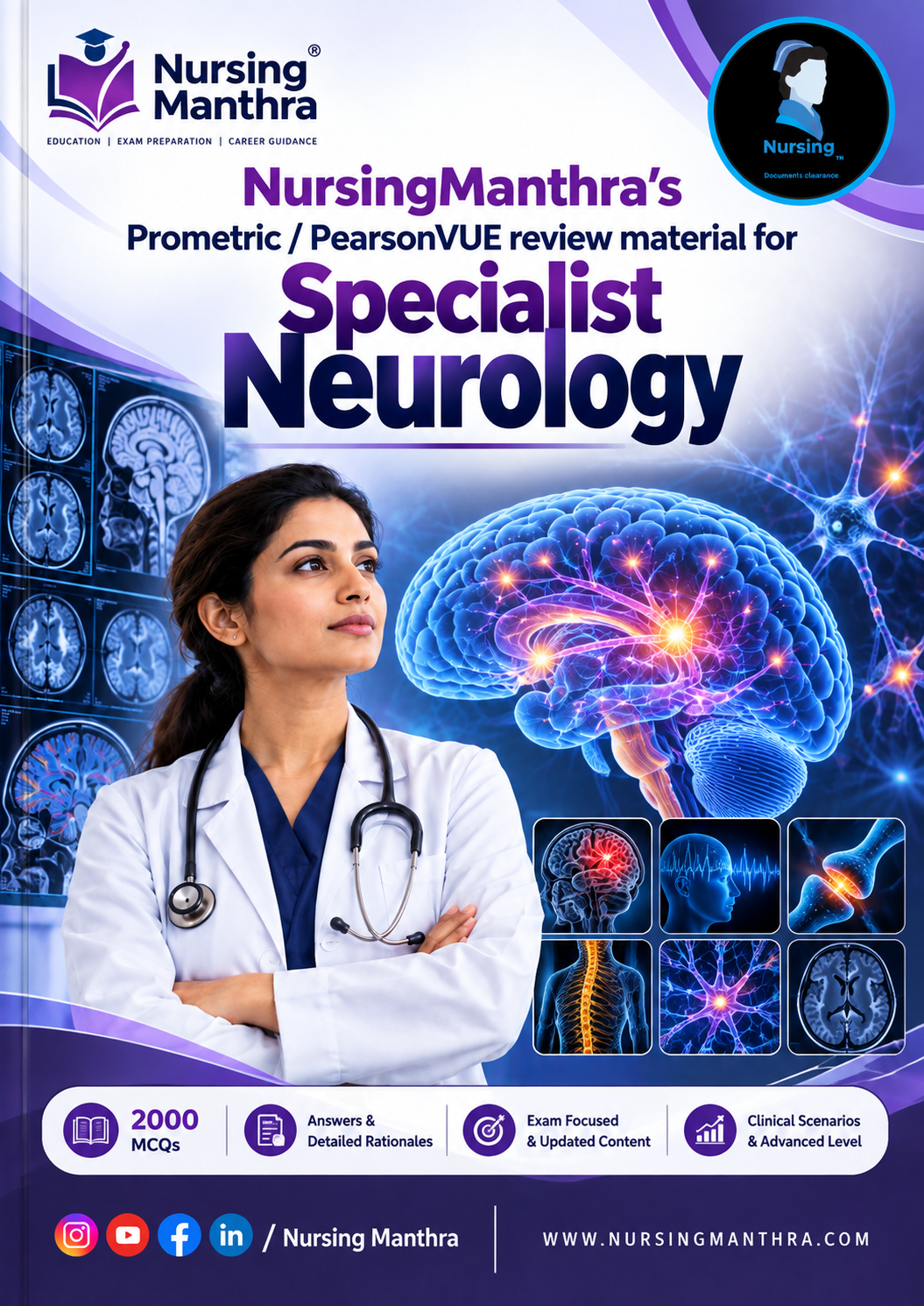
*NursingManthra’s Prometric / Pearson VUE Exam Review Material for Specialist Neurology*
AED250.00
Important Access & Usage Terms
Please read the following conditions carefully before purchasing NursingManthra study materials.
- Read-Only PDF: Study materials are provided as read-only PDF files. Downloading, printing, copying and sharing are not permitted.
- Non-Refundable: Payments for digital study materials are non-refundable, subject to applicable consumer law.
- Individual Access: Access is provided exclusively to the registered candidate.
- Correct Gmail Address: Candidates must provide a valid Gmail address at the time of purchase to receive access.
- Copyright Protection: Unauthorised reproduction, recording, redistribution, resale, screen reproduction or sharing of the materials is strictly prohibited.
About the material: NursingManthra provides independent educational review materials for examination preparation.
Description
2,000 Advanced MCQs with Answers & Detailed Rationales
NursingManthra’s Specialist Neurology Prometric / Pearson VUE Exam Review Material is a comprehensive, examination-focused question bank developed for physicians preparing for Specialist Neurology licensing examinations conducted through Prometric / Pearson VUE-based testing systems.
The material contains 2,000 carefully developed multiple-choice questions covering the major domains of the Specialist Neurology examination syllabus. Questions range from moderate to advanced and highly challenging specialist level, with strong emphasis on clinical reasoning, localization, neurological examination, interpretation of investigations, differential diagnosis, emergency management, treatment decisions, neurophysiology, patient safety and professional practice.
A significant proportion of the questions are written as complex clinical scenarios rather than simple recall questions. Candidates may be required to integrate neurological symptoms, examination findings, neuroanatomical localization, CT/MRI findings, EEG results, nerve-conduction studies, CSF analysis, laboratory data and treatment history before selecting the most appropriate answer.
Question Format
Every MCQ follows a structured examination-oriented format:
Question → Multiple Options → Correct Answer → Detailed Rationale
The rationale explains the reasoning behind the correct answer and reinforces important neurological concepts, differential diagnoses and management principles.
This allows the material to function both as a 2,000-question practice bank and as an extensive revision resource for Specialist Neurology candidates.
Detailed Syllabus Coverage
1. Cerebrovascular Disorders
Comprehensive coverage includes:
- Ischemic stroke
- Hemorrhagic stroke
- Transient ischemic attacks
- Cerebral venous sinus thrombosis
- Subarachnoid hemorrhage
- Intracerebral hemorrhage
- Lacunar syndromes
- Large-vessel occlusion
- Posterior circulation stroke
- Stroke localization
- Stroke mimics
- Acute stroke imaging
- CT and MRI interpretation
- Thrombolysis
- Mechanical thrombectomy
- Antiplatelet therapy
- Anticoagulation
- Secondary stroke prevention
- Carotid disease
- Cardioembolic stroke
- Young stroke
- Cerebral vasculitis
- Moyamoya disease
- Stroke rehabilitation
- Post-stroke complications
Questions frequently require candidates to identify the vascular territory, neurological localization, appropriate imaging and most suitable acute intervention.
2. Epilepsy & Paroxysmal Disorders
Detailed coverage includes:
- Focal seizures
- Generalized seizures
- Absence seizures
- Myoclonic seizures
- Epileptic syndromes
- Status epilepticus
- Refractory status epilepticus
- Psychogenic nonepileptic seizures
- Syncope
- Transient neurological events
- EEG interpretation
- Seizure semiology
- Antiseizure medications
- Drug interactions
- Treatment during pregnancy
- First seizure evaluation
- Epilepsy surgery concepts
- Driving and safety considerations
- Febrile seizures
- Metabolic and toxic seizures
Complex scenarios may include witnessed seizure descriptions, EEG findings, medication history and imaging results.
3. Cognitive Disorders
Coverage includes:
- Alzheimer disease
- Vascular cognitive impairment
- Frontotemporal dementia
- Dementia with Lewy bodies
- Parkinson disease dementia
- Mild cognitive impairment
- Rapidly progressive dementia
- Prion disease
- Normal pressure hydrocephalus
- Reversible causes of cognitive decline
- Delirium
- Neuropsychological assessment
- Memory disorders
- Language disorders
- Executive dysfunction
- Visuospatial impairment
- Cognitive screening
- Biomarkers
- Neuroimaging
- Pharmacologic and non-pharmacologic management
Questions focus on distinguishing similar cognitive syndromes using history, examination and investigation findings.
4. Movement Disorders
Topics include:
- Parkinson disease
- Parkinsonism
- Essential tremor
- Dystonia
- Chorea
- Huntington disease
- Tics
- Myoclonus
- Ataxia
- Restless legs syndrome
- Drug-induced movement disorders
- Tardive dyskinesia
- Wilson disease
- Progressive supranuclear palsy
- Multiple system atrophy
- Corticobasal syndrome
- Deep brain stimulation
- Levodopa complications
- Motor fluctuations
- Dyskinesias
Candidates are tested on phenomenology, localization, differential diagnosis and treatment selection.
5. Neuro-Immunological Disorders
Extensive coverage includes:
- Multiple sclerosis
- Neuromyelitis optica spectrum disorder
- MOG-associated disease
- Acute disseminated encephalomyelitis
- Autoimmune encephalitis
- CNS vasculitis
- Neurosarcoidosis
- Paraneoplastic neurological syndromes
- Autoimmune neuropathies
- Myasthenia gravis
- Guillain-Barré syndrome
- Chronic inflammatory demyelinating polyneuropathy
- Immune-mediated myopathies
- Immunotherapy
- Steroids
- IVIG
- Plasma exchange
- Immunosuppressive therapy
- Disease-modifying treatments
Questions may require interpretation of MRI patterns, CSF oligoclonal bands, antibody results and clinical presentation.
6. Neuro-Infectious Disorders
Topics include:
- Bacterial meningitis
- Viral meningitis
- Tuberculous meningitis
- Fungal meningitis
- Encephalitis
- HSV encephalitis
- Brain abscess
- Neurocysticercosis
- Cerebral malaria
- Neurosyphilis
- HIV-related neurological disorders
- Opportunistic CNS infections
- Progressive multifocal leukoencephalopathy
- Prion disease
- Spinal infections
- Post-infectious neurological syndromes
Emphasis is placed on:
- CSF analysis
- Neuroimaging
- PCR testing
- Microbiological diagnosis
- Empirical treatment
- Antimicrobial selection
- Neurological complications of infection
7. Neuromuscular Disorders
Comprehensive coverage includes:
- Peripheral neuropathies
- Polyneuropathy
- Mononeuropathies
- Radiculopathy
- Plexopathy
- Motor neuron disease
- Amyotrophic lateral sclerosis
- Myasthenia gravis
- Lambert-Eaton syndrome
- Guillain-Barré syndrome
- CIDP
- Muscular dystrophies
- Inflammatory myopathies
- Metabolic myopathies
- Toxic myopathies
- Neuromuscular junction disorders
- Critical illness neuropathy and myopathy
- Genetic neuromuscular disorders
Special emphasis is placed on EMG, nerve-conduction studies, repetitive nerve stimulation and neuromuscular localization.
8. Cephalgia & Headache Disorders
Topics include:
- Migraine
- Migraine with aura
- Chronic migraine
- Tension-type headache
- Cluster headache
- Trigeminal autonomic cephalalgias
- Medication-overuse headache
- Thunderclap headache
- Secondary headache
- Raised intracranial pressure
- Idiopathic intracranial hypertension
- Temporal arteritis
- Trigeminal neuralgia
- Occipital neuralgia
- Headache associated with infection
- Headache related to vascular disease
- Acute and preventive migraine therapy
- CGRP-targeted treatments
- Red-flag symptoms
Questions challenge candidates to differentiate primary headache syndromes from potentially life-threatening secondary causes.
9. Neurology of Systemic Diseases
This section covers neurological complications associated with:
- Diabetes mellitus
- Thyroid disorders
- Renal failure
- Liver disease
- Electrolyte abnormalities
- Vitamin deficiencies
- Autoimmune diseases
- Cancer
- Paraneoplastic syndromes
- Hematological disorders
- Cardiovascular disease
- Pregnancy
- Toxic exposure
- Drug-related neurological complications
- Critical illness
- Nutritional disorders
- Connective-tissue diseases
Questions emphasize recognition of systemic disease through its neurological presentation.
10. Clinical Neurophysiology
This major diagnostic area includes:
- EEG
- EMG
- Nerve-conduction studies
- Repetitive nerve stimulation
- Evoked potentials
- Sleep studies
- EEG patterns in epilepsy
- Status epilepticus EEG
- Encephalopathy patterns
- Neuropathy localization
- Demyelinating versus axonal neuropathy
- Neuromuscular junction testing
- Myopathy patterns
- F-waves
- H-reflexes
- Sensory and motor nerve studies
Candidates are presented with neurophysiological data and asked to determine the most likely lesion, disease process or next diagnostic step.
11. Neurological Emergencies
The question bank also integrates high-priority neurological emergencies such as:
- Acute ischemic stroke
- Intracranial hemorrhage
- Status epilepticus
- Meningitis
- Encephalitis
- Raised intracranial pressure
- Brain herniation
- Acute neuromuscular respiratory failure
- Myasthenic crisis
- Guillain-Barré syndrome
- Acute spinal cord compression
- Cauda equina syndrome
- Cerebral venous thrombosis
- Thunderclap headache
- Coma
- Acute encephalopathy
Candidates must identify the most urgent investigation or treatment step.
12. Patient Safety
Coverage includes:
- Medication safety
- Antiepileptic drug monitoring
- Anticoagulation safety
- Fall prevention
- Aspiration prevention
- Dysphagia management
- Stroke safety
- Seizure precautions
- Prevention of hospital complications
- Communication
- Clinical handover
- Documentation
- Error prevention
- Safe discharge planning
- Multidisciplinary care
13. Professionalism & Ethics
Specialist-level scenarios include:
- Confidentiality
- Informed consent
- Decision-making capacity
- Advance directives
- Surrogate decision-making
- Disclosure of diagnosis
- End-of-life neurological care
- Brain death
- Withdrawal of life-sustaining therapy
- Professional boundaries
- Medical errors
- Communication with families
- Ethical conflicts
- Patient autonomy
- Beneficence
- Non-maleficence
- Professional accountability
These questions require selection of the most ethically and professionally appropriate course of action.
Advanced Specialist-Level Question Design
The question bank is specifically developed to challenge Specialist Neurology candidates.
A question may provide:
Sudden neurological deficit + NIHSS findings + CT brain + CT angiography + onset time + medication history
and ask the candidate to determine the most appropriate reperfusion strategy.
Another scenario may include:
Progressive weakness + reflex findings + sensory examination + nerve-conduction results + CSF analysis
and require differentiation among GBS, CIDP, motor neuron disease, neuromuscular junction disease or peripheral neuropathy.
Other complex questions may integrate:
- MRI findings
- EEG patterns
- EMG/NCS findings
- CSF results
- Autoimmune antibodies
- Neuroanatomical localization
- Pharmacological treatment
- Genetic information
- Cognitive testing
- Systemic disease
- Emergency neurological management
The aim is to strengthen diagnostic localization, differential diagnosis, interpretation and specialist-level clinical decision-making.
Material Overview
Total Questions: 2,000 MCQs
Difficulty: Moderate, Difficult & Advanced Specialist Level
Format: Question + Options + Correct Answer + Detailed Rationale
Primary Purpose: Specialist Neurology Prometric / Pearson VUE Examination Preparation
Study Approach: Clinical Cases + Diagnostic Reasoning + Investigation Interpretation + Management Decisions + Exam Practice
The material is suitable for topic-wise learning, daily MCQ practice, self-assessment, identification of weak areas, intensive preparation and final examination revision.
Reviews (0)
Related Products


- Total pages – 1000
- Total MCQ –More than 2000
- Cost — 100 AED
[See the price in your currency : Click here]
Total pages – 137 pages
Total MCQ – 273 questions
Cost —150 AED

Total Theory pages – 510
Total MCQ – 235

Total pages – 609
Total MCQ – 1571
Cost – 150 AED

Total pages- 580
Total MCQ –1480
Cost —200 AED


Total pages –
Total MCQ –
Cost — 150

- Total MCQ – 1100 MCQ
- Cost — 100 AED
Reviews
There are no reviews yet.