
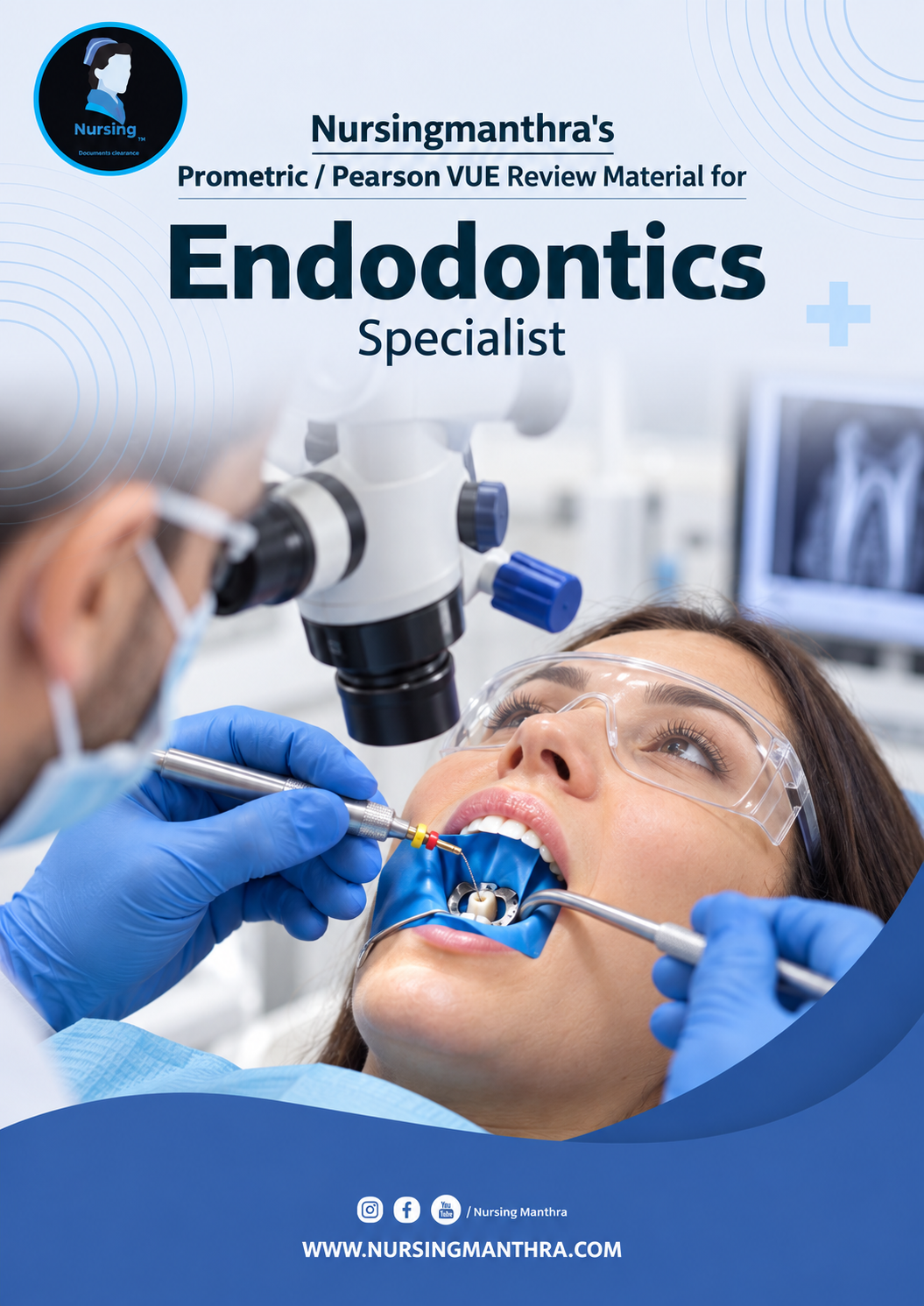
NursingManthra’s Specialist Endodontics Prometric /Pearsonvue Examination Review Material
AED200.00
TOTAL MCQ-2000
1- Additional Picture book
Important Access & Usage Terms
Please read the following conditions carefully before purchasing NursingManthra study materials.
Read-Only PDF: Study materials are provided as read-only PDF files. Downloading, printing, copying and sharing are not permitted.
Non-Refundable: Payments for digital study materials are non-refundable, subject to applicable consumer law.
Individual Access: Access is provided exclusively to the registered candidate.
Correct Gmail Address: Candidates must provide a valid Gmail address at the time of purchase to receive access.
Copyright Protection: Unauthorised reproduction, recording, redistribution, resale, screen reproduction or sharing of the materials is strictly prohibited.
Description
Advanced Clinical & Patient-Centred Review Material for Specialist Endodontists
NursingManthra’s Specialist Endodontics Prometric Examination Review Material is an advanced examination-preparation resource developed for dentists preparing for Specialist Endodontics licensing examinations in the Gulf region, particularly examinations following a Prometric-style multiple-choice format.
The book contains 2,000 high-complexity MCQs designed specifically for specialist-level candidates.
Unlike basic recall-based question banks, this material focuses heavily on clinical reasoning, differential diagnosis, treatment planning, interpretation of clinical findings, medically compromised patients, endodontic emergencies, complications, retreatment decisions, regenerative endodontics, pharmacological considerations, patient safety, ethics, and evidence-based practice.
The questions are designed to make candidates decide between several clinically plausible options—the type of reasoning expected from a practicing Specialist Endodontist, rather than an undergraduate dental student.
Book Details
| Feature | Details |
|---|---|
| Book Title | NursingManthra’s Specialist Endodontics Prometric Examination Review Material |
| Specialty | Specialist Endodontics |
| Total Questions | 2,000 Advanced MCQs |
| Question Level | Specialist / Advanced Clinical Level |
| Format | Question + 4 Options + Correct Answer + Detailed Rationale |
| Primary Focus | Clinical reasoning & patient-centred decision-making |
| Exam Style | Gulf Licensing / Prometric-Style Examination |
| Question Type | Clinical scenarios, diagnostic reasoning, treatment planning and complication management |
| Difficulty | Moderate → Difficult → Very Difficult |
| Recommended For | Endodontists preparing for Gulf healthcare licensing examinations |
Examination Pattern Used for the Review
Based on the examination information supplied:
Specialty: Specialist Endodontics
Duration: 3 Hours
Number of Questions: 150
Passing Score: 60%
Examination fees, codes, eligibility requirements and examination policies can be revised by the licensing authority. Candidates should confirm the latest information with the relevant authority before booking the examination.
Exam Areas Covered
The 2,000-question bank will extensively cover:
Diagnosis, Outcome & Treatment Planning
Advanced questions involving pulpal and periapical diagnosis, prognosis assessment, case selection, treatment sequencing, restorability, strategic value of teeth and treatment-versus-extraction decisions.
Candidates will encounter cases where symptoms, vitality tests, percussion findings, periodontal probing, radiographic findings and medical history may appear contradictory.
Endodontic Pain & Emergencies
Complex clinical cases covering:
- Symptomatic irreversible pulpitis
- Acute apical periodontitis
- Acute apical abscess
- Endodontic flare-ups
- Interappointment pain
- Emergency access
- Drainage decisions
- Occlusal reduction
- Analgesic selection
- Antibiotic stewardship
- Facial swelling
- Spreading infection
- Systemic involvement
- Referral and emergency escalation
Questions will focus on what should be done next, rather than merely asking for definitions.
Surgical Endodontics
Advanced scenarios involving:
- Apical surgery
- Apicoectomy
- Root-end preparation
- Root-end filling
- Periradicular surgery
- Microsurgical endodontics
- Flap selection
- Anatomical danger zones
- Haemostasis
- Surgical complications
- Healing assessment
- Persistent apical pathology
- CBCT-based surgical planning
Dental Traumatic Injuries
High-level clinical scenarios involving:
- Concussion
- Subluxation
- Extrusion
- Intrusion
- Lateral luxation
- Avulsion
- Crown fractures
- Crown-root fractures
- Root fractures
- Immature permanent teeth
- Pulp revascularisation considerations
- External inflammatory root resorption
- Replacement resorption
- Ankylosis
- Follow-up decisions
Endodontic Pharmacology
Cases will integrate pharmacology into realistic patient situations, including:
- Local anaesthesia
- Failure of anaesthesia in irreversible pulpitis
- Supplemental anaesthetic techniques
- NSAIDs
- Paracetamol/acetaminophen
- Antibiotics
- Drug allergies
- Anticoagulants
- Drug interactions
- Pregnancy considerations
- Renal impairment
- Hepatic disease
- Cardiovascular disease
- Immunocompromised patients
The emphasis will be on safe prescribing and clinical decision-making, not simply memorising drug names.
Regenerative Endodontics & Vital Pulp Therapy
Advanced questions covering:
- Pulp capping
- Partial pulpotomy
- Full pulpotomy
- Immature permanent teeth
- Apexogenesis
- Apexification
- Calcium hydroxide
- MTA
- Calcium-silicate materials
- Regenerative endodontic procedures
- Case selection
- Disinfection protocols
- Scaffold concepts
- Root maturation
- Follow-up and outcome assessment
Endodontic Relationship With Other Specialties
Integrated cases involving:
- Periodontics
- Prosthodontics
- Orthodontics
- Oral surgery
- Implant dentistry
- Paediatric dentistry
- Restorative dentistry
- Oral medicine
Special attention will be given to differentiating endo-perio lesions, determining tooth restorability and deciding whether endodontic treatment, periodontal treatment, surgery or extraction is the most appropriate management.
Endodontic Mishaps
A major difficult section of the book will cover real-world procedural complications such as:
- Instrument separation
- Canal transportation
- Ledge formation
- Perforation
- Strip perforation
- Sodium hypochlorite accident
- Over-instrumentation
- Underfilling
- Overfilling
- Missed canals
- Post-operative flare-ups
- Obturation errors
- File separation beyond the apex
- Irrigant extrusion
- Foreign-body aspiration or ingestion
- Management versus referral decisions
Questions will frequently ask candidates to determine the safest immediate action and definitive management.
Classic & Current Endodontic Literature
Questions will also assess the candidate’s ability to apply established endodontic principles alongside current clinical approaches.
Instead of asking:
“What is the ideal working length?”
questions will use a clinical context where electronic apex locator findings, radiographic working length, apical anatomy and clinical findings conflict and the candidate must determine the best next action.
Medically Compromised Patients
This will be one of the strongest areas of the book.
Cases will include patients with:
- Diabetes mellitus
- Hypertension
- Ischaemic heart disease
- Previous myocardial infarction
- Prosthetic heart valves
- Infective endocarditis risk
- Anticoagulant therapy
- Chronic kidney disease
- Liver disease
- Pregnancy
- Immunosuppression
- Cancer therapy
- Bisphosphonate/antiresorptive therapy
- Bleeding disorders
- Drug allergies
Questions will integrate the medical condition + endodontic diagnosis + pharmacology + treatment modification + patient safety.
Patient Safety
Clinical scenarios will evaluate:
- Patient identification
- Medical history verification
- Allergy checks
- Medication reconciliation
- Rubber dam use
- Instrument aspiration prevention
- Infection prevention
- Cross-infection control
- Safe use of irrigants
- Radiation safety
- Documentation
- Consent
- Incident reporting
- Medication errors
- Referral
- Emergency response
Professionalism & Ethics
Advanced cases will cover:
- Valid consent
- Capacity
- Confidentiality
- Professional boundaries
- Documentation
- Disclosure of complications
- Clinical errors
- Duty of candour
- Patient refusal
- Referral obligations
- Scope of practice
- Conflict of interest
- Professional communication
- Managing dissatisfied patients
These questions will often contain two or three apparently reasonable answers, requiring the candidate to select the professionally and clinically most appropriate action.
How the 2,000 Questions Will Be Designed
A key selling point should be that this is not a basic ChatGPT-style recall question bank.
The question bank will deliberately include:
Long Clinical Vignettes — age, chief complaint, medical history, clinical examination, pulp testing, periodontal findings, radiographic/CBCT findings and previous dental treatment.
Multi-variable Decisions — candidates may need to simultaneously consider pulpal diagnosis, restorability, medical history, prognosis and patient preferences.
Best-Next-Step Questions — not merely “What is the diagnosis?” but “What is the most appropriate next step?”
Diagnostic Traps — cases where referred pain, cracked tooth syndrome, periodontal disease, sinusitis or non-odontogenic pain can mimic endodontic disease.
Treatment Planning Conflicts — technically possible treatment may not necessarily represent the best overall clinical decision.
Complication Management — the question may start after something has already gone wrong and ask what the endodontist should do next.
Evidence-Based Decisions — questions requiring candidates to distinguish traditional practices from contemporary evidence-based endodontic management.
Difficulty Distribution
For this book I suggest approximately:
| Level | Questions |
|---|---|
| Moderate Specialist Level | 300 |
| Difficult Clinical Level | 700 |
| Very Difficult Specialist Level | 1,000 |
| Total | 2,000 |
This means 85% of the book will be difficult or very difficult, which should address the feedback you received that previous questions were too simple.
Main Reference Framework
The review material will be developed around the references indicated in the supplied examination guide, including major resources such as:
- Seltzer and Bender’s Dental Pulp
- Surgical Endodontics
- Dental Management of the Medically Compromised Patient
- Ingle’s Endodontics
- Cohen’s Pathways of the Pulp
- Professional ethics guidance
- Patient-safety principles and applicable professional guidance
The material should be described as reference-aligned, rather than claiming that questions are copied from or officially endorsed by these textbooks or the examination authority.
Sample Complexity Expected
For example, instead of a simple question such as:
Which irrigant is commonly used during root canal treatment?
the actual book should use scenarios more like:
A 47-year-old patient receiving apixaban for atrial fibrillation presents with persistent symptoms associated with a previously treated mandibular first molar. CBCT demonstrates an untreated middle mesial canal and a separated instrument in the apical third of the mesiobuccal canal. A 7-mm isolated periodontal probing defect is present on the distal aspect, although no fracture line is identified clinically. The patient reports pain on biting but no spontaneous pain. Before recommending nonsurgical retreatment, which additional finding would have the greatest impact on the prognosis and potentially alter the proposed treatment strategy?
That is the level I would maintain throughout the difficult sections.
Why Choose NursingManthra’s Specialist Endodontics Review Material?
This book is designed especially for candidates who have already studied Endodontics and now need exam-oriented specialist practice.
It concentrates on:
✓ 2,000 specialist-level MCQs
✓ Advanced clinical scenarios
✓ Patient-centred questions
✓ Gulf licensing examination orientation
✓ Differential diagnosis
✓ Complex treatment planning
✓ Medical–dental integration
✓ Endodontic emergencies
✓ Retreatment and failed cases
✓ Surgical Endodontics
✓ Regenerative Endodontics
✓ Traumatic dental injuries
✓ Procedural complications
✓ Patient safety
✓ Ethics and professionalism
✓ Correct answer for every question
✓ Detailed rationale explaining why the answer is correct
Reviews (0)
Related Products

Delivery and Usage Conditions
-
- The study material will be shared with the candidate’s registered Gmail account after payment confirmation.
- The material is provided as a view-only PDF.
- It cannot be downloaded, printed, copied, forwarded, or shared with another person.
- Once the payment has been completed and access has been provided, the amount is non-refundable.
- Access is intended only for the registered purchaser.
Total mcq-2000
Question , option, answer and rational format
To view sample questions: https://nursingmanthra.com/dental-lab-technician-prometric-sample-questions/
Total pages – 609
Total MCQ – 1571
Cost – 150 AED
[See the price in your currency : Click here]
Total pages – 137 pages
Total MCQ – 273 questions
Cost —150 AED

Total pages-483
Total MCQ -1600
Cost -150

- Total pages-1500
- Questions-5000
- cost -150 AED



Reviews
There are no reviews yet.