
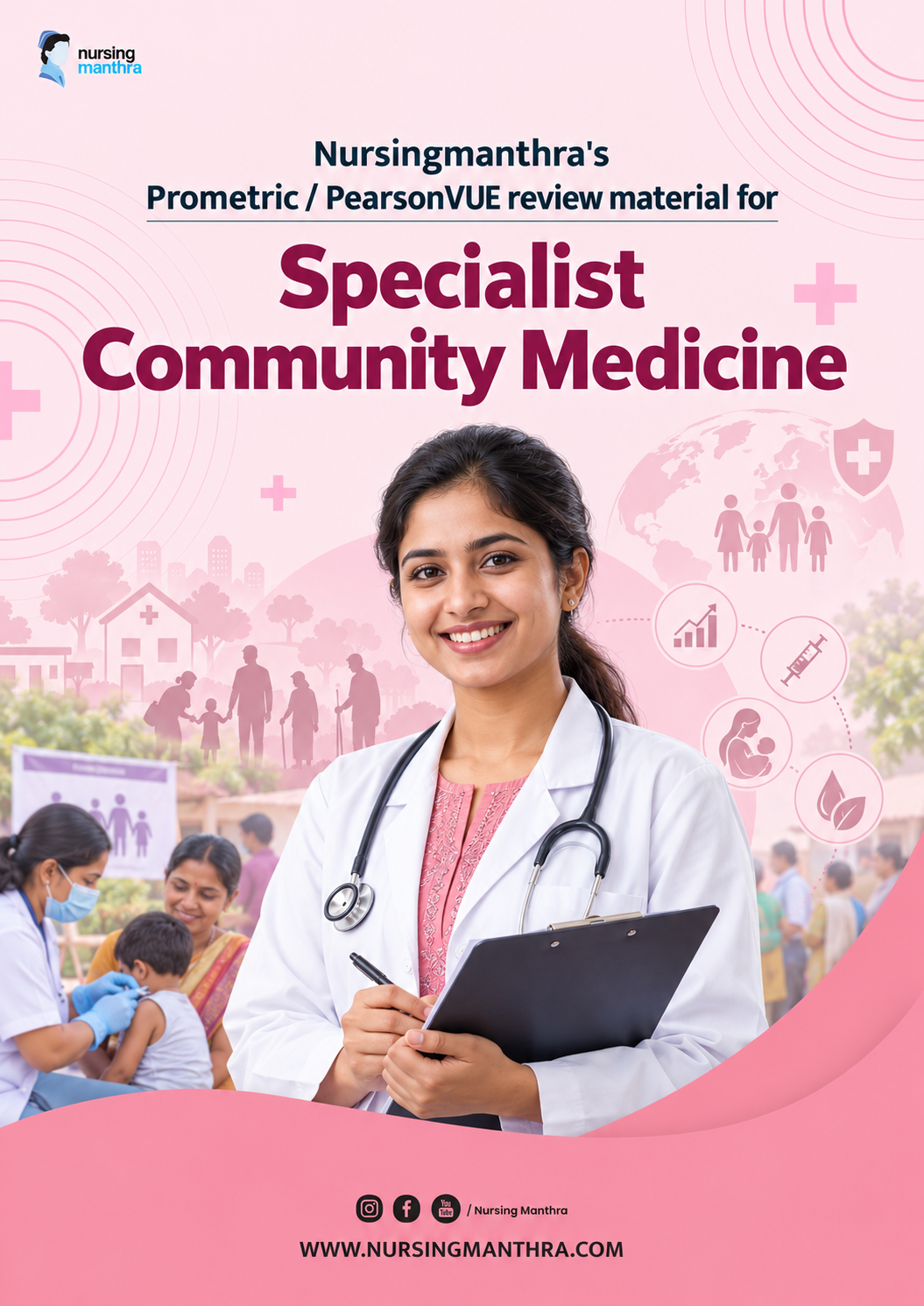
*NursingManthra’s Prometric / Pearson VUE Exam Review Material for Specialist Community Medicine*
AED250.00
Important Access & Usage Terms
Please read the following conditions carefully before purchasing NursingManthra study materials.
- Read-Only PDF: Study materials are provided as read-only PDF files. Downloading, printing, copying and sharing are not permitted.
- Non-Refundable: Payments for digital study materials are non-refundable, subject to applicable consumer law.
- Individual Access: Access is provided exclusively to the registered candidate.
- Correct Gmail Address: Candidates must provide a valid Gmail address at the time of purchase to receive access.
- Copyright Protection: Unauthorised reproduction, recording, redistribution, resale, screen reproduction or sharing of the materials is strictly prohibited.
About the material: NursingManthra provides independent educational review materials for examination preparation.
Description
2,000 Advanced MCQs with Answers & Detailed Rationales
NursingManthra’s Specialist Community Medicine Prometric / Pearson VUE Exam Review Material is a comprehensive examination-focused question bank designed for physicians preparing for Specialist Community Medicine licensing examinations conducted through Prometric/Pearson VUE-based testing systems.
The material contains 2,000 carefully developed multiple-choice questions covering the major domains listed in the Specialist Community Medicine examination syllabus. Questions are designed from moderate to advanced specialist level, with particular emphasis on application of public-health principles, epidemiological reasoning, interpretation of statistics, programme planning, prevention strategies, healthcare management and clinical-community decision-making.
Rather than concentrating only on simple recall questions, the material includes complex case scenarios, outbreak investigations, epidemiological datasets, screening-test calculations, research interpretation, community-health programmes, occupational and environmental exposures, maternal and child health situations, healthcare-management problems and ethical dilemmas.
Question Format
Every question follows a consistent exam-oriented structure:
Question → Multiple Options → Correct Answer → Detailed Rationale
The rationale is designed to explain the underlying concept and clinical/public-health reasoning so candidates can use the book both as a question bank and a structured revision resource.
Detailed Syllabus Coverage
1. Epidemiology
Extensive coverage of core and applied epidemiology, including:
- Incidence and prevalence
- Morbidity and mortality measurements
- Measures of disease frequency
- Risk ratios and odds ratios
- Attributable risk
- Epidemiological study designs
- Cohort studies
- Case-control studies
- Cross-sectional studies
- Randomised controlled trials
- Ecological studies
- Bias and confounding
- Causality
- Surveillance systems
- Outbreak investigation
- Epidemic curves
- Screening programmes
- Sensitivity and specificity
- Predictive values
- Likelihood concepts
- Disease transmission
- Communicable-disease epidemiology
- Non-communicable disease epidemiology
- Interpretation of population-health data
Questions include outbreak scenarios and numerical interpretation requiring candidates to identify appropriate epidemiological measures and interventions.
2. Preventive Medicine
Detailed examination of:
- Primordial prevention
- Primary prevention
- Secondary prevention
- Tertiary prevention
- Quaternary prevention
- Immunisation
- Screening
- Chemoprophylaxis
- Lifestyle interventions
- Communicable-disease prevention
- Non-communicable disease prevention
- Cancer prevention
- Cardiovascular disease prevention
- Diabetes prevention
- Population-level interventions
- Health-promotion strategies
Questions emphasise choosing the most appropriate preventive intervention for an individual, community or population.
3. Biostatistics & Research Methods
Major areas include:
- Types of variables
- Data presentation
- Mean, median and mode
- Standard deviation and variance
- Normal distribution
- Confidence intervals
- Hypothesis testing
- P values
- Type I and Type II errors
- Statistical power
- Correlation and regression
- Chi-square testing
- t-tests
- ANOVA concepts
- Parametric and non-parametric tests
- Sampling methods
- Sample-size concepts
- Research design
- Clinical trials
- Systematic reviews
- Meta-analysis
- Evidence-based medicine
- Critical appraisal
- Validity and reliability
Numerical and scenario-based questions are included to assess the candidate’s ability to interpret research results rather than simply memorise statistical definitions.
4. Health Care Management
Coverage includes:
- Planning
- Organisation
- Leadership
- Staffing
- Resource allocation
- Healthcare financing
- Health-system organisation
- Programme evaluation
- Performance indicators
- Healthcare quality
- Patient safety
- Risk management
- Cost-effectiveness
- Cost-benefit concepts
- Human-resource management
- Healthcare policy
- Strategic planning
- Monitoring and evaluation
- Health-service utilisation
Management scenarios require candidates to select the most appropriate administrative, quality or public-health response.
5. Health Informatics
Questions cover:
- Electronic health records
- Health information systems
- Public-health surveillance databases
- Data collection
- Data quality
- Health indicators
- Electronic reporting
- Confidentiality
- Data security
- Digital health
- Telemedicine
- Health-information analysis
- Use of health data for planning and decision-making
6. Health Education & Communication
Detailed coverage of:
- Health education principles
- Behaviour-change theories
- Communication methods
- Individual counselling
- Group education
- Community participation
- Health promotion
- Social marketing
- Risk communication
- Communication during outbreaks
- Cultural considerations
- Patient education
- Community mobilisation
Scenario questions assess which communication strategy would be most effective for different populations.
7. Maternal & Child Health Care
Topics include:
- Antenatal care
- Maternal mortality
- Infant mortality
- Neonatal mortality
- Perinatal health
- Breastfeeding
- Immunisation
- Growth monitoring
- Child development
- Childhood screening
- High-risk pregnancy
- Family planning
- Reproductive health
- Adolescent health
- Maternal and neonatal preventive services
8. Primary Health Care Principles & Elements
Coverage includes:
- Primary healthcare concepts
- Accessibility
- Equity
- Community participation
- Intersectoral coordination
- Appropriate technology
- Preventive services
- Continuity of care
- Referral systems
- Universal health coverage
- Community-oriented primary care
- Integration of preventive and curative services
9. Community Medicine Ethics & Legal Aspects
Questions address:
- Confidentiality
- Informed consent
- Autonomy
- Beneficence
- Non-maleficence
- Justice
- Public-health ethics
- Mandatory reporting
- Disease notification
- Population-health interventions
- Quarantine and isolation
- Privacy
- Screening ethics
- Research ethics
- Vulnerable populations
- Professional accountability
- Ethical conflicts between individual rights and population safety
Complex scenarios require candidates to identify the most ethically and legally appropriate action.
10. School Health
Coverage includes:
- School-health programmes
- Screening of schoolchildren
- Vision and hearing assessment
- Immunisation
- Nutrition
- Growth and development
- Communicable-disease prevention
- School sanitation
- Mental health
- Health education
- Adolescent health
- Identification of learning and developmental concerns
11. Nutrition
Includes:
- Macronutrients
- Micronutrients
- Nutritional assessment
- Malnutrition
- Obesity
- Vitamin deficiencies
- Mineral deficiencies
- Nutritional epidemiology
- Community nutrition programmes
- Maternal nutrition
- Childhood nutrition
- Dietary assessment
- Food fortification
- Nutritional surveillance
12. Elderly Health Care
Topics include:
- Ageing
- Healthy ageing
- Chronic disease
- Functional assessment
- Falls
- Nutrition
- Polypharmacy
- Screening
- Disability
- Social isolation
- Preventive care
- Elder abuse
- Long-term care
- Community support systems
13. Mental Health
Coverage includes:
- Community mental health
- Depression
- Anxiety
- Suicide prevention
- Substance-use disorders
- Mental-health promotion
- Screening
- Community rehabilitation
- Stigma
- Crisis intervention
- Referral strategies
- Mental-health epidemiology
14. Special Needs Health Care
Questions address healthcare needs of:
- Persons with disabilities
- Children with special needs
- Developmental disabilities
- Physical disabilities
- Intellectual disabilities
- Rehabilitation
- Accessibility
- Inclusive healthcare
- Community support
- Long-term healthcare planning
15. Occupational Health
Comprehensive coverage of:
- Occupational hazards
- Chemical exposure
- Biological hazards
- Physical hazards
- Ergonomic hazards
- Workplace accidents
- Occupational diseases
- Occupational screening
- Worker surveillance
- Personal protective equipment
- Industrial hygiene
- Prevention strategies
- Workplace health promotion
Case scenarios may require identification of the occupational exposure, disease association and appropriate preventive measure.
16. Environmental Health
Major areas include:
- Water quality
- Water purification
- Air pollution
- Waste management
- Sewage disposal
- Food hygiene
- Housing
- Vector control
- Environmental toxicology
- Climate-related health effects
- Noise pollution
- Radiation
- Environmental risk assessment
- Disaster-related environmental health
17. International Health
Coverage includes:
- Global health
- International disease control
- Emerging infections
- Pandemics
- International travel health
- Vaccination requirements
- Global disease burden
- Health inequalities
- International healthcare organisations
- Sustainable development
- Humanitarian emergencies
- Disaster response
- International surveillance
- Cross-border public-health threats
Advanced Specialist-Level Question Design
The question bank is developed to challenge candidates beyond basic factual recall.
Questions may present a community experiencing an outbreak and require the candidate to calculate an attack rate, determine the most appropriate epidemiological study, identify the likely mode of transmission and select the most appropriate public-health intervention.
Other questions may provide the results of a screening programme and ask candidates to interpret sensitivity, specificity, positive predictive value, negative predictive value or the consequences of changing disease prevalence.
Research questions may present a study abstract and require identification of bias, confounding, study design, statistical significance or appropriate statistical tests.
Occupational and environmental scenarios may require candidates to connect exposures with diseases and determine appropriate surveillance, prevention or control measures.
This format helps prepare candidates for examinations that assess interpretation, prioritisation, analysis and specialist-level decision-making.
Material Overview
Total Questions: 2,000 MCQs
Difficulty: Moderate to Advanced / Specialist Level
Format: Question + Options + Correct Answer + Detailed Rationale
Primary Purpose: Prometric / Pearson VUE Specialist Community Medicine Examination Preparation
Study Approach: MCQ Practice + Concept Revision + Applied Public-Health Reasoning
The material is suitable for:
- Topic-wise preparation
- Daily MCQ practice
- Self-assessment
- Identification of weak areas
- Rapid revision
- Final examination preparation
Reviews (0)
Related Products

Total questions-2500 MCQ
Cost -150 AED
Click to view Sample study material
Question bank Contents:
Total questions-2000 MCQ
Total pages- 699 Pages
It contains MCQ(multiple Choice Questions) with all options, correct answer and rational.
-Previously asked MCQ

Total MCQ —-2300 (QUESTION, OPTION, ANSWER AND RATIONAL ) FORMAT
Theory book -Total pages-344 pages
Cost —150 AED

Total Theory pages – 510
Total MCQ – 235

- Total questions-3000 MCQ
- Total pages – 878pages
- Review notes pages-223

Total pages –
Total MCQ –
Cost — 150
Delivery & Terms
The Nursing Manthra study material will be sent to the candidate’s registered Gmail account after confirmation of payment.
The study material is supplied as a read-only PDF file. It cannot be downloaded, printed, copied or shared.
The amount once paid is non-refundable under any circumstances.
Candidates are responsible for confirming the latest licensing, eligibility and examination requirements directly with the concerned regulatory authority before applying.
Total pages:
Part 1- 339
Part 2- 360
Theory material- 93 PAGES
Total MCQ- 2000
MCQ format-Question, Options, Answer and rational



Total pages – 609
Total MCQ – 1571
Cost – 150 AED
Reviews
There are no reviews yet.